Did a Cosmic Craftsman Build the Universe? Plato’s Timaeus
A Cosmic Story Begins in Athens

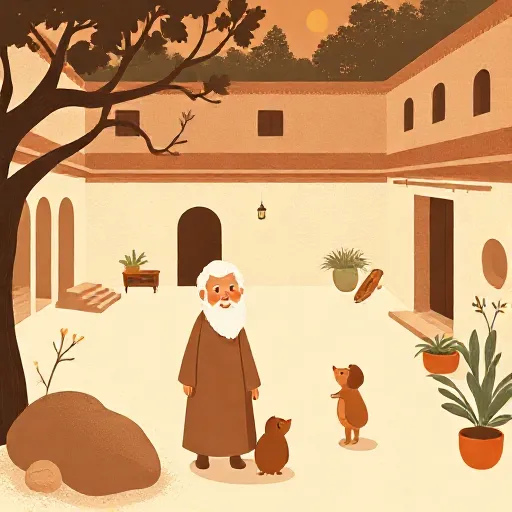
Athens, around 360 BCE. After a long day of festival games, four friends relax in a quiet courtyard. One of them, Socrates, has just described his ideal city — a place governed by wisdom. Now it is time for his friend Timaeus to speak. Timaeus is a philosopher from Italy, known for his knowledge of the stars. He leans forward. He says he will begin by telling where everything came from.
That is the opening of Plato’s dialogue called the Timaeus (written around 360 BCE). But Timaeus does not just spin a myth. He lays out a careful argument. He wants to explain why the universe exists, why it is orderly, and why it contains living, thinking beings like you.
Right away he draws a sharp line. He claims there are two kinds of things in reality: what always is and never changes, and what becomes and never stays the same. This single distinction will shape everything that follows.
Two Realms: The Perfect and the Copy

The things that always are — like perfect circles or the idea of justice — can only be grasped by your understanding, not by your eyes or ears. Timaeus calls them the forms. They are invisible, unchanging blueprints. The things that become — like a sandcastle or a thunderstorm — are grasped by your senses and by opinion (doxa). They come and go.
Timaeus asks: Which group does our universe belong to? Look around. You can see, touch, and hear it. It has a body. That means it must be a thing that has become, not something that always was. And, he argues, anything that becomes must have a cause — something that brings it into being.
So what caused the universe? A supremely good maker, whom Timaeus calls the Craftsman. This Craftsman is not a clumsy tinkerer. He is Intellect (nous) itself — a living, wise mind. He looked at an eternal model, a perfect “Living Thing,” and set out to shape a moving, visible image of it: our cosmos.
The universe, then, is a work of craft. It exists because the Craftsman wanted to make something as beautiful and as good as the model would allow. That is the first great claim.
The Good Builder Works Within Limits

Why would a perfect mind build anything at all? Timaeus’s answer is simple and striking: the Craftsman is good, and a good being does not hoard its goodness. It wants to spread order and excellence.
He begins by giving the world a soul. Why? Because any living thing with a soul is better than a lifeless lump. The soul is made from a special mixture of Sameness, Difference, and Being — half divisible, half indivisible — blended in exact musical proportions. Then he divides this soul-stuff into two great circling bands, like the track of the sun and the track of the moon. When the soul is joined to a spherical body, the whole universe becomes a single living animal, complete and unique.
But even a divine Craftsman cannot do absolutely anything. He works with something that already exists: a disorderly, chaotic something that Timaeus calls the receptacle (or “space,” chōra). Picture a lump of unflavored dough that can take any shape, or neutral oil that can carry any fragrance. The receptacle has no qualities of its own — it is just the “where” and the “out of which” everything physical appears.
Before the Craftsman steps in, the receptacle is a churning storm, full of half-formed traces of fire, air, water, and earth, shaking like ingredients in a giant sieve. The Craftsman brings mathematical order to this chaos — but the matter fights back. It has its own necessary properties (“Necessity,” anankē) that cannot be erased. The Craftsman must use persuasion, not force, to coax matter into cooperating with the good.
Triangles, Elements, and the Bones of the World

Timaeus now shows precisely how the Craftsman built the body of the world. He chose four of the five regular solids — the only perfectly symmetrical shapes that can be made from identical faces — and assigned one to each of the traditional elements:
- Fire → tetrahedron (four triangular faces)
- Air → octahedron (eight triangular faces)
- Water → icosahedron (twenty triangular faces)
- Earth → cube (six square faces)
The faces of the first three solids are made from six half-equilateral right triangles; the cube’s faces are made from four isosceles right triangles. These tiny triangles are the true “simples” of the physical world.
This geometry explains why we see elements change into one another. A fire particle can be cut apart and its triangles rebuilt as two particles of air — the math adds up. But earth, with its different triangles, can never transform into the other three. For Timaeus, that is a necessary feature of the world, even if it seems odd to our eyes.
The story does not stop with rocks and flames. The same patient, persuasive work of Intellect and Necessity builds the human body and its different souls. The immortal, rational soul lives in the head. The mortal parts — the spirited part (courage, anger) and the appetitive part (hunger, desire) — are housed in the chest and belly, separated by the diaphragm like a curtain between two rooms.
Why Your Soul Fell Out of Tune

When you were born, your soul’s perfect revolutions — designed to mirror the circles of the heavens — were jolted into chaos. The body flooded the soul with sensations: loud noises, bright lights, hot and cold, pleasure and pain. Your thinking became wobbly, like a spinning top knocked off its axis.
That is why, Timaeus says, a child does not yet think clearly. But it is also why education matters so much. With the right training, the original, harmonious motions of your soul can be restored. Studying astronomy and mathematics re-aligns your inner circles with the outer circles of the stars. Watching the sky is not just for predicting weather; it is a way to heal your mind.
The Craftsman did not abandon you. He designed your eyes, for instance, so that the steady motions of light would teach your soul about smooth, rational movement. Sense perception, properly used, is a first step back toward wisdom.
Timaeus ends his long speech with an urgent plea: the goal of a human life is to become well-ordered (eu kekosmēmenon) — to bring your soul into harmony with the whole living universe. That, he says, is that most excellent life offered to humankind by the gods, both now and forevermore.
Still a Puzzle After 2,400 Years

Timaeus calls his own account a “likely story” (eikōs logos), not a proven fact. The universe is a shaky, visible image, so any story about it can only be plausible, never rock-solid. From ancient times, many readers have wondered: should we take the creation story literally — as something that happened in the past — or is it a metaphor for the eternal principles that hold the world together at every moment? Plato’s own followers argued about this, and scholars still do.
What is not in doubt is the boldness of the vision. The Timaeus says the world is not a random heap. It is the best possible work of a good intelligence, wrestling with stubborn matter. And you — your ability to think, to feel wonder, and to choose — are right at the center of it. You are a miniature cosmos, meant to run in tune with the great one.
The next time you look up at the night sky and see the planets moving in their silent paths, you might ask the same question Timaeus asked: is there a mind behind all this, and what does that mean for how I should live?
Think about it
- If you could design a universe from scratch, what would you make sure it includes — and why would those things matter?
- Do you think order can come from chaos all by itself, or does an organized world always need a mind behind it?
- Suppose studying the stars could actually make you a braver, fairer, or calmer person. Would that change how you spend your free time? How?