Can a Statement Be False?
A Hunt in the Shadows
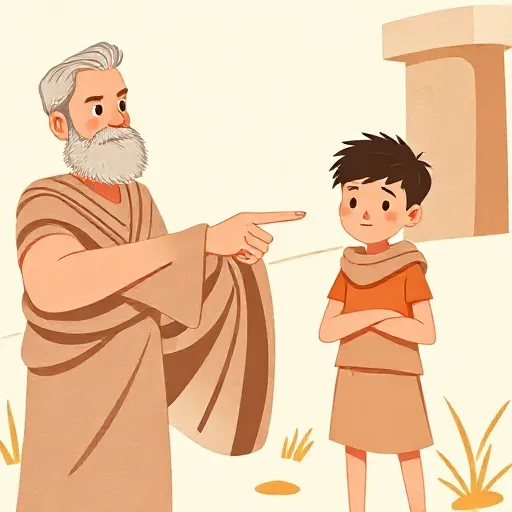
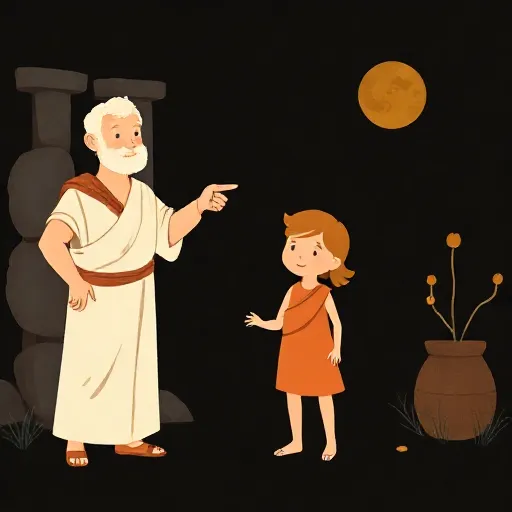
The trial is over. Socrates is about to die. The day before, he spoke with a brilliant young student about what knowledge is. Now, on his last full day, a visitor from a distant city arrives. The visitor claims he knows how to define things.
The group decides to hunt three elusive targets: a sophist, a statesman, and a philosopher. Two of those hunts still exist as texts we can read. The third — the Philosopher — was never written. Perhaps Plato wanted his students to finish the job.
A sophist was a traveling teacher in ancient Athens. For a fee, he would teach rich young men how to win arguments. The visitor — the Eleatic Stranger — doesn’t trust these flashy talkers. But to trap one, he needs to show exactly what a sophist is. That hunt will force him to say something impossible: that a false statement is real.
The Prey Who Keeps Escaping
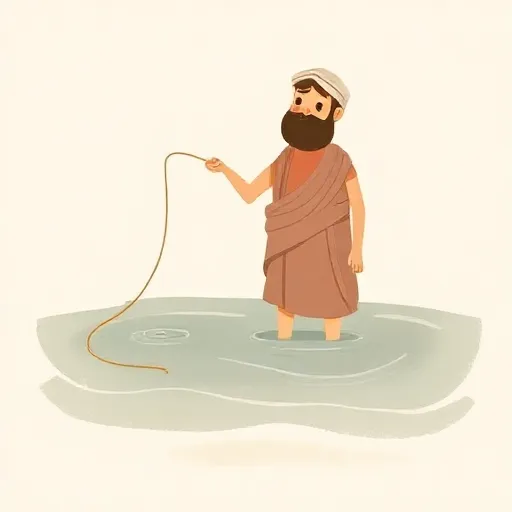
The Stranger starts with fishing. An angler, he says, hunts water animals with a hook. The search for a definition works like a branching path. At each fork, you choose left or right. Angling is an art of acquisition, by hunting, by striking, using a hook, from below. The method is called division — you split a general group into two smaller ones, over and over, until you reach the thing you want.
The Stranger tries the same trick on the sophist. He takes the branch that leads to hunting land creatures and finds something odd. The sophist turns up not at one final stop, but at many. He is a hired hunter of rich young men. He is a salesman of knowledge. He is a debater about justice. The sophist appears all over the map.
This is the first clue. The angler had one clear activity everyone could see. The sophist seems to have a hundred talents. The Stranger asks: why do we call all these different figures by one name? We must be missing the one thing that ties his activities together — his essence, the property that makes him what he truly is.
The Artist Who Fools Children
The Stranger realizes what he overlooked. The sophist doesn’t just happen to do many things. He pretends to know everything. His single, hidden art is imitation.
Think of a painter who can make a picture of a shoe. A child might think it is a real shoe. The painter doesn’t know how to make leather, but he knows how to make an appearance of a shoe. The sophist does the same thing, but with words. He makes small things seem large and difficult things seem easy. He can fool young people into thinking he is wise.
But this creates a disaster. The sophist produces false appearances. A false appearance is something that seems real but is not. To talk about this, the Stranger must use a forbidden phrase: “what is not.” And that means he must fight the ghost of a great thinker from Elea — Parmenides.
The Father of Logic Says No

Parmenides (born around 515 BCE) was a giant. He gave a brutal rule: you cannot speak or think about what-is-not. If you think, you must think about something. “Nothing” is not a thing. So any sentence about “what is not” is gibberish — just noise, like talking about a square circle.
The Stranger sees the trap. If Parmenides is right, the sophist wins. The sophist can just say: “My fake images are not nothing. They are images. They are something. And if I speak falsely, I must be speaking about what-is-not. But you just agreed that is impossible. So I have never lied.” The young Theaetetus is stuck. The Stranger announces they must do a terrible thing: prove that Parmenides was wrong.
A Five-Part Solution

The fix starts with a simple mistake. When people hear “not large,” they think of the opposite — “small.” But “not large” just means “different from large.” Something could be not-large and not small at all — it could be exactly equal.
The Stranger builds a new toolkit using five special kinds, what he calls the great kinds: change, rest, being, sameness, and difference. The last one is the key. Difference is like a vowel that lets other letters join into words.
Consider Theaetetus, who is sitting down. The sentence “Theaetetus is flying” is false because flying is something different from what Theaetetus is actually doing. Flying is not some dark empty silence. It is a real action. It just happens to be a different action from sitting. To say “Theaetetus is not flying” is not to speak about nothing. It is to pick out one thing — flying — and mark it as different from the things Theaetetus is doing right now.
This is a revolution. Negation — saying something is not the case — isn’t about grasping a void. It’s about seeing difference. The Stranger has untangled reality just enough to let false statements exist.
Why We Still Walk the Path
The hunt for the sophist was never just about one annoying teacher. It was about making us better at thinking. In the sister dialogue, the Statesman, the Stranger admits the real goal: becoming more dialectical — sharper at sorting reality into its real parts.
Plato leaves us with a challenge. If you can learn to separate a charlatan from a true expert, you can learn to separate justice from revenge, or a fact from a story. The missing dialogue on the Philosopher is an empty space on the shelf, and that space is for you.
Every time you ask, “Wait, is that really true?” you are stepping into the hunt. Every time you spot a fake online or realize a claim is just different from the evidence, you are doing what the Stranger did. The shadowy sophist is still here, tricking us into confusing noise with knowledge. But now you know the trick. The words “that is not true” are safe to say.
Think about it
- If someone shows you a video that looks real but is completely fake, have they created an “image” like the painter, or a lie like the sophist? Is there a difference?
- Can you think of a time when telling the truth still left someone with a false idea about what happened?
- Is it worse to be fooled by a confident speaker, or to never trust anyone at all?