Why Didn't the Arrow Fall? John Philoponus's Answer
The Arrow That Wouldn’t Stop
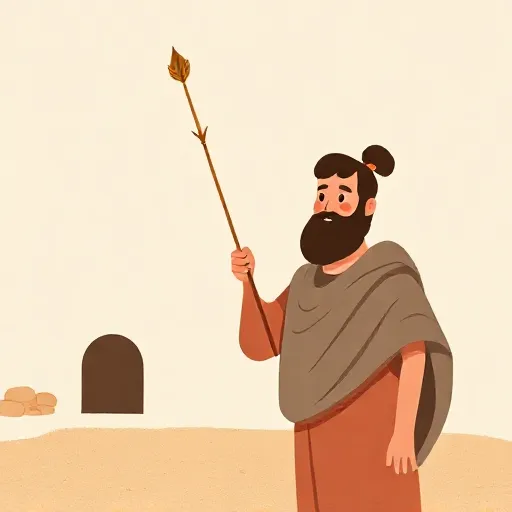
Imagine you shoot an arrow into the air. The moment it leaves the bowstring, nothing is pushing it anymore — yet it sails onward. Why? That simple question plagued philosophers for centuries, and the answer a student in sixth‑century Alexandria gave would eventually help Galileo change the rules of the universe.
That student was John Philoponus (c. 490–after 570), a man nicknamed “the Grammarian” who spent his early career writing detailed explanations of Aristotle’s works. He had been trained by the great Neoplatonist teacher Ammonius (c. 440–520), and like any good pupil he learned to comment on texts line by line, showing how all the ancient Greek philosophers supposedly agreed with one another. But Philoponus didn’t stay a loyal pupil. Soon he started noticing cracks in Aristotle’s system — and he couldn’t keep quiet about them.
Light as a Push, Not a Glow

Philoponus’s first big departure from Aristotle happened while he was writing a commentary on the soul. Aristotle had taught that light is something incorporeal — not a body, but a state: when a medium like air stops being potentially transparent and becomes actually transparent. Light, in that picture, is just the instantaneous switch from “dark but see‑through” to “bright and see‑through.” No movement, no force.
Philoponus couldn’t accept that. He pointed to two everyday facts: sunlight warms the earth, and it follows the laws of optics. If light were only a state, how could it deliver heat? And how could it bend predictably? He reinterpreted Aristotle’s key term, enérgeia, shifting its meaning from a static “actuality” to a dynamic “incorporeal activity.” Just as the soul, though incorporeal, makes a living body warm through its presence, so light is an active power streaming from the sun. In his later work he went even further, suggesting the sun is made of fire and that its rays cause heat by friction when they strike the air.
This was no small tweak. For the first time, Philoponus was treating light as something that does something — a force that travels and acts on matter. That idea would soon explode into a far bigger fight over motion itself.
Why Stones Fall: The Birth of Impetus
Aristotle had an answer for why an arrow flies after leaving the bow: the air, displaced in front of it, rushes around and pushes it from behind. For over a thousand years this theory held, even though anyone who waves a hand through water knows that turbulence slows objects down, not speeds them up. Philoponus called the idea nonsense.
He proposed something radically different. When you throw a stone or loose an arrow, you impress a motive force directly into the projectile. This force — what later scholars called impetus — is not something external pushing, but an internal power that gradually exhausts itself as the object moves. As the impetus runs out, the arrow slows and stops. The medium isn’t the engine of motion; it’s the brake.
This single move overturned Aristotle’s most basic rule: that everything in motion needs a constant external mover in contact with it. Now Philoponus could explain something Aristotle couldn’t — why a thrown stone keeps going in a vacuum. Since the medium only gets in the way, motion through empty space should actually be easier, not impossible. He even backed up his case with simple experiments, dropping weights of different sizes and pointing out that they hit the ground at almost the same time — the very kind of test Galileo would repeat a millennium later. Aristotle had claimed heavier bodies fall much faster, but Philoponus’s observations said otherwise.
Could the World Have Always Existed?

While Philoponus was rewriting physics, he was also preparing a frontal assault on one of Greek philosophy’s most sacred beliefs: the eternity of the world. For most pagan thinkers, the universe had no beginning — it had always existed, with no act of creation from nothing. In 529 CE, the same year the emperor shut down the philosophical academy in Athens, Philoponus published a blow‑by‑blow rebuttal of the great Neoplatonist Proclus (c. 411–485) on this very point.
Philoponus fought the eternity doctrine using Aristotle’s own logic. Imagine an infinite chain of events stretching back into the past, each cause depending on a prior one. According to Aristotle, an actual infinite cannot be traversed or added to. But if the universe had no beginning, an infinite number of past days has already been completed. Not only that — different celestial spheres, moving at different speeds, would have completed different infinite numbers of revolutions, making one infinity larger than another. That struck Philoponus as absurd. The universe must therefore have a starting point.
He went further. The universe is a finite body. Aristotle himself argued that a finite body cannot house an infinite power to exist. So a finite cosmos cannot possess the power to endure for an infinite time. Using only premises his opponents accepted, Philoponus cornered them into admitting that the world cannot be eternal. And for the first time, a major philosopher working within Greek thought defended creation out of nothing — the idea that God brought matter itself into being where nothing existed before. If God is more powerful than nature, he argued, restricting him to what nature can do makes no sense.
What Is Empty Space, Anyway?

Some of Philoponus’s most daring ideas concerned place and void. Aristotle had defined a thing’s place as the inner surface of the container that holds it — like the glass wall touching the water inside a cup. Philoponus pushed back: place is not a two‑dimensional wrapping, but the three‑dimensional extension a body fills: its volume. Space as a whole is the empty three‑dimensional expanse that can receive bodies, even if nature never leaves it truly empty.
He defended the reality of a vacuum not with abstract reasoning alone but with a pocket‑sized experiment. Take a clepsydra — a narrow‑necked pipette. Dip it in water, seal the top with your finger, and lift it out. The water stays inside. Remove your finger, and the water falls. What holds the water up? Nothing visible, yet something exerts a force. Philoponus saw the power of a vacuum at work, refusing to vanish into an air‑pushing explanation.
This picture of space as volume — an empty container that can be occupied — was a giant step away from Aristotle’s cramped cosmos. Later thinkers would recognise in Philoponus’s three‑dimensional extension something like the infinite, geometrical space that Isaac Newton would make central to physics.
The Grammarian’s Dangerous Faith
Around the 530s, Philoponus abruptly stopped writing commentary and threw himself into the theological battles of his time. He argued fiercely for monophysite Christianity, a position that stressed the unified divine nature of Christ against what it saw as splitting him into two persons. Using an Aristotelian scalpel, he insisted that if Christ is one hypóstasis (one concrete individual), he cannot be “discernible in two natures” — a phrase the Council of Chalcedon had approved. For Philoponus, “particular nature” and “hypostasis” meant the same thing. So Christ must have only one complex nature, divine and human fused.
His reasoning was as precise as it was unsettling. In his late treatise On the Trinity, he pushed Aristotelian categories further, arguing that if the three Persons of the Trinity are real individuals, then they are three separate divine substances — three distinct gods, not one. He quickly added that they share the universal essence of divinity, and that unity of concept preserves monotheism, but church authorities saw only tritheism. In 680‑81, the official church condemned him posthumously as a heretic.
Yet this very audacity — using plain reason to dismantle both philosophical authority and theological mystery — is exactly why Philoponus still matters. His arguments against the eternity of the world travelled through Arabic philosophy (Al‑Kindi and later thinkers) and into the Latin West, where they were studied by Bonaventure, Buridan, Oresme, and finally Galileo. The impetus theory he hammered out in a long‑forgotten commentary became a stepping stone to the modern law of inertia.
More than any single idea, Philoponus modelled something new. He read Aristotle’s books not as sacred manuals to be harmonised but as the work of a fallible human being who could be wrong. When you ask why an arrow flies, you are already doing what Philoponus did: testing what you have been told against what you see, respectfully but without fear. That habit — more than any experiment — is what pulls a whole civilisation forward.
Think about it
- If you were taught that a widely accepted scientific law was wrong, how would you test it? What would count as good evidence?
- Why do people sometimes reject new ideas even when the arguments for them are strong? Can you think of a time when you held onto a belief even though the facts didn’t fully support it?
- Philoponus had to choose between loyalty to the tradition of his teacher and what his own reason told him. Have you ever faced a similar choice between fitting in and thinking for yourself?