
Can God Make It So Rome Was Never Founded? A Monk’s Dinner Debate
The Dinner Debate That Started It All

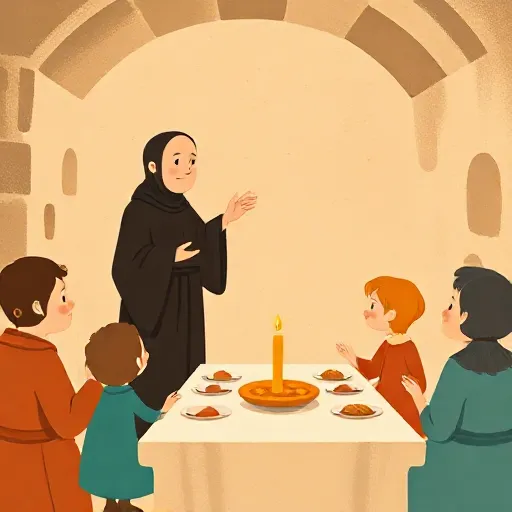
It was early 1065 at the Abbey of Monte Cassino in Italy. Monks sat eating together in silence while a passage from a letter by Saint Jerome was read aloud. The words made one monk nearly choke on his bread. The letter claimed that God, even though He is all-powerful, cannot restore lost virginity to a woman. Peter Damian (1007–1072), a fiery preacher and expert in religious law, could not let that stand. He insisted that saying God cannot do something good is a dangerous way to talk — it makes God look weak. Abbot Didier of Monte Cassino defended the letter’s view. Soon, others at the table jumped in, pushing the question further: if God is truly all-powerful, could He make it so that something that already happened never happened? For example, could God bring it about that Rome was never founded?
Damian later wrote down his answers in a long letter now called De divina omnipotentia — On Divine Omnipotence. That letter became one of the most puzzling and misunderstood documents in medieval philosophy. To understand Damian, we need to see what he meant by “all-powerful,” how he answered both questions, and why he sometimes seemed to say two different things at once.
What Does “All-Powerful” Really Mean?
Before Damian could say what God can do, he had to define omnipotence — the property of being able to do everything. His definition is surprising. Damian argued that an all-powerful being does not need to be able to do absolutely anything you can dream up. For example, God cannot lie. Lying is an evil thing, and not being able to do evil is not a weakness, Damian said; it is a lack of the ability to do nothing real.
Here is where Damian makes a bold move. He claims that evil things are nothing — they do not truly have being. Good things are made by God and are real; they are something. Evil is the absence of good, a kind of empty hole where goodness should be. So if evil is nothing, then being unable to do evil does not take anything away from God’s power. True omnipotence means being able to do everything that is truly something — that is, everything good. Damian sums this up: to be capable of “everything,” you must be capable of everything that is a genuine thing, but you do not need to be capable of nothing.
This means checking whether God can do a specific thing is, in principle, simple. You just have to ask: is the thing good or evil? If it is good, God can will it and bring it about. If it is evil, it is not really a thing at all — and God does not need to be able to do it to be all-powerful. That framing shapes everything that follows.
Can God Make a Lost Virgin Whole Again?

The first question seemed straightforward: can God restore virginity to a woman who has lost it? Using his definition, Damian answered yes. Losing virginity is an evil, so restoring it would be a good thing. An all-powerful God can do any good thing, so He can restore virginity.
But what does “restoring virginity” actually mean? Damian carefully explains two different senses. One is a restoration of fullness of merits — a person turning back to God with a whole heart again. The other is a restoration of the physical integrity of the flesh — the body being repaired as it once was. Both are possible, Damian says. God can make the flesh as perfect as when the woman came from her mother’s womb, no matter how many husbands she has had.
Crucially, Damian does not claim that God erases the past itself. He compares the miracle to closing a door that has been opened or to the resurrection of Lazarus. Raising Lazarus from the dead did not remove the fact that he had died and been dead; it simply made him alive again. In the same way, restoring physical integrity does not undo the real history of what happened — it just changes things from this moment forward. Damian says this is a lesser miracle than the virgin birth, which was like going through doors without opening them. God can reset the state of things without turning back time.
Can God Undo What Has Been Done?

The second question was much harder: can God bring it about that what has been done has not been done? Can He make it so that Rome was never founded? Damian’s main answer is careful and firm: no, God cannot do that.
The reason is that undoing the past would mean a contradictory state of affairs. Saying “Rome was founded and Rome was never founded” at the same time is a violation of the principle of non-contradiction — the idea that a thing cannot both be and not be in the same way at the same moment. Damian argues that a contradictory state would not be a real thing at all; it would be nothing, and therefore it is not something an all-powerful being needs to be able to do. He even uses a striking image: asking God to make a contradiction is like asking Him to create nothing — but the Gospel of John says that nothing was made without Him, meaning making “nothing” is not His job.
Some objectors brought up a tricky logical puzzle: if it is true that “Rome was founded,” then isn’t that truth now necessary — impossible to make false? Damian waves this aside. He says the same line of reasoning would make everything necessary, including the future, which would lock God out of action. The kind of necessity that follows from a past truth is not a threat to God’s power, Damian believes — it does not force anything to happen ahead of time. Dialectics, the study of logical argument, must serve theology like a maid serves her mistress, not try to be the boss.
Damian also appeals to God’s eternal perspective. God is outside time; all moments are present to Him in one unchanging providential plan. The past cannot be altered because the events that happened are immovably fixed in that eternal plan. If God had willed something different, He could have — before He created anything — but once He freely chose this plan, it became unchangeable. So the past is settled, but that does not make God any less powerful.
The Tricky Part: Did Damian Deny Logic?
For many years, scholars thought Damian said exactly the opposite. Early twentieth-century interpreters picked up on one confusing passage in Damian’s letter where he seems to say that God “easily removes the necessity of nature when he wills,” even if that means setting aside the principle of non-contradiction. They concluded Damian was an anti-logic thinker who thought God could make contradictions true to defend His power.
Nearly all recent experts disagree. The text is too messy to carry that weight. Damian never actually says a contradiction can become true. In fact, he calls the idea outrageous elsewhere in the same letter. The passage that caused the confusion is probably about God’s ability to restore virginity by miraculously rewinding physical integrity, not about making a contradiction real. Damian does not deny logic; he just shifts the conversation from “can the past be erased” to “can God repair things right now.”
Curiously, near the end of his letter Damian adds a “supplementary” strategy. He says that, in a certain way, you could say God “can” make it so Rome was never founded — but this turns out to be a grammatical trick. From God’s eternal point of view, it was always possible for Him never to have created the world or to have chosen a different history. So we can say God “could have” made it so Rome never existed. But that is not changing the actual past; it’s saying that before the world was made, different outcomes were open. Damian himself warns that this way of speaking can mislead simple believers and must be handled with care.
Why It Still Matters: Speaking Wisely About Power

At the dinner table in Monte Cassino, Damian was doing more than answering abstract puzzles. He was trying to teach something about language and power. His deepest worry was that if ordinary people heard “God cannot undo the past,” they might think God is weak and lose their faith. So Damian wanted to show that divine power is solid even with that limit — but he also thought it was dangerous to shout that limit too loudly. Philosophy sometimes requires saying difficult truths; wisdom sometimes requires knowing when to say them in a softer voice.
You face a version of this problem whenever someone asks if an all-powerful being can make a square circle or create a rock too heavy for them to lift. Damian would say those things are not genuine possibilities because they describe “nothing” — logical patterns that cannot hold in any reality. Being unable to make a square circle is not a genuine lack of power. The real challenge is figuring out which apparent limits are real and which are just empty words. Damian’s careful dance reminds us that the biggest questions about what can and cannot be done are also questions about what words like “all-powerful” really mean.
Think about it
- If someone says “I can do anything,” would you accept that they can make 2+2 equal 5? Why or why not — and what does your answer say about what “anything” really means?
- Damian worried that saying “God cannot undo the past” might confuse ordinary people. Is it ever right to keep a true fact hidden to protect someone’s feelings or beliefs?
- Can you think of something that is logically impossible — like drawing a square circle — that you would not expect even an all-powerful being to do? What makes such things different from things that are just very, very hard?