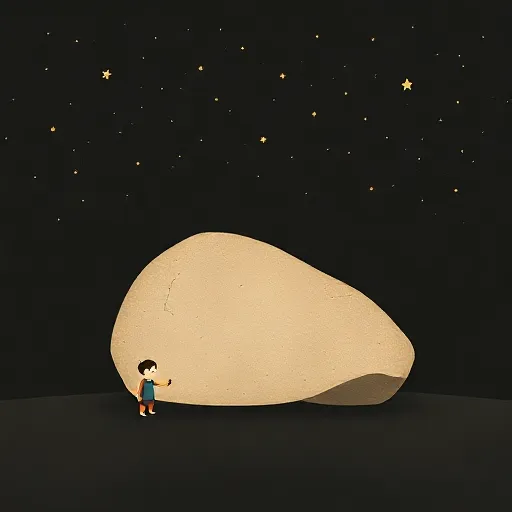
Can an All-Powerful Being Make a Rock So Heavy It Can’t Lift?
The Impossible Rock
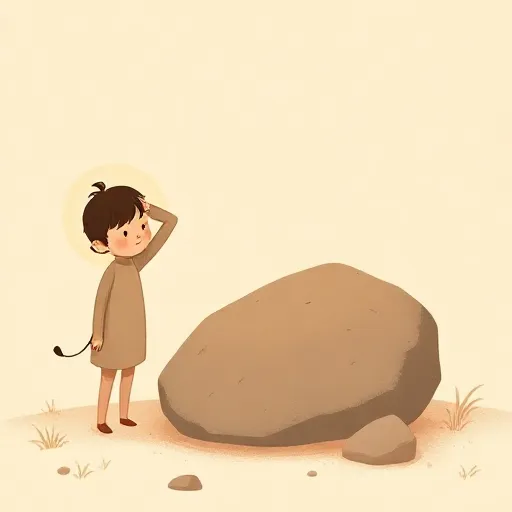
It’s a quiet afternoon, and you’re imagining a being with unlimited power. Lightning shoots from its fingers. It can rearrange stars, stop time, and make mountains dance. You think of the ultimate challenge: “Make a rock so heavy that you can’t lift it.” The being tries… and suddenly the puzzle snaps shut. If it can make the rock, then it can’t lift it, so it’s not all-powerful. If it can’t make such a rock, then it’s not all-powerful either. Either way, omnipotence — the power to do anything — seems to defeat itself.
Medieval thinkers like Moses Maimonides (1138–1204) and Thomas Aquinas (1225–1274) thought this paradox was a trick of words. They argued that true omnipotence does not mean doing literally anything — it means doing anything that is logically possible. Creating a rock too heavy for an all-powerful being to lift is like drawing a square circle. It’s a contradiction, so it isn’t a real action at all. The being isn’t missing any power; the task is just nonsense. This idea — that omnipotence is about maximal power, not the ability to do impossible things — still shapes most discussions today.
What Does “All-Powerful” Even Mean?
René Descartes (1596–1650) took a different route. He seemed to hold that God could do absolutely anything — even make 2+2 equal 5, or make a mountain exist without a valley. This is often called absolute omnipotence. But Aquinas and Maimonides already saw a problem. If an agent could bring about an impossible state of affairs, then that impossible thing would happen — which is a contradiction. Since contradictions cannot be true, no agent can make them happen. Therefore, absolute omnipotence makes no sense.
Most philosophers today agree with Aquinas. They say omnipotence is better understood as maximal power: no being could possibly have more overall power. A maximally powerful being doesn’t need to do the logically impossible. It only needs to be able to do everything that is possible to do. If making an unliftable rock is impossible for an all-powerful being, then not being able to do it doesn’t count against that being’s power. This shift in thinking turns the stone paradox from a devastating objection into a puzzle with a solution — or even two solutions.
Solving the Rock Puzzle
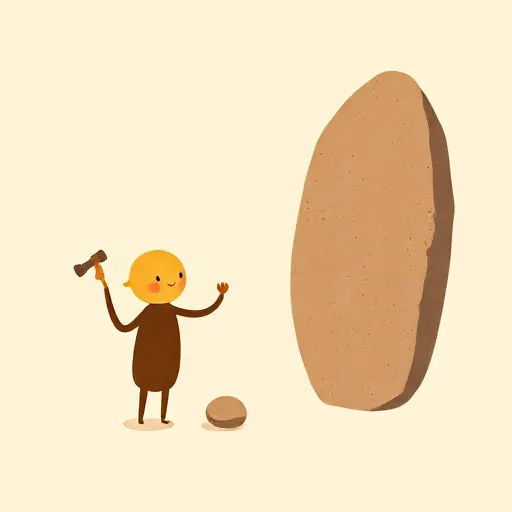
Philosophers Joshua Hoffman and Gary Rosenkrantz (writing in the late 20th century) offered a pair of answers, depending on the kind of omnipotence involved. First, suppose the being is essentially omnipotent — it cannot stop being all-powerful, no matter what. Then making a rock it can’t move would require the being to become non-omnipotent, which is impossible. Since omnipotence doesn’t require doing impossible things, the being is off the hook.
Second, suppose the being is accidentally omnipotent — it has all power right now, but it could lose that power later. Then it can bring about the whole puzzle, just not all at once. While still omnipotent, it creates an enormous stone and gives itself the ability to lift it. Later, it chooses to shed its omnipotence, becoming weak. Now the rock is too heavy to lift, and the being has successfully made it so. The two states of affairs — “I can lift this rock” and “I can’t lift this rock” — occur at different times, so no contradiction arises. With these two moves, the ancient riddle dissolves.
Beyond Rocks: What Can’t an All-Powerful Being Do?
If omnipotence means maximal power, we still need to know where that power ends. Hoffman and Rosenkrantz proposed a detailed answer. An omnipotent being must be able to bring about any state of affairs (a way things could be) that meets two conditions. First, it must be logically possible for someone to bring it about. Second, the state of affairs must be unrestrictedly repeatable — something that could, in principle, happen again and again forever, like a ball rolling for seven seconds. States of affairs that aren’t repeatable — like “a raindrop falls for the first time ever” or “Plato freely decides to write a dialogue” — often involve either the past or someone else’s free choice. Because no one can change what has already happened, and no one can cause another person’s free decision without taking away that freedom, an omnipotent being doesn’t need to bring those about.
This may sound like a cheat, but the idea is that any real display of power can be cashed out in terms of bringing about repeatable states of affairs. If you want to make Parmenides lecture for the first time, you bring it about that he lectures — and it just happens to be the first time. The repeatable event (lecturing) is what matters; the “firstness” isn’t something extra you have power over. So a maximally powerful being can still do an astonishing amount — just not the strictly impossible.
Could There Be Two All-Powerful Beings?

Some philosophers, like Richard Swinburne (born 1934), have suggested that multiple omnipotent agents could coexist — for instance, in the Christian idea of the Trinity. But many others think this is impossible. Imagine two omnipotent beings, X and Y. X wants a feather to move. At the same time, Y wants the feather to stay still. Both try to make their wish come true. Since each has equal, unlimited power, neither can overpower the other. The feather doesn’t move. So X is powerless to move the feather, and Y is powerless to keep it still — yet an omnipotent being shouldn’t be powerless about anything as simple as a feather. The very idea of two all-powerful beings seems to lead to a stalemate that proves neither is truly omnipotent.
Swinburne replies that such beings would be necessarily omniscient (all-knowing) and morally perfect, so they would never disagree. They’d want exactly the same things. But critics point out that there might still be choices that are morally optional — neither required nor forbidden — and the beings could want incompatible optional things. If so, a clash remains possible. The debate is still open, but the feather example gives a powerful reason to think that “all-powerful” is a title only one being can hold.
Power, Goodness, and Why It Still Matters

One more puzzle connects omnipotence to goodness. If God is all-powerful and all-good, why does evil exist? Some argue that the two qualities are incompatible: an all-powerful God could prevent evil, and an all-good God would want to. The standard reply, defended by thinkers like Alvin Plantinga (born 1932), is that God cannot force free creatures to always choose good, because taking away freedom destroys a greater good. Moral evil results from free choices that God, without contradiction, cannot control. And natural evils (like earthquakes) might be necessary for a world that operates by regular, knowable laws — another kind of good. In a world created by a maximally powerful, morally perfect being, any evil that remains must be logically unavoidable if those greater goods are to exist.
This doesn’t end the argument about the problem of evil, but it shows that omnipotence and moral perfection are not obviously incompatible. The same thread runs through every puzzle in this article. “All-powerful” never meant “able to do absolutely anything you can dream up.” It meant having the most power a being could possibly have, within the boundaries of logic, time, freedom, and goodness. Those boundaries are not weaknesses — they are the shape of a world where choices matter, the past is real, and power has meaning.
In your own life, you face limits too. You can’t undo a harsh word after it’s spoken. You can’t force a friend to like the same games you do. But you can plant a seed and watch it grow. You can learn, change your mind, and make new choices. Figuring out what true power means isn’t just for theologians — it’s for anyone who has ever wished things were different and then asked, “So what can I actually do?”
Think about it
- If you could do anything except change the past, would you feel limited? Why or why not?
- Imagine you’re the referee in a game where two all-powerful players disagree. Could you solve the stalemate? What would you do?
- Do you think a world where everyone always did the right thing would be better than a world where people sometimes make bad choices but have real freedom? Why?