The Philosophy That Says You Are a "Someone," Not a "Something"
Imagine You’re Just a Number
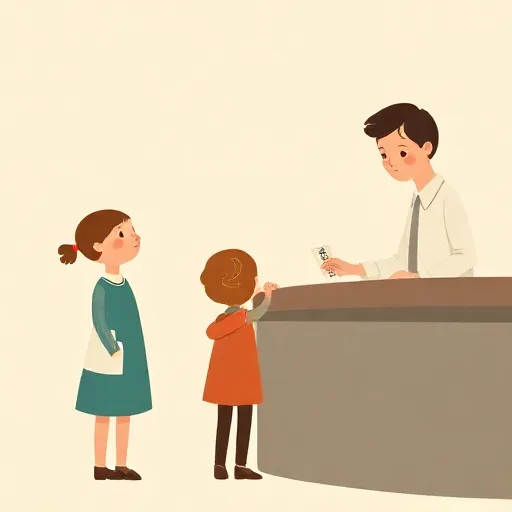
You walk into a huge building. A guard points you to a machine, hands you a slip of paper, and says, “From now on, answer to 84729.” Suddenly you don’t have a name. You’re just an entry in a system — a number that can be swapped for another number, a replaceable part. It feels wrong. But why?
For a group of philosophers called personalists, that gut feeling points to a huge truth. They believe that a person isn’t just a body in a crowd or a useful tool. A person is a someone, not a something — and that changes everything about how we think and live. Personalism isn’t a single school with one founder, but a broad current of thought that puts the person at the center of reality. Its big idea is that your worth isn’t a price, and you can never be replaced.
What Does It Mean to Be a Person?

The word “person” has travelled a long way. It comes from the Latin persona, the mask an actor wore on stage in ancient plays. Early Christians used the term to talk about the Trinity — how God could be three “persons” without splitting into three gods. But soon philosophers began to ask what makes a human being a person, too.
The classic definition came from Boethius (about 480–524): a person is “an individual substance of a rational nature.” In ordinary words, that means you are a single, complete being whose nature includes the power to think and reason. That definition gave personalism its starting point. But later thinkers added more.
In the 1700s, Immanuel Kant (1724–1804) drew a sharp line between things with a price and beings with dignity. A chair can be priced and traded for another chair. But a person has a worth that cannot be measured — what Kant called “intrinsic worth.” For him, you must never treat a human being only as a means to your own goal. This became a core personalist rule: the personalist principle, picked up and developed by later thinkers who insisted that persons are ends in themselves.
The Battle Against the “Impersonal”
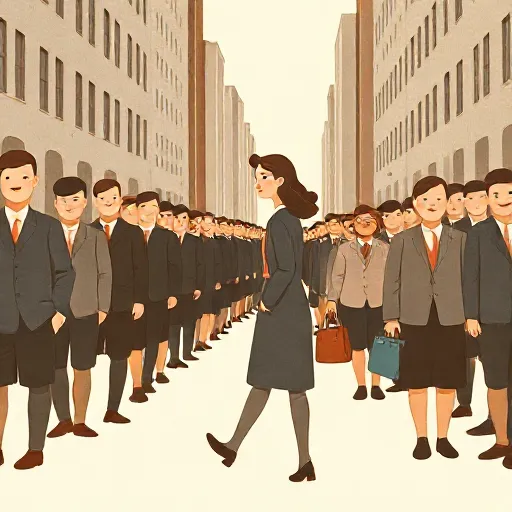
Personalism didn’t appear out of nowhere. It rose up as a reaction — sometimes an angry one — to powerful modern ideas that seemed to erase the individual person. In the 1800s, G. W. F. Hegel (1770–1831) described history as a huge, necessary process of an “absolute spirit” unfolding. In that picture, individual people were like tiny waves on a cosmic tide: their choices hardly mattered. Not long after, Karl Marx (1818–1883) turned that idea into a system where your essence was your place in a social class, not your unique self. Meanwhile, Charles Darwin (1809–1882) offered a view of life where human beings differed from other animals only by degree, not by kind.
Personalists saw these philosophies — and later the political totalitarianisms that used them — as deeply dehumanising. Thinkers such as Friedrich Heinrich Jacobi (1743–1819) and F. W. J. Schelling (1775–1854) had already started fighting back against “impersonal” systems. They insisted that reality was personal, and that no philosophy should swallow up the singular, thinking, feeling person.
Much later, the personalist Jean Lacroix declared personalism to be an “anti-ideology” — a permanent rebellion against any theory that reduces a person to a number, a class, a biological machine, or a tool of the state. For Mounier, the person was the one thing that must never be sacrificed to a system.
Are You a Person or Just an Individual?

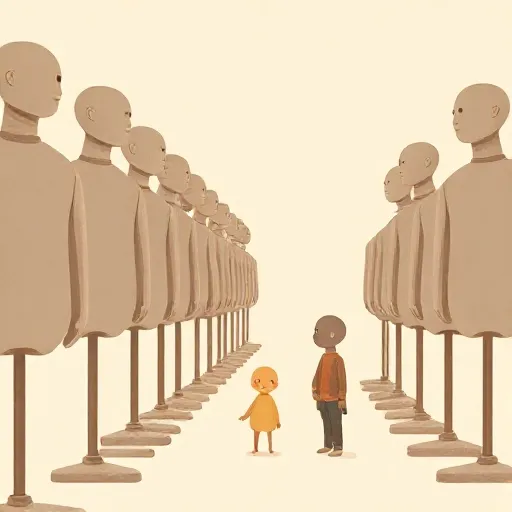
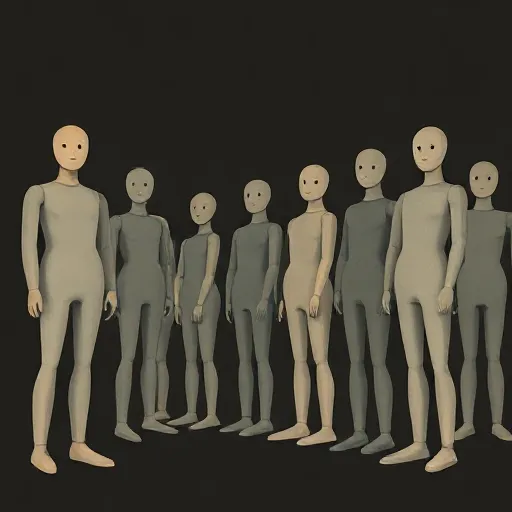
One of personalism’s most striking insights is the difference between an individual and a person. An individual is just one member of a set — one apple in a bushel, one sheep in a flock. If you’re only an individual, you’re interchangeable with any other of the same species. But a person, personalists say, is irreplaceable.
Jacques Maritain (1882–1973) put it bluntly: a person is “more than a mere parcel of matter,” more than an elephant or a blade of grass. You are not just a highly clever animal. You have an inner life, a self-presence that cannot be seen from the outside and that no scientist can fully capture by poking and measuring. The person is the only being who is simultaneously an object you can study and a subject who experiences, chooses, and says “I.”
That inner core, your subjectivity, means that each person is a world of their own. As the German psychologist William Stern (1871–1938) noted, despite every way you can be grouped — age, gender, nationality — a primal uniqueness remains. And because of that, personalists deny that personhood is something you can earn or reach gradually. It’s more like a toggle switch: either you are a person, with all the dignity that brings, or you are not. And every living human being, they insist, is one.
Freedom, the Gift, and Love
If personhood is a toggle, what is the switch made of? Personalists point to self‑determination: the power to act from inside yourself rather than being pushed around by forces from outside. You are the author of your actions. That makes you free, and it also makes you responsible for the kind of person you become. Every choice not only does something in the world, it also shapes your own moral identity. The person, thinkers like Karol Wojtyła (1920–2005) wrote, is both the cause of what they do and, in a deep sense, the creator of themselves.
But freedom does not mean sitting alone in a room guarding your private world. Personalists push hard against individualism — the idea that looking out for yourself is the path to fulfilment. Mounier wrote that the “first condition of personalism is decentralisation” — turning yourself outward. A person, he said, becomes most fully herself only by making herself a gift to others.
This “law of the gift” runs through personalist thought. You possess yourself in a way that no animal does, and that self‑possession isn’t for hoarding — it’s so you can freely give yourself in love. Only persons can love and be loved in this sense. Your deepest nature, personalists argue, is not to be independent of others but to be with them, in communion. Society isn’t just a handy arrangement; it’s built into what you are.
Why It Still Matters

In 1948, the United Nations adopted the Universal Declaration of Human Rights. Jacques Maritain, a personalist philosopher, helped draft it. The declaration’s first article says that all human beings are “born free and equal in dignity and rights.” That sentence echoes the personalist conviction that dignity isn’t awarded by governments or earned by achievements — it comes with being a person.
Personalism’s battle is not over. It first fought against monstrous twentieth‑century totalitarianisms that turned persons into raw material for the state. Today it fights quieter pressures: algorithms that guess your desires, social scores that sort people into worthiness, a culture that sometimes treats you as a consumer rather than a someone. The core insight remains the same. The state, the market, the data‑set — all of them exist for persons, not the other way around.
But personalism also challenges the quieter totalitarianism of the lonely self. It says you aren’t fully yourself until you share your inner life with others, give rather than grab, and see the irreplaceable worth in every face. The next time a voice tells you to treat someone as a stepping stone, or that you’re just a statistic, personalism hands you a different language: you are a someone. And that changes everything.
Think about it
- If a friend tells you that every human being is just a very complicated biological machine, what would you point to in your own experience that might push back against that view?
- Can you treat a person as a means to an end and still respect their dignity? For example, if you pay a neighbour to feed your cat while you’re away, are you using them as a tool — or is something else going on?
- In what everyday situation do you feel most like a replaceable part of a system rather than a unique person? What, if anything, could help you — and others — feel more like a “someone”?