Are You an Animal? The Surprising Philosophy of Personal Identity
The Mirror Question
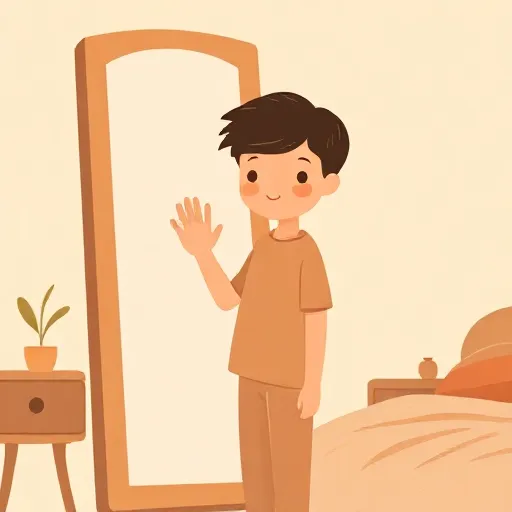
You stumble into the bathroom, still half-asleep, and face the mirror. A familiar pair of eyes looks back. You know that face is yours. But what, exactly, is a “you”? A brain? A soul? A series of memories? Or something more ordinary?
This is not just a silly morning thought. For decades, philosophers have argued fiercely about the answer. One group, called animalists, makes a claim so simple it might startle you: you are an animal. Not that you have an animal body, but that you are a biological organism — a member of the species Homo sapiens, a breathing, digesting creature made of flesh and bone. The philosopher Paul Snowdon gave this view its name in 1991, and Eric Olson, who began publishing on animalism in the 1990s, became its most famous defender. Animalism is still a minority view, but its supporters keep growing because the argument behind it is remarkably hard to shake.
At first, this seems laughable. You are a person, with thoughts and feelings and plans. A cat or a cow is an animal; you are something more. But animalists do not deny you are a person. They say “person” is a temporary status you acquire, like “teenager.” A human animal becomes a person when it develops the right mental abilities: self‑awareness, reason, and a sense of its own past. Before that, as a fetus or an infant, you were the same animal but not yet a person. You might slip back into a non‑person state if you ever enter a persistent vegetative state. But through it all, you stay the same animal.
This idea clashes with a powerful rival view that traces back to the English philosopher John Locke (1632–1704). To understand why animalism is so controversial, we need to meet Locke’s famous puzzle.
Locke’s Strange Distinction: Persons and Human Animals
Locke reshaped the whole debate in 1694 when he added a chapter to his Essay Concerning Human Understanding. He drew a sharp line between a human animal (which he called a “man”) and a person. A human animal, he said, is a living organism with a certain shape and biological functions, no different in kind from an oak tree or a horse. A person, in contrast, is “a thinking intelligent being, that has reason and reflection, and can consider itself as itself, the same thinking thing in different times and places.”
Locke’s point was not just wordplay. He was wrestling with a religious problem: if bodies rot away after death, how could a person be resurrected on judgment day? He realized that what matters for being the same person is psychological — memories, consciousness, rational thought — not having the same clump of physical particles. In a famous thought experiment, a prince’s consciousness (with all his memories) gets swapped into a cobbler’s body. Everyone would say the person in the cobbler’s body is now the prince, Locke argued. Why? Because the prince’s psychological life continues, even if his animal body is left behind.
This led to what philosophers now call a psychological criterion of personal identity: you remain the same person over time if your mental states (memories, beliefs, desires) are linked in the right way. For Locke, the human animal is just a container — a living vessel that can host different persons, or no person at all. Person is a sortal concept, a category that tells you what something essentially is and under what conditions it persists.
Animalists reject that last step. They agree with Locke that human animals persist by staying alive (or at least keeping their organized structure). But they say “person” is not a sortal; it is a phase sortal — like “teenager” or “locomotor.” A locomotor is anything that can move itself (a snail, a missile). Person, animalists say, is a functional category: anything with the right capacities for self‑consciousness and rationality qualifies. A human animal becomes a person around age two, just as it becomes a teenager at thirteen. The animal is the underlying thing; personhood is a phase.
This disagreement is the engine behind most of the battle. And it leads directly to the most famous argument for animalism.
The Thinking Animal Argument: Are You the One in the Chair?
Imagine you are sitting in a chair, reading this. According to the thinking animal argument, you can prove you are an animal with three simple steps:
- Sitting in that chair is a human animal. (Unless you believe the world is an illusion, that is hard to deny.)
- That human animal is thinking. After all, you are thinking right now, and human animals have the same brains and nervous systems as other thinking primates.
- You are the thinking being sitting in the chair.
If all three are true, then the human animal in the chair is you. You are not a separate mind or soul; you are that animal.
The argument, sharpened by Olson and Snowdon, is powerful because denying any premise costs you a lot. Denying the first premise seems absurd — there is clearly a living Homo sapiens where you are. Denying the second forces you to say human animals cannot think, a claim that goes against all biology and ordinary experience. Denying the third means there are at least two thinking beings in your chair: you and the animal. That leads to a mess: which one owns your hands? If both think “I am hungry,” who is actually hungry? You would have to figure out which thinker you are, and the duplicate thinker problem multiplies into a headache.
So animalism seems to win by default — unless you can escape the third premise. Many of animalism’s rivals try to do exactly that.
Too Many Thinkers: When Arguments Multiply
Philosophers have launched a barrage of objections against the thinking animal argument. One family of problems asks: why should we think the whole human animal is the thinker, rather than your brain, or your head, or your torso‑minus‑left‑arm? If those parts can think too — and they share the same brain — then the thinking animal argument would prove you are any number of things, which is impossible. This is the thinking parts problem. Unless animalists give a special reason to pick the whole organism over its thinking parts, the argument collapses.
Another objection comes from constitutionalism, championed by Lynne Rudder Baker. She argues that you are a person constituted by a human animal, just as a marble statue is constituted by a piece of marble without being identical to it. The person and the animal share the same matter but differ in important ways: the person has a first‑person perspective (the ability to think of itself as “I”) essentially, while the animal does not. So when you think, you are the person, not the animal — the animal only thinks “derivatively” by sharing your brain. On this view, premise (3) fails because “the thinking being” is ambiguous.
Other critics point to bizarre thought experiments. If we transplanted your cerebrum into a different body, many people feel strongly that you would go with the brain, not stay in the brainless animal left behind. Since animalism says you are the animal, it implies you would be stuck in the empty‑headed body, which seems wildly implausible. Even more puzzling is the remnant person problem: imagine your cerebrum is removed but kept alive mid‑surgery. That isolated brain would be a conscious person — but where did that person come from? It wasn’t in you before the operation, or you’d have had two persons in one animal. Yet animalism seems forced to say a new person suddenly appears just by cutting tissue.
These objections have kept animalists busy. Some, like Olson, respond by biting the bullet: our intuitions about brain transplants might just be unreliable, shaped by science fiction. Others, like Stephan Blatti, offer new arguments that bypass the thinking animal argument altogether. For instance, the animal ancestors argument says that if you are not an animal, then neither were your parents, nor your grandparents, all the way back — meaning humans didn’t evolve from animals, which contradicts biology. That is a high price to pay.
The debate remains wide open.
Why It Matters: Life, Death, and Rights
So why does any of this matter beyond abstract philosophy? Because animalism forces us to rethink big practical questions.
If you are a human animal, then you existed long before you were a thinking person — as a fetus, and even earlier as an embryo. You might also outlive your personhood, as a patient in a persistent vegetative state whose brain no longer supports consciousness. This has immediate implications for moral debates about abortion and euthanasia. Should a fetus have the same rights as a person? If you are the same being from embryo to adult, perhaps your moral standing starts earlier than Locke’s framework suggests. Likewise, if a permanently unconscious human animal is still you, decisions about ending life support become deeply personal.
Moreover, animalism chips away at the sharp line between us and other animals. A great ape or a dolphin may lack the full‑blown first‑person perspective of a human person, but they are thinking, feeling organisms too. If what matters fundamentally is the animal, then our ethical codes might need to acknowledge that we are not uniquely special — just one kind of animal among many. Some philosophers are exploring how animalism might reshape the way we treat non‑human creatures.
None of this means animalism automatically gives one side victory in these moral fights. But it does shift the ground. The question “What am I?” turns out to be tied up with “How should I treat others — including those who can’t speak for themselves?” And that is a question worth asking, the next time you glance in the mirror.
Think about it
- If you were in a brain transplant scenario and your consciousness seemed to move to a new body, would you still believe you were an animal? Why or why not?
- Suppose a person in a coma will never wake up again, but their body still breathes. Is it still them? What would an animalist say, and what would Locke say?
- Many people think you have a soul or a mind separate from your body. Does the animalist view make it harder to believe in an afterlife? Why might that matter?