
You Are Not a Thing — You Are a Project
When Nothing Feels Real

One evening you’re lying on your bed, scrolling past thousands of posts, and a quiet thought slips in: What’s the point? Why am I even here? The world suddenly feels flat, like a movie set where someone switched off the lights behind the scenery. This unsettling sense that life has no built‑in purpose is what the German philosopher Friedrich Nietzsche (1844–1900) called nihilism. He famously announced that God is dead, meaning that for more and more people the old religious guarantees — the idea that a divine plan gives your life a ready‑made meaning — had stopped working. Without that north star, Nietzsche wrote, modern humans are “wandering as if through an endless nothing.”
By the 1800s, science was explaining the universe as a giant, soulless machine of causes and effects. Traditional communities were dissolving into big, anonymous cities. People felt less like members of a close‑knit village and more like interchangeable parts in a factory. A Spanish thinker, José Ortega y Gasset (1883–1955), would later speak of “the mass man” — a person who does whatever everybody else does and feels fine about it, as if wearing the exact same gray suit as everyone on the subway were the highest achievement. This new, impersonal world set the stage for a radical question: If the universe doesn’t hand you a meaning, what do you do with your life?
Who Are You, Really? Existence Before Essence
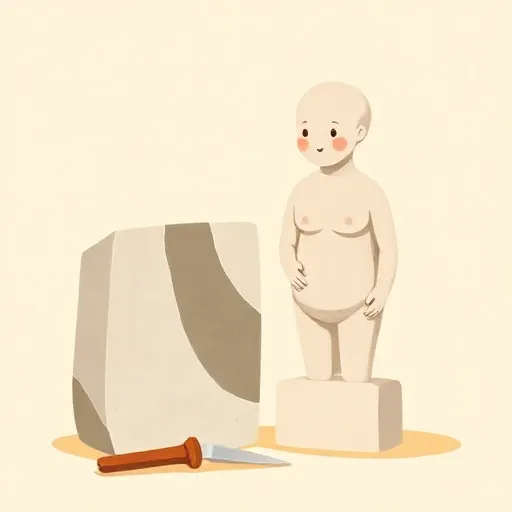
A group of thinkers we now call existentialists refused to run away from the anxiety of nihilism. They turned it into a starting point. One of them, the French philosopher Jean‑Paul Sartre (1905–1980), summed up their core idea in a five‑word sentence: existence precedes essence. To see what he meant, imagine a paper knife. The idea of the knife — its purpose, its shape — exists in a designer’s head before the knife is ever manufactured. Its essence comes first. But for a human being, Sartre argued, the order is reversed. You show up in the world, a breathing, hungry, scared, giggling creature, before anyone can say what kind of person you are supposed to be. Your essence is not a finished blueprint; it’s something you build as you go.
This does not mean you start with a blank slate. You are thrown into a specific body, a particular family, a certain country and century — all things you didn’t choose. Sartre called this your facticity, the raw material you have to work with. What makes you different from a pencil sharpener is that you can step back and ask, What do I make of this? You can reinterpret your past, question your desires, and imagine a different future. Sartre named that capacity transcendence, your ability to always be more than whatever label someone has stuck on you. A shy person is not a shy‑thing; she is a person who is currently living out the pattern of shyness and who might one day choose to act differently. Existentialists insist that you are never just the sum of your facts — you are the story you weave out of them.
The Terrifying Freedom of Choice

Realizing you are free sounds like good news. But Sartre saw that it’s also deeply frightening. If there is no cosmic script, no rulebook stitched into the fabric of reality, then you alone are responsible for your choices. Sartre wrote that we are “condemned to be free” — condemned because we cannot escape the weight of having to decide, and because there are no excuses to hide behind. You can’t blame your genes, your upbringing, or “the way the world is” in the same final way a rock can blame gravity for falling.
The Russian novelist Fyodor Dostoevsky (1821–1881) captured this dread in his story Notes from the Underground. His nameless “underground man” rebels against the idea that human actions are the predictable result of scientific laws. When the rational thinkers of his day claimed they could explain why people do everything they do, the underground man felt reduced to a piano key that gets hammered by forces outside itself. To prove he was free, he deliberately did the opposite of whatever made sense: when he had a toothache, he refused to see the doctor; when a former schoolmate offered kindness, he lashed out in cruelty. He insisted that the most advantageous advantage a human being has is independent choice — even when that choice leads straight into disaster. Freedom, for the existentialist, is not a guarantee of happiness. It is a vertigo. You stand at the edge of a cliff of possibilities, and the only one who will catch you if you jump is you.
The Crowd and the Real You: Authenticity

If freedom is this hard, it’s no wonder people try to escape it. The Danish philosopher Søren Kierkegaard (1813–1855) noticed that many of us live a frightened life. We let the crowd decide what we value, what we wear, what we think is cool, even what we believe is right. Doing what they do feels safe. But Kierkegaard thought this was a form of self‑deception: a refusal to face the task of becoming a real individual. He called the alternative authenticity, a word that comes from an old Greek term for being the author of your own life. An authentic person makes personality‑defining commitments — choices that tie the scattered moments of a life into a coherent whole, the way a strong spine holds up a body.
Nietzsche had an even more dramatic vision. He imagined a figure he called the Overman (often translated as “Superman”), the rare human being who has the courage to stare at the death of God and create his own values from scratch. Most people, Nietzsche thought, follow a slave morality — they obey rules given by tradition because they are afraid. The Overman lives by a master morality that says yes to life exactly as it is, even to its ugliest parts. Nietzsche captured this spirit with his thought experiment of eternal recurrence: If a demon whispered that you would relive every single moment of your life, good and bad, over and over forever, would you collapse in despair or would you say, “I have never heard anything more godlike”? For Nietzsche, loving your fate — amor fati — is the ultimate test of authenticity.
The German thinker Martin Heidegger (1889–1976) and later Sartre and Simone de Beauvoir (1908–1986) gave this idea a final twist. They said that self‑deception, or bad faith, is a constant human temptation. In bad faith, you pretend you are a finished object — “I’m just a bad student,” “I’m just a hot‑headed person” — to avoid the anxiety of having to remake yourself tomorrow. Authenticity doesn’t mean discovering a solid “true self” deep inside you. It means accepting that you are a messy double‑property: a facticity you can’t escape and a transcendence that never lets you settle into a final version. Living authentically is like riding a bike: you’re always a little off‑balance, but that wobble is exactly what keeps you moving.
Your Freedom is Woven into Others
At first glance, existentialism can sound lonely — one person on a cliff, deciding alone. But Sartre and Beauvoir came to see that freedom is never just a private affair. Sartre wrote that he could not want his own freedom without also wanting the freedom of others. If I treat another person as a mere tool for my own goals, I am objectifying them — turning a human into an it — and in that moment I shrink their world. Beauvoir described authentic love as a relationship where two freedoms meet, each helping the other to open up new possibilities, rather than one person trying to possess the other. For her, the ethical question is not just “What should I choose?” but “What kind of world do my choices build for others?”
Beauvoir showed how this works on a large scale in her landmark book The Second Sex. She famously wrote that a woman “is not born, but rather becomes a woman.” A girl doesn’t arrive in the world feeling inferior or weak; she absorbs those meanings from a society that has already decided what a female body is supposed to mean. The body, Beauvoir said, is not just a physical object; it is a situation loaded with values, taboos, and expectations. But because those meanings are human‑made, they can be challenged and changed. This insight — that oppressive structures are collective choices, not natural laws — gave powerful fuel to the feminist and civil rights movements that followed. Existentialist ethics turns the dizzying freedom of the individual into a shared responsibility: if we are all authors of the social world, we can also rewrite it.
Why This Matters in Your Life

Existentialism didn’t stay locked in philosophy departments. Its fingerprints are all over the way we think about identity, mental health, and the planet. When you hear that you shouldn’t let other people define you, or that the climate crisis isn’t just a technical problem but requires a new way of seeing how you belong to the earth — those are existentialist echoes. Today, therapists who work with deep feelings of emptiness often draw on existentialist ideas, helping patients face anxiety not as a sickness to be medicated away, but as a signal that something matters and needs attention.
The next time you lie on your bed and wonder what the point is, existentialism doesn’t offer a tidy comfort. It says: there is no pre‑written answer, and that’s the whole point. The question belongs to you. You are not a thing that can be summed up in a report card or a social media profile. You are a project — an open, unfinished experiment in becoming human. And that, even when it’s scary, is an invitation to get started.
Think about it
- If your life were a video game with no built‑in quests and no final boss, what would you set out to do? What makes that goal worth more than just following whatever someone else tells you?
- People often say “just be yourself.” But what if you aren’t sure who that is? Where would you look for clues about what kind of person you want to become?
- Imagine a world where a perfect supercomputer could predict every choice you will make tomorrow. Would you still feel like you were really choosing? Why or why not?