
Who’s Really in Control—You or Your Brain?
The Cake You Grabbed—and the Question You Can’t Shake

It’s a birthday party. You told yourself this morning: “Today I’ll skip dessert.” Then someone places a giant chocolate cake in front of you. Your hand reaches out, forks a piece, and you eat it before you even register the decision. Afterward, you feel a twist in your stomach—part guilt, part confusion. Did you actually choose that? Or did something inside you take the wheel while you sat in the passenger seat?
Philosophers call this puzzle personal autonomy: the ability to govern yourself, to be the real author of your own actions. It’s not just about big life decisions; it’s about every moment when you act and wonder whether the action was truly yours. When a craving overwhelms you, when a habit kicks in automatically, or when someone else’s pressure seems to steer you—these are moments that make the question urgent. This article walks you through the main answers philosophers have offered, and the stubborn problem that none of them fully solves.
Your Mind’s Invisible Throne: Every Agent Has Authority
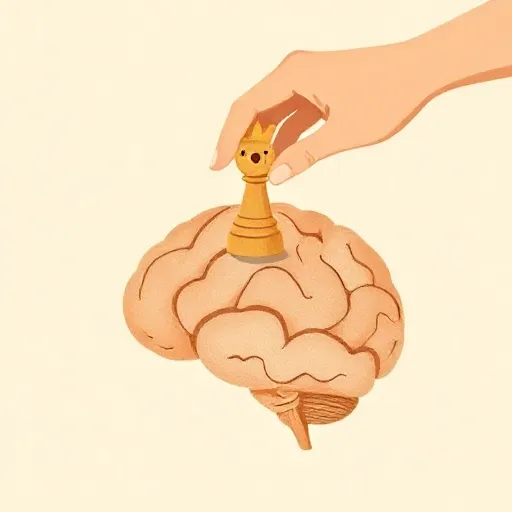
You are an agent: that simply means you act. When you act, you initiate your own action. Nobody else can do that part for you. Even if you follow someone else’s advice, you are the one who decided to follow it. So you have a kind of authority over your actions that can’t be taken away—it comes built in with being an agent. It’s like wearing a crown you cannot remove.
But wearing a crown doesn’t guarantee you really rule. A president might sign a law because the army forces her hand. In the same way, you might “endorse” a desire while being bullied by an addiction or a compulsion. Your authority is real, but it can become a mere formality. The real puzzle is telling the difference: when do you genuinely govern yourself, and when are you just a figurehead?
If You Like Your Desires, Are You Free? The Coherentist Test
One popular idea says you are autonomous when your deepest attitudes line up with what you actually do. Harry Frankfurt (1929–2023) noticed that you can have not just desires (“I want cake”), but also second-order desires—desires about which desires move you. You might want the desire to be healthy to win, even when the desire for cake is shouting loudest. If the desire that finally moves you is the one you wanted to move you, then you are in charge.
Imagine you are trying to quit a bad habit, like nail-biting. Your fingers head toward your mouth, and you really wish that urge would lose. When it wins anyway, you feel like a victim of your own body—you’re not governing yourself. But if you decide that biting your nails doesn’t bother you, and you endorse that habit, then (on this view) you are free while you do it. Another philosopher, Gary Watson (20th century), added a similar idea: you have evaluative judgments about what is worth doing, and autonomy comes when your motives harmonize with those judgments.
The catch? You could be brainwashed. If a mad scientist reprogrammed your second-order desires so you love biting your nails and want to want it, you’d pass the coherentist test with flying colors. Yet almost everyone would say you’re not truly self-governing. Harmony by itself isn’t enough.
What If You Can’t See the Reasons? The Reasons-Responsive View

Another group of philosophers, including Susan Wolf (born 1952), argues that autonomy requires more than cozy feelings about your desires. You must be responsive to reasons—able to recognize facts that count for or against what you’re doing. If you hand someone a glass of poison, not knowing it’s poison, you aren’t a murderer because you couldn’t respond to the reason against giving it. You were out of touch with reality.
This view suggests that someone who doesn’t understand what she’s doing—or why—isn’t really self-governing, even if she happily endorses her actions. But here’s a tricky case. In Shakespeare’s play, Othello kills his wife Desdemona because he wrongly believes she betrayed him. He’s furious, he ignores obvious evidence of her innocence, and he acts on a terrible reason. Yet we still hold him responsible—he’s the author of his act, not a helpless puppet. So maybe autonomy doesn’t require perfect reason-tracking. That’s why a third approach, responsiveness to reasoning (championed by Alfred Mele and John Christman, late 20th century), focuses not on getting the right answer but on whether you think things through for yourself. Even if your beliefs are false, so long as you genuinely evaluate your motives using your own reasoning, you count as self-governing. But again, what if someone secretly programmed your reasoning process through indoctrination? Then your “own reasoning” might still be a puppet show. The problem creeps back in.
The Big, Uncomfortable Question: Are We All Just Dominoes Falling?

All these views assume that you can be in control, even if your brain is a causal machine. But incompatibilists, such as Peter van Inwagen (born 1942), argue that if every event has a cause, then your every choice is determined by events before you were born—your genes, your upbringing, your brain chemistry. If that’s true, then no matter how much you endorse your desires or respond to reasons, you are merely the next domino in a chain that started long ago. You never really had a chance to do otherwise. Autonomy would be an illusion.
That sounds alarming. Yet many philosophers push back. When you are actually making a decision, you simply must see yourself as the one who decides. Even if a scientist could predict your every move, you still experience the moment of figuring out what to do. Immanuel Kant (1724–1804) argued that we have two points of view: the theoretical point of view, where we explain causes, and the practical point of view, where we must choose. From the practical angle, you are free because it is up to you to determine which reasons to follow. No fact about brain chemistry can take away the fact that, right now, you have to make up your mind. So perhaps autonomy is not a scientific fact—it’s a stance you cannot avoid. This doesn’t prove you have magical free will, but it explains why you feel responsible, and why society holds people accountable.
Why It Matters When You Blame Your Friend (or Yourself)

Every day you decide whether someone is blameworthy. When a classmate with a concussion acts aggressively, you cut them slack because their brain is injured. When a person steals because of a severe addiction, courts sometimes treat them differently—but where’s the line? If we can’t pin down exactly when someone is self-governing, how do we know when blame is fair?
The philosophical maze teaches you that autonomy is a matter of degree, not an on/off switch. It’s shaped by your understanding, your reasoning, and the forces that formed you. Still, you can’t live without assuming it. The moment you ask, “Did I really choose this?” you are exercising the very capacity that makes you an agent. You step back from your desires and evaluate them. That act of reflection is the seed of autonomy.
Next time you grab that cake against your better judgment, you might not know whether a hidden puppet master moved your hand. But the fact that you can ask the question means you are more than a domino. You are a mind trying to govern itself—and that’s a start.
Think about it
- If a brain implant made you love eating broccoli, would your new love be truly yours? What if you also started to want to love it—would that make a difference?
- Imagine a friend who never reflects on their mistakes and ignores all advice, versus someone who over-analyses every move but still messes up. Are they governing themselves to the same degree? Why?
- Should a sleep-deprived person who commits a crime in a confused fog be held just as responsible as someone who plans it carefully? Where do you draw the line between “they couldn’t help it” and “it was their choice”?