
Do You Need Words to See What's in Front of You?
A mango, a child, and a puzzle about seeing
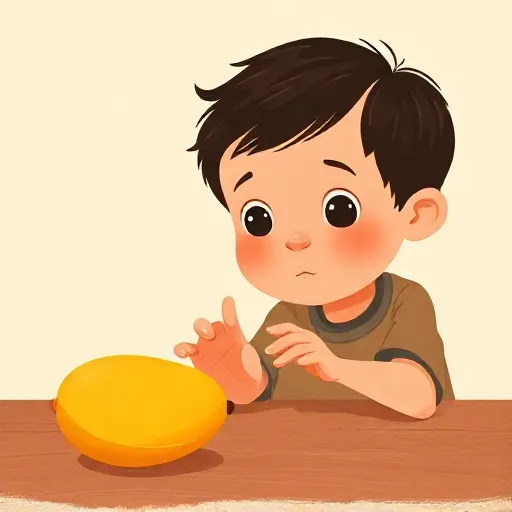
Seven-year-old Rohan has never seen a mango. When his aunt places the golden fruit on the table, his eyes widen. He sees a yellow-orange oval, a gleam of light, a faint perfume. But does he see it as a mango? He doesn’t have that word. What exactly happened in his mind the very first instant he looked? Indian philosophers would say he had a nirvikalpaka perception — a raw, concept-free awareness. A moment later, after his aunt says “mango,” his mind would produce a savikalpaka perception, a thought shaped by the concept “mango.” That two-stage picture is one side of a debate that raged for over a thousand years. The other side insists that every perception is already steeped in concepts — that you never really see anything purely.
The Nyāya school, founded by the sage Gautama (c. 2nd century CE), held that perception is a two-step process. First comes a nirvikalpaka (non-conceptual) flash: the raw sensory data of colour, shape, and smell hit you before any mental labelling. Immediately after, your mind draws on memory and language to produce savikalpaka (conceptual) perception — you see the fruit as a mango. For the Nyāya, both stages are genuine knowledge.
But the Buddhist philosopher Diṅnāga (c. 480–540 CE) disagreed sharply. He defined perception as a cognition “devoid of conceptual construction.” In his view, only the first moment of pure sense‑awareness counts as real perception. As soon as you think “mango,” you’ve added something made by your mind — a word, a universal category — that was never in the world. The real world, according to Diṅnāga, is made of bare, unrepeatable particulars, and your concepts distort it. So for Buddhists, nirvikalpaka perception alone is valid; savikalpaka is imagination.
The Buddhist challenge: Only what is real right now

Walk into a barn for the very first time. According to the Buddhists, your eyes catch a particular brown shape with four legs and a tail — a unique, momentary flicker of colour and form. You never directly see “cowness.” That universal, the idea shared by every cow, is a mental construct. Real things are particulars — each one entirely distinct, never repeated. Only particulars have causal efficacy: they can kick over a bucket or give milk. The universal “cowness” can’t do either.
But if words don’t name universals, how do they work? Diṅnāga proposed the apoha (exclusion) theory. The word “cow” doesn’t point to a positive property cowness; instead it means “not non‑cow.” By ruling out horses, goats, and everything else that isn’t a cow, the word carves out a group. Think of sorting fruit: you pick out apples not by finding a hidden “appleness” inside each one, but by noticing they are not oranges, not bananas. The name is just a negative filter. Later Buddhist thinker Dharmakīrti (c. 7th century CE) sharpened this idea. He added that conceptual thoughts superimpose general features onto the particular flash of perception. Those super‑impositions can be correct if they lead to successful action — calling something a cow and getting milk is fine, even though your mind never touched a universal. But the particular-as-it-really-is remains wordless.
The realists strike back: Universals are real features

The Nyāya and Mīmāṃsā schools refused to accept a world of bare particulars. Kumārila (c. 7th century CE), a fierce Mīmāṃsā philosopher, argued that even the first, wordless glance takes in both the particular and the universal. When you see a cow from a distance and wonder whether it’s a Brahmin’s cow or another kind, you must already perceive “cowness” — otherwise you wouldn’t be able to ask the question. The universal is not added later; it is given right alongside the individual.
Gaṅgeśa (c. 12th century CE), a master of “New Logic” (Navya‑Nyāya), put forward a famous inference. Suppose a child sees a cow for the very first time. She has no memory of cows, yet after this first look she can later say “That’s a cow.” How is that possible? Gaṅgeśa argued that the qualifier — cowness — must have been grasped already in that first glance, even though the child wasn’t aware of grasping it. There must be a non‑conceptual perception of universals, a direct taking‑in of the property before it’s named. Otherwise the child would never connect the word to the world. For Nyāya, real universals exist out there, stitched into the fabric of things, and you sense them every bit as much as the coloured shape.
The Grammarian’s twist: All thought is language

What if there is no wordless awareness at all? The Grammarian philosopher Bhartṛhari (c. 5th century CE) claimed that every cognition is soaked in language. Even an infant’s gaze is driven by speech‑potency, a hidden verbal seed carried from previous lives. When you stumble over a tuft of grass because you’re walking absent‑mindedly, you might feel a touch, but Bhartṛhari would say that’s not real awareness unless it can be verbalised — even if only by a ghostly “this” or “that.” Without words, nothing is properly seen.
The realists fought back with everyday experience. Vātsyāyana, an early Nyāya commentator, pointed out that you learn the meaning of a word after you’ve perceived the object. A child touches a hot pot, recoils, and feels the pain before anyone names it “hot.” The Mīmāṃsakas added that you can distinguish shades of red long before you know the names “crimson” or “scarlet.” A musician hears differences between notes even if she’s never been taught their labels. So the realists held firm: perception comes first, language rides along later. Words can shape how you describe what you see, but they don’t build seeing from scratch.
Why this still matters: Can you ever trust your own eyes?

The debate took a dizzying turn when the Buddhist Vasubandhu (c. 4th century CE) asked how we tell veridical perception from illusion. In a dream you can feel certain that a snake is real — until you wake up. Could waking life be a similar projection? Vasubandhu argued that if the mind can conjure images without any external object, perhaps all experience is consciousness‑only.
Nyāya realists and Advaita Vedantins answered that illusion is a parasite on real seeing. You can mistake a rope for a snake only because you’ve previously encountered real snakes. You can’t imagine a “son of a barren woman” — an utterly unreal thing — because no such thing exists to borrow features from. So at least some perceptions must be truthful. Still, the puzzle lingers in modern life. Two friends look at the same photograph of a dress; one swears it’s white‑and‑gold, the other sees blue‑and‑black. Each trusts their own eyes, yet their perceptions are live‑constructed blends of raw light and the brain’s powerful habit of labelling. The same experiment in concept‑free seeing that ancient Indian monks ran in meditation is still running whenever your senses tangle with a trick of the light. The oldest Indian question — do you need words to see? — turns out to be right behind your eyeballs every day.
Think about it
- If a baby sees a mango without knowing the word, can she ever tell us what that first silent moment was like? Could a scientist ever test whether she had a “pure” sensation?
- Suppose you see a photo as blue and black, and your best friend sees the same photo as white and gold. Does that mean your perception is partly built by your brain’s expectations, not just by what hits your eyes?
- If learning new words can make you notice things you used to miss – like a birder spotting a warbler – would a person with a richer vocabulary literally see a richer world?