Can a Tiny Universe Contain an Infinity Too Big to Count?
The Town That Believed It Was Uncountable

In 1922, the Norwegian mathematician Thoralf Skolem (1887–1963) stumbled on a brain-twister. Imagine you build a tiny toy universe that follows every written rule of set theory—the part of math that studies collections. The toy universe is countable, which means you can match its objects one‑to‑one with the counting numbers: 1, 2, 3, and so on. Yet one of the rules says “there exists an uncountable set”—a collection so gigantically large that it cannot be paired with the counting numbers. How can a countable world hold an uncountable set? It sounds like a map that shows a mountain taller than the paper it’s printed on. This puzzle, known as Skolem’s Paradox, has kept mathematicians and philosophers arguing for a century.
Cantor’s Discovery: Two Sizes of Infinity
To understand the paradox, we have to start with the German mathematician Georg Cantor (1845–1918). Cantor invented a simple way to compare the size of collections. Two collections have the same cardinality if you can pair up every member of the first with exactly one member of the second, like matching 1 with A, 2 with B, and so on.
When Cantor looked at infinite collections, he found a surprise. Some infinities are the same size, like the counting numbers {1, 2, 3, …} and the even numbers {2, 4, 6, …}. Pair x with 2x and everything lines up—they are both countably infinite. But other infinities are genuinely larger. The real numbers (all the unending decimals like π and √2) cannot be paired with the counting numbers no matter how hard you try. They are uncountably infinite. Cantor’s great theorem says that uncountable sets exist. So any full‑fledged theory of collections must be able to talk about both countable and uncountable sets.
The Shrinking Theorem That Shook the Rules

A few decades after Cantor, a result appeared that seemed to pull the rug out from under him. Leopold Löwenheim (1878–1957) and Thoralf Skolem proved a theorem about first‑order logic. First‑order logic is a precise language mathematicians use to write rules about objects—it can say “all things” and “there exists a thing,” but it cannot talk about “all collections of things” at once. The Löwenheim–Skolem Theorem says: if a set of first‑order sentences has any infinite model (a mathematical world that makes the sentences true), then it also has a model whose domain—the collection of all objects in that world—is only countable.
Now, the standard axioms of set theory are themselves a short list of first‑order sentences. They prove Cantor’s theorem, so they say “there is an uncountable set.” By the Löwenheim–Skolem theorem, there must exist a model of those axioms that is countable. Inside that model, the sentence “there is an uncountable set” still comes out true. But from the outside, the entire model is only countable. That, in a nutshell, is Skolem’s Paradox.
Why the Town Isn’t Really Uncountable
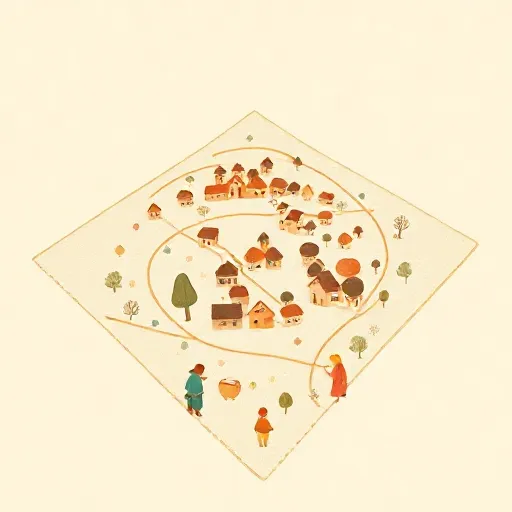
The paradox disappears once you notice a trick of perspective. Inside a countable model M, what does it mean for the model to say “x is uncountable”? It means this: the model checks whether it contains any object that is a bijection—a perfect one‑to‑one pairing—between the counting numbers and x. Since M is only countable, it might simply be missing the needed bijection. The bijection really exists in the larger mathematical universe, but it is not a member of M’s domain. The quantifier “there exists” inside the model only looks at the model’s own small collection of objects.
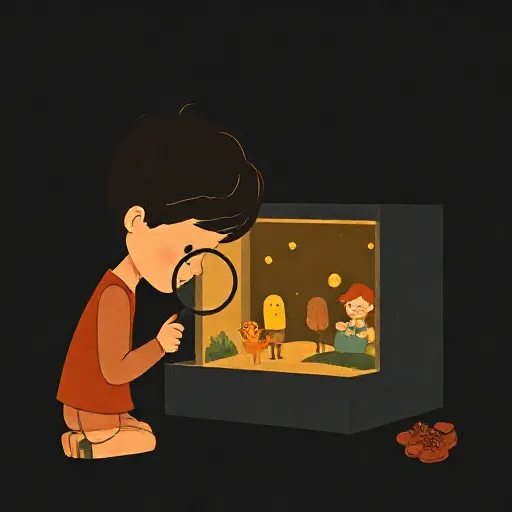
Think of a tiny village drawn on a handkerchief. The village map does not show a road to the next town—not because no road exists, but because the handkerchief stops at the village border. The village “thinks” it has no road, just as the model “thinks” the set is uncountable. The mismatch is between what the model says and what we, standing outside, can see. The mathematics is safe: Cantor’s theorem and the Löwenheim–Skolem theorem coexist without contradiction. Skolem’s Paradox is a striking lesson in how a formal system can be locally right while being globally misleading.
Does Infinity Break When We Write It Down?

Skolem himself drew a deeper philosophical lesson. He thought that if we treat the axioms of set theory simply as a set of rules—an algebraic approach where any model is as good as any other—then big ideas like “uncountable” become relative. A set can be uncountable in one model and countable in another. He wrote that axiomatizing set theory brings a relativity of set-theoretic notions, and that this relativity clings to every thorough formal system.
Some later thinkers, sometimes called Skolemites, went farther. They claimed that, from an absolute point of view, every set is actually countable—being uncountable is always a thing only relative to a particular model’s limited vision. Other philosophers pushed back. They pointed out that the paradox only strikes first‑order logic. If we use second‑order logic, which lets us talk about all possible collections, the Löwenheim–Skolem theorem does not apply, and Skolem’s Paradox vanishes. Many mathematicians believe our intuitive understanding of sets picks out a unique, real‑world “intended model” that is not fooled by countable pretenders.
More recently, set theorist Joel Hamkins has championed a multiverse view—the idea that set theory should study many different models at once, none of them more real than the others. In that picture, making a set countable is always possible by moving to a larger model, so every set really is countable from some point of view. This modern approach gives new life to Skolem’s old suspicion that there is no single, absolute uncountable set.
The American philosopher Hilary Putnam (1926–2016) also used the Löwenheim–Skolem theorem in a famous argument. He tried to show that our mathematical language might not have a single fixed interpretation at all—that there could be rival intended models that make different statements true. His argument stirred fierce debate, but it shows how a technical puzzle about countable models can ripple all the way into questions about what words mean.
Why It Still Matters: The Map Is Not the Territory

Skolem’s Paradox is not a disaster for mathematics. It is a reminder that any system of symbols—no matter how carefully written—can have blind spots. When you use a map, you know it leaves out details. When you play a video game, the world looks infinite but is really made of a finite number of code‑generated rooms. Skolem’s Paradox shows that even the most abstract rules of infinity can behave like that map: they can say “this set is uncountable” while the model itself is tiny.
Every time you trust a formal description—a computer program, an AI, a set of school rules—you are keeping a model in your head. Skolem’s puzzle nudges you to ask: “What is the model leaving out? Are the things it claims as big truths just artifacts of its own small vocabulary?” That habit of checking the gap between the map and the territory is a gift from a Norwegian mathematician who realized infinity is trickier than it looks.
Think about it
- A video game character in a world that is secretly built from a small grid of repeating rooms might never reach an “edge.” Does it make sense for the character to believe the world is truly infinite? Why or why not?
- If two different mathematical universes both obey all the rules of set theory that we know, is there a fact of the matter about which one is the “real” universe of sets—or is that question itself meaningless?
- Can you imagine a property of numbers that we can never capture, simply because our written language of first‑order logic is too weak? What might that tell us about the limits of human knowledge?