
Can You Think God Into Existence?
A Monk in His Cell Tries to Prove God with Pure Thought
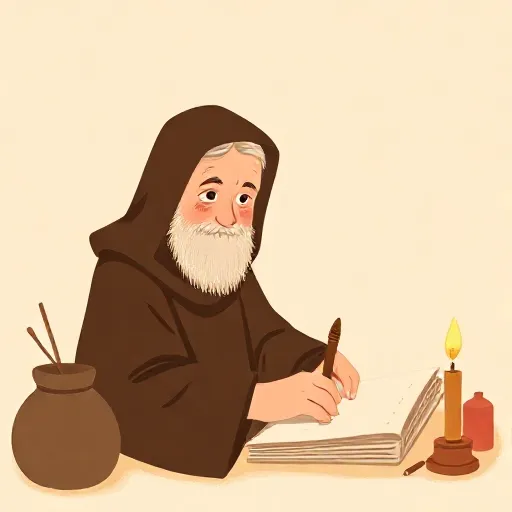
In the year 1078, a monk named Anselm (c. 1033–1109) sat in his small room at the Abbey of Bec in Normandy, staring at a candle. He wanted to prove that God exists — not by looking at the stars or the design of the world, but using nothing but reasoning and the meaning of words. He wrote his argument in a book called the Proslogion.
Anselm’s starting point is something almost anyone can do: think. He asks you to form a concept in your mind — “that than which no greater can be conceived.” In plain language, this means the greatest possible being, the most perfect thing you can imagine. He says that even a person who denies God’s existence (a “fool,” as the ancient psalm says) can understand this phrase when they hear it. So the greatest conceivable being exists in the understanding.
But does it exist in reality too? Anselm argues it must. Suppose it exists only in your mind. Then you could imagine an even greater being — one that exists both in the mind and in the real world. But that would be a being greater than the greatest conceivable being, which is impossible. Therefore, the greatest conceivable being must exist in reality. That being, Anselm says, is God.
The Fool Strikes Back: A Perfect Island Has to Exist Too?
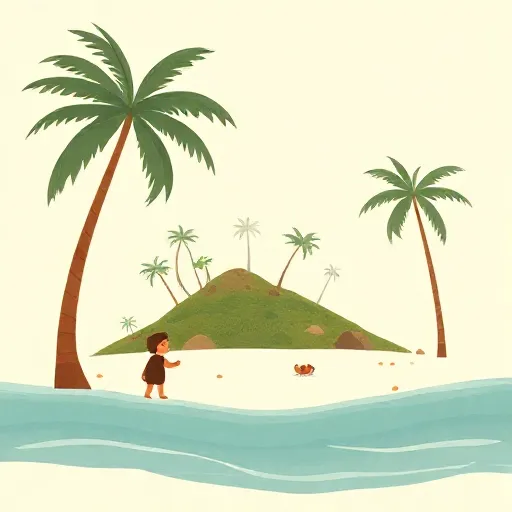
Anselm’s argument didn’t go unchallenged for long. A monk named Gaunilo (11th century) wrote a reply called On Behalf of the Fool. He used the same logical moves to reach an obviously ridiculous conclusion.
Gaunilo asked you to imagine “that island than which no greater island can be conceived” — the most perfect island possible. According to Anselm’s pattern, you understand those words, so the island exists in your understanding. If it existed only in the understanding, you could conceive of a greater island that also existed in reality. So the greatest island must exist in reality. But no one actually believes a perfect island is out there somewhere. Gaunilo thought this showed that Anselm’s argument was not a safe guide to what exists.
Defenders of Anselm reply that a “greatest being” is fundamentally different from a “greatest island.” They argue that greatness for a being might have a built-in ceiling — like perfect knowledge or power — while the greatness of an island can always be improved by adding another palm tree or a prettier beach. Still, Gaunilo’s parody raises a big question: is the move from thought to reality ever a free lunch?
Descartes Adds a New Twist: Perfection Includes Existence
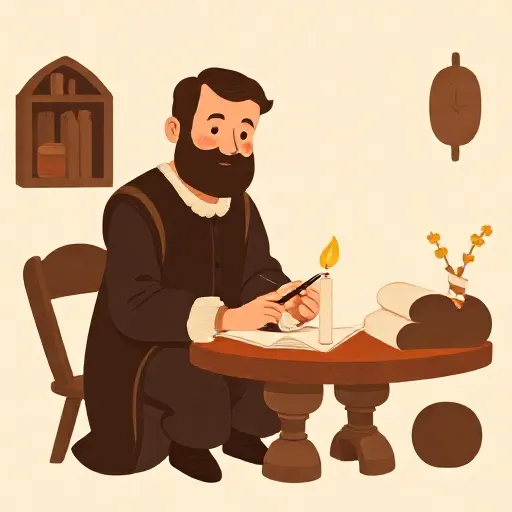
Centuries later, the French philosopher René Descartes (1596–1650) offered his own version of the argument. In his Meditations, Descartes starts from the concept of God as a being that has every perfection — a property that makes something good, complete, or excellent. He then claims that existence itself is a perfection. A being that doesn’t exist would lack something; a being that exists is greater. So God, defined as having all perfections, must include existence among those perfections — God must exist.
Descartes thought this reasoning was as solid as geometry. Just as the idea of a triangle necessarily includes having three angles that add up to 180 degrees, the idea of a supremely perfect being necessarily includes existence. Therefore, denying God’s existence would be like denying a triangle has three sides.
But many critics immediately spotted a problem. To accept that God has all perfections, you first have to accept that there is such a being to have them. An atheist or an agnostic doesn’t grant that a supremely perfect being exists in the first place. They can simply say the concept is empty. So the argument may be logically neat, but it doesn’t give a non-believer any new reason to believe. It seems to beg the question — assuming what it needs to prove.
Kant’s Insight: Existence Is Not a Trait
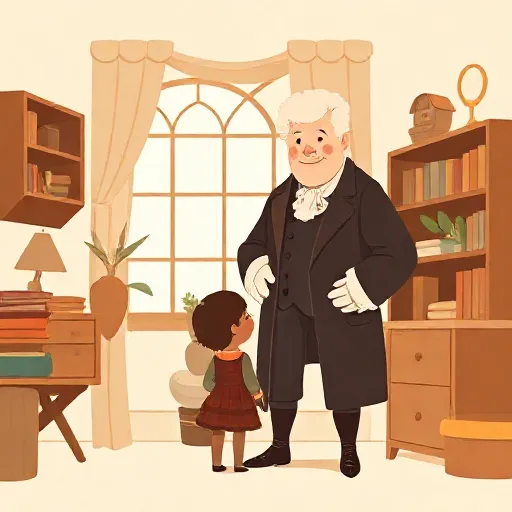
The most famous objection came from the German philosopher Immanuel Kant (1724–1804). Kant claimed that existence is not a real predicate — it isn’t a property you can add to a list, like “red” or “tall” or “having wings.”
Imagine you are thinking of a hundred gold coins. If you think of a hundred possible coins and a hundred actual coins sitting on a table, the concept “a hundred gold coins” is exactly the same in both thoughts. “Exists” doesn’t make the idea richer — it just says the idea is instantiated in reality. So when Descartes says existence is a perfection that makes a being greater, Kant would say he’s treating existence like a decoration on a crown, when it’s really the difference between having the crown at all or only a drawing of it. You can’t improve a concept by simply insisting it refers to something real.
For Kant, this mistake doomed not only Descartes’ version but any argument that tries to define something into existence.
Possible Worlds and the Trap of Symmetry
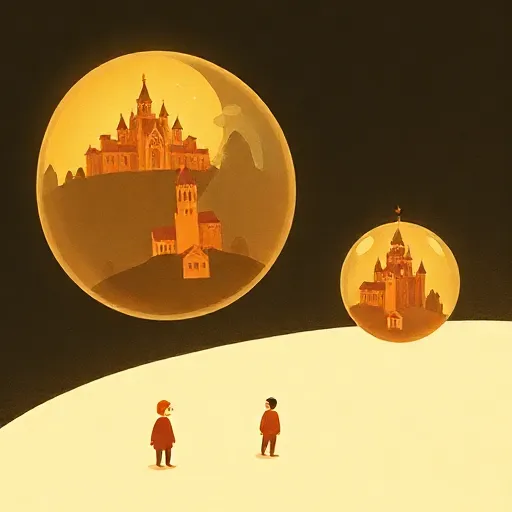
In the 20th and 21st centuries, some philosophers revived the ontological argument using modal logic — the logic of possibility and necessity. They imagine all the different ways the world could have been, called possible worlds. A being is necessary if it exists in every possible world, not just the actual one.
Alvin Plantinga (born 1932) and others built an argument like this:
- It is possible that a maximally great being exists.
- If a maximally great being exists in any possible world, it must exist in all possible worlds (that’s part of what maximal greatness means).
- Therefore, it exists in the actual world.
This looks like a real advance. But a problem called the symmetry problem won’t go away. You could just as easily run the argument in reverse:
1*. It is possible that no maximally great being exists. 2. (Same as above) If there is a maximally great being, it exists in all possible worlds. 3*. So if it’s possible that none exists, then necessarily none exists — and God doesn’t exist.
Both arguments use identical logic. If you don’t already believe in God, what reason do you have to prefer the first premise over the second? Most philosophers think that without a symmetry breaker — a convincing, independent reason to think a perfect being is possible in the first place — the modal argument gets you nowhere with an open-minded non-believer.
Why a 1,000-Year-Old Puzzle Still Matters

You might be wondering: if these arguments don’t convince people who start out unconvinced, why do philosophers still care? Because the ontological argument touches something deep about the limits of human thinking. It pushes us to ask: can pure logic ever reveal a new fact about the world? Or can it only unpack ideas we already accept?
Think about a time you tried to figure something out just by mulling it over — maybe whether a friend was upset with you, or whether a puzzle was solvable. You probably realized that thinking hard can clarify your ideas, but it rarely hands you new facts you didn’t already have tucked in your mind. The ontological argument tries to do the impossible: deductively prove a mind-boggling reality — a perfect being — starting from nothing but words. Even if you think it fails, watching brilliant minds attempt it for a thousand years is a lesson in both the power and the weakness of human reason.
And the mystery remains open. A small number of philosophers today still search for a version that finally works. They tweak the logic, refine the definitions, and wrestle with the symmetry problem. Meanwhile, critics keep inventing new parodies — like arguments for a perfect pizza or a maximally great movie — to keep the pressure on. For now, the puzzle stands unsolved: can you think something into existence? The answer tells you as much about the nature of thought as about God.
Think about it
- If you can imagine the “greatest possible pizza,” does that mean it must exist? Why or why not?
- Suppose a friend insists that logic proves dragons exist. What questions would you ask to test whether their argument is any good?
- Can you name something you once thought was real just because the idea made sense, but later found out wasn’t real at all? What convinced you to change your mind?