Can You Think a Perfect Being Into Existence? Descartes’ Bold Bet
A Stove, a Triangle, and a Bold Claim
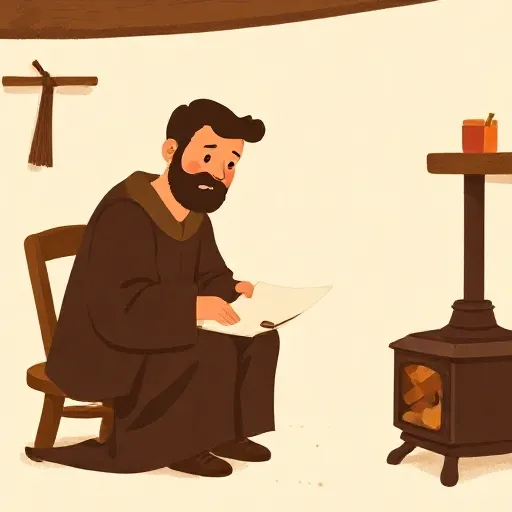
It is 1641. René Descartes (1596–1650), a French philosopher, is sitting alone by a stove in a small room. He has been training himself to doubt everything he can—his senses, his memories, even the world outside his window. But today he wants to build something solid, a piece of knowledge so certain that no one can shake it. And he thinks he has found it: a way to prove that God exists without ever stepping outside his own mind.
The argument grabs your attention because it sounds almost too neat. Descartes suggests that if you look carefully at your idea of a “supremely perfect being”—a being with every good-making feature you can think of—you will notice that necessary existence is tucked right inside that idea. Existence is one of the perfections, just like being all-powerful or all-knowing. And if you really understand that, he says, you cannot honestly picture God as not existing, any more than you can picture a triangle whose angles add up to something other than two right angles. This is the ontological argument, a proof that tries to move from the mere idea of God to the conclusion that God must be real.
The strangest part? Descartes does not think this is a long chain of reasoning like a math test. He calls the mind’s power to “see” this truth clear and distinct perception—a flash of understanding so bright that doubting it feels impossible. He sees the argument as a kind of mental shortcut, an inspection of an idea that reveals what it already contains.
Inside the Perfect Idea: Descartes’ Shortcut

Descartes actually offers more than one way to frame this insight, but he insists the real work happens in a single mental act. One version of the argument goes like this: Whatever I clearly and distinctly perceive to be contained in an idea of something is true of that thing. I clearly and distinctly perceive that necessary existence is contained in the idea of a supremely perfect being. Therefore, that being exists. The first premise is his famous rule for truth, which he had already defended in earlier meditations: a perfect God would not deceive us when we use our minds properly, so whatever we perceive with total clarity must be correct.
But Descartes knows most readers are used to formal arguments that look like cathedrals of logic. So he also offers a skin-and-bones version: I have an idea of a supremely perfect being, which by definition includes all perfections. Necessary existence is a perfection. Therefore, a supremely perfect being exists. The trick, according to him, is not to treat these sentences as a one-off proof. They are more like training wheels. A meditator who struggles to “see” that existence is part of the perfect-being package can first notice that the idea already bundles together every perfection. Trying to peel one out, he says, is like trying to think of a mountain without a valley—a contradiction in your own thoughts.
Once you really grasp that necessary existence is not an extra accessory but something baked into greatness itself, you no longer need the little argument. The truth becomes self-evident, something your own mind lights up with. Descartes compared it to geometry: some people spot a truth like “the hypotenuse faces the largest angle” right away; others need to work through the Pythagorean theorem first. Either way, the goal is the same flash of clear understanding.
Why Existence Isn’t Just Another Ingredient

To feel the weight of Descartes’ proposal, you need to know an older puzzle about essence and existence. For most things, you can describe their essence—what they are—without being sure they exist. You can list the essential features of a horse, or even a unicorn, without knowing if any real horses or unicorns are wandering the planet. The medieval philosopher Thomas Aquinas (1225–1274) and his followers argued that in every created thing, essence and existence are somehow distinct; a horse’s “what-ness” doesn’t guarantee that a horse is actually out in the field. The one exception, they thought, is God. God’s essence just is to exist.
Descartes takes this tradition in a surprising direction. He says that for any substance—God, a rock, your own mind—there is only a rational distinction between essence and existence. That means you can pull them apart in your thinking, by focusing on a thing’s definition while ignoring that it exists, but in reality they are exactly the same thing. A real horse is identical with its own existence. So far, it sounds like he has ruined his own argument: if every single thing contains existence in its idea, why can’t you produce an ontological argument for a perfect pizza?
Descartes’ answer is that there are different grades of existence. The idea of any finite thing contains only possible or contingent existence—the kind that depends on something else. A horse’s idea includes existence, but only the kind that says “it could exist if the right conditions are met.” The idea of God, by contrast, uniquely contains necessary existence, meaning existence that depends on nothing at all—a being that exists fully by its own power and could never not be. That, Descartes holds, is why you cannot multiply the ontological argument for islands or lions. Only the clear and distinct idea of a supremely perfect being reveals a reality that must be.
Objection! You Can’t Define Things Into Being

Almost as soon as Descartes published his Meditations, objectors pushed back. The theologian Johannes Caterus (17th century) voiced a concern that still feels powerful today: even if the concept of God includes existence, what forces that concept to match something in the real world? You can perfectly define an existing lion, but that doesn’t make a lion appear in your living room. The argument seems to leap from the mental world of ideas to the extra-mental world of rocks, trees, and stars.
Descartes leans on his rule for truth once more. He claims that whatever you clearly and distinctly perceive in an idea of a thing is true of that thing—not just true “in your head,” but true of the reality the idea represents. The rule acts like a bridge. If you genuinely, clearly see that necessary existence is woven into the idea of a perfect being, then a perfect being must exist. The trick, he adds, is that you cannot manufacture this clarity on demand. A lion’s nature is muddy and confused; you can’t clearly and distinctly perceive what it involves, so the bridge doesn’t hold. God’s idea, on the other hand, is innate and can be grasped with a pure, trained attention.
Marin Mersenne (1588–1648) and later Gottfried Wilhelm Leibniz (1646–1716) pressed further: even if the argument is logically consistent, you still need to show that a being with all perfections is possible—that the perfections aren’t secretly contradictory. After all, maybe being all-powerful clashes with being all-good in ways our finite minds miss. Descartes’ reply points to the simplicity of God. In his view, God’s attributes are not separate puzzle pieces you have to check; they are all one thing viewed from different angles. When you clearly perceive one perfection, you are already in touch with the whole being. That, he thinks, dispels the worry about hidden contradictions.
Kant’s Pouch of Coins: Is Existence Even a Property?
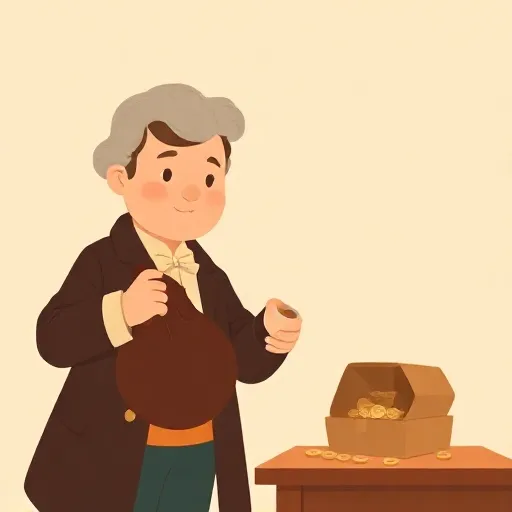
The most famous objection came a century after Descartes from Immanuel Kant (1724–1804), though an earlier version was already voiced by Pierre Gassendi (1592–1655). The complaint is that existence is not a predicate—not a real property that a thing can have or lack, like “red” or “tall.” Kant asked you to imagine a hundred real coins and a hundred possible coins. The concept is identical; existence doesn’t add a new feature to the mental picture. To say “God exists” is not to describe God’s nature further, but to assert that there is a real being answering to that concept.
Descartes might be less defenseless here than many textbooks assume. He actually agrees that, inside your mind, existence doesn’t add a new element to an idea. In fact, he says that every clear and distinct idea already includes existence—you can’t think of a thing without regarding it as existing in some mode. What matters for his argument is not that existence is an extra “attribute” stacked on top of the others, but that the grade of existence found in the idea of God is necessary, independent existence. That kind of existence is not a separable add-on; in reality, God simply is his own existence. The distinction we draw between a substance and its existence is, he says, only in our thought. So the ontological argument does not try to tack existence onto a list; it asks you to see that the idea of a perfect being cannot be conceived without independent reality.
Why It Still Matters: Thinking vs. Checking

Descartes’ ontological argument never won everyone over, and most philosophers today do not accept it as a proof of God’s existence. But the argument refuses to vanish because it forces us to ask a bigger question that matters every day: how do our concepts hook onto reality? When you solve a geometry problem in your head, you usually trust that the answer is true of actual shapes. When you reason that a thing must be a certain way because it’s part of its definition, you are doing something similar to what Descartes attempted—using pure thought to reach a conclusion about the world.
Not every attempt works. You cannot think a free lunch into the cafeteria by defining it as “the lunch that exists in my locker.” And yet we rely on the idea that some truths are known not by looking, but by understanding. Mathematicians speak of necessary truths that hold in every possible world. Scientists talk about laws of nature that couldn’t have been otherwise. Descartes’ bold bet—that the right kind of clear thinking can guarantee a reality beyond our minds—is still a live wire. It touches everything from the foundations of mathematics to the question of whether we can know anything for certain without getting up to check.
Think about it
- If you could imagine a perfect meal that “has to exist,” would that prove it’s waiting in the kitchen? Why or why not?
- Is there anything you can be completely certain exists without using your senses at all? How would you defend your answer to someone who disagrees?
- Suppose a friend claims that a perfect being must have every good quality, and that existence is one of those. What question would you ask to test their reasoning, without just saying “you’re wrong”?