If the Highest God Is Perfect, Who Made the World?
A God Too Pure to Touch the World
Picture a king so clean that he refuses to leave his palace. Even a speck of dust sends him to bathe for days. Now imagine a god that extreme — a god so perfectly good that he cannot even look at the lumpy, muddy stuff we call matter. If that sounds strange, you are already inside the mind of an ancient thinker named Numenius. Around 150 CE, he stared at the world — full of birth, decay, and trouble — and asked: how could a flawless, all‑good source be responsible for this? His solution was daring. The highest God, he argued, never touched matter at all. A lower god did the creating. This was not an insult to the highest God. It was a way of protecting his perfection. And it set off a philosophical fire that burned for centuries.
The Philosopher Who Wanted to Purify Plato

Numenius lived in the middle decades of the 100s CE, probably in Apamea, a city in Roman Syria, and later in Rome. He called himself a Platonist, a follower of Plato. But he also believed that Plato got his deepest wisdom from an even older source — Pythagoras, the legendary Greek thinker who treated numbers and music as the keys to reality. For Numenius, true philosophy was a secret revelation passed down from ancient sages: first Pythagoras, then Socrates, and then Plato, who wrote it all down (though not clearly enough, he complained). After Plato, things fell apart. The Academy, the school Plato founded, turned toward skepticism — the habit of doubting everything. Numenius wrote a furious book called On the Dissension of the Academics from Plato. He wanted to tear away everything that later teachers had added and return to the pure, original philosophy. He was so convinced that Plato was part of a larger divine story that he once remarked, “What is Plato but Moses speaking Attic Greek?” To him, the Jewish tradition and Greek philosophy were two versions of the same ancient truth. That openness made him unusually popular with early Christians, who later quoted him eagerly.
Why Matter Made Everything Messy
To understand Numenius’s big question, you need a piece of Plato’s picture of reality. Platonists divided the world into two levels. The upper level, the intelligible realm, is full of perfect, unchanging ideas — Forms like Justice, Beauty, or Circularity. They are what is most real. The lower level, the sensible world we see and touch, is a shifting shadow. Bodies change, rust, grow old, and die. Behind all those bodies, Numenius thought, lies matter — a stuff that has always existed, never created, with no shape or reason of its own. To him, matter was formless, wild, and the root cause of all disorder, badness, and ugliness. There was a real enemy in the universe, and it was matter itself. The puzzle was sharp: if the highest God is pure goodness, how could he be the one who reaches down, grabs chaotic matter, and shapes it into this world of pleasure and pain? Wouldn’t that make him dirty? Numenius’s answer was simple: he couldn’t — and he didn’t.
The Answer: A Divine Ladder

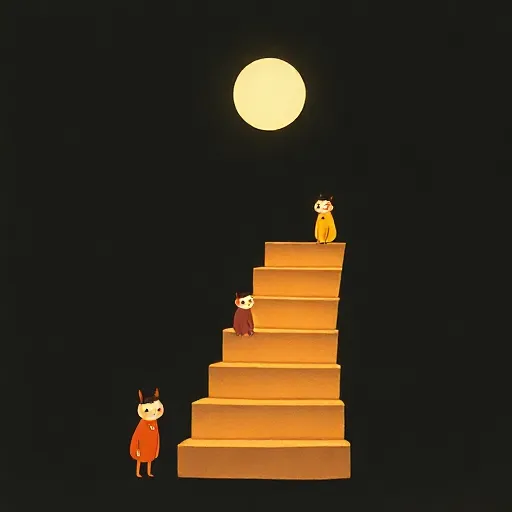
Numenius built a ladder of three divine principles. At the very top stands the first God, which he called the Good or the first Intellect. This God is absolute goodness, pure being, and does absolutely nothing. He rests alone, unaware of the messy world below. Because he is utterly simple and still, no disorder can touch him. The second God is the demiurge, a divine craftsman. This second intellect gazes at the first God and receives his goodness, like a moon reflecting sunlight. Inside himself, the demiurge holds all the perfect Forms — the blueprints for everything that could exist. He wants to create, to share order and goodness. But the moment he tries to shape formless matter, something dramatic happens. Matter is so chaotic that it splits the demiurge in two. One part stays still, continuing to contemplate the perfect Forms. The other part, the third God or world‑soul, actually rolls up its sleeves and puts the Forms into matter, making the ordered universe we know. Think of an architect who designs a whole city (the second God) but then has to become the builder who plunges his hands into wet cement (the third God). The architect stays clean; the builder gets messy. That way, the highest God remains untouched, but the world still gets built — and because it is built, it is good. Some scholars debate whether Numenius really meant three separate beings or just two that split. But his core idea was clear: the summit of reality never gets its hands dirty.
Our Souls Fell from the Stars
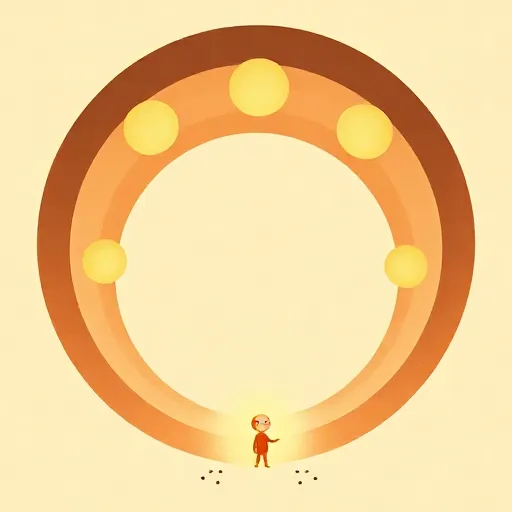
Numenius didn’t stop with gods and matter. He also had a dramatic story about human souls. Every human soul, he said, starts as a pure spark of intellect — a little piece of that divine mind. But to live in a body on Earth, the soul must descend. It passes through the seven planets (the Moon, Mercury, Venus, the Sun, Mars, Jupiter, and Saturn). At each stage, the soul picks up new capacities — desire, imagination, the power of speech — but also a coating of sticky, astral matter. By the time you are born, you are not just a pure intellect. You are weighed down with layers of non‑rational stuff that cause bad impulses and confusion. In Numenius’s eyes, that is why we struggle: matter has latched onto us. The rational part of the soul — the intellect — is immortal. After death, it sheds the extra layers, returns to its starry home, and lives on. Some believed he even said all souls could be reborn, sometimes into animals if a life was especially bad. It was a cosmic journey from purity, through mess, and — with luck — back to purity again.
The Puzzle That Never Went Away

Numenius’s ideas spread quickly, stirring both admiration and controversy. The great philosopher Plotinus (204/5–270 CE) was so deeply influenced that his students had to defend him against charges of copying Numenius. Meanwhile, early Christian thinkers like Origen (c. 185–254) and Eusebius (c. 260–340) loved Numenius’s ladder of gods because it looked a bit like the Christian Trinity — Father, Son, and Spirit. His claim that Plato was just “Moses speaking Attic Greek” gave Christians a way to show that their faith was not out of step with the best ancient thought. But the deepest mark Numenius left was a question that refuses to go away: If there is a perfect source of everything, why is the world so tangled and messy? His answer — push the perfect source far away and let a lower creator take the blame for the dirt — was one of the boldest ever attempted. Today, people still wrestle with the same puzzle. Next time you stub your toe, watch something beautiful crumble, or just wonder why life is so hard, you are standing exactly where Numenius stood: in the gap between perfection and the mess in front of you.
Think about it
- If you believed a perfect being made everything, would every flaw in the world need a special explanation? Why might someone say yes, and why might someone say no?
- Numenius thought everything bad comes from chaotic physical stuff (matter). Can you think of something bad that does not involve physical stuff — like a lie or a broken promise? Where would that badness come from?
- If the highest God never directly touches the world, does that make it harder to feel close to that God? Or could it actually feel safer that way?