
Can a Set Belong to Itself? The Fight Over Circular Sets
A stream that points to itself

Imagine a never-ending list of numbers. We call it a stream. The first number is its head, and the rest of the stream — after you remove the head — is the tail. So a stream is just a pair: ⟨head, tail⟩. Now consider this stream: its head is 0, and its tail is the very same stream. In symbols, s = ⟨0, s⟩. If you keep looking at the tail, you get 0,0,0,… forever.
Does s actually exist? On the surface it seems harmless. But in the most common kind of set theory, a stream defined that way is impossible. The problem is that a stream is made of pairs, and pairs are built from sets — and the standard rules of sets say you can’t have a chain of membership that loops back on itself. So s cannot be a set at all, unless we work around the definition.
Mathematicians often do work around it. They say a stream is really a function from the natural numbers to numbers — in this case the function that always returns 0. That trick banishes the circle, but it also feels like cheating. You wanted a pair that directly contains itself, not an infinite table. The question of whether s can be a real set — and whether a set can contain itself — leads to a real mathematical fight.
The no-self-reference rule

Most mathematicians work in a theory called ZFC (Zermelo–Fraenkel set theory with the Axiom of Choice). One of its rules is the Foundation Axiom (FA). It says that you cannot have an endless chain where each set belongs to the previous one — like a staircase that descends forever. In symbols, you can never find sets x₁ ∋ x₂ ∋ x₃ ∋ … that go on infinitely. In particular, no set can be a member of itself, because then you’d have x ∋ x ∋ x ∋ … forever.
Why would anyone accept such a rule? Many philosophers and mathematicians think of sets as being built in stages. You start with the empty set, ∅. Then you form all sets from what you already have. At the next stage you get new sets, and so on, climbing through the ordinals — just as you might count from 0 upward. This is called the iterative conception of sets. In this picture, every set appears at some stage, and everything inside it shows up earlier. A set that contains itself would need to exist before its own members, which makes no sense in a bottom‑up universe.
The Foundation Axiom makes this picture precise. It bans non‑wellfounded sets — that is, sets that fail to be grounded in the empty set. In the world of FA, the stream s from the last section simply does not exist as a pair. Neither does Ω = {Ω}, the most famous self‑containing set. So if you want circles, you have to break the rule.
A different rule: the Anti‑Foundation Axiom

In 1983, mathematicians Marco Forti and Furio Honsell studied axioms that deliberately flip the Foundation Axiom on its head. One of their ideas, later called the Anti‑Foundation Axiom (AFA), says that every picture of membership — every graph where arrows point from a set to its members — can be turned into a real set. This is the coiterative way of thinking: you don’t build sets from the bottom; you describe their structure and declare that they exist.
How does this work? Think of a graph, a collection of points with arrows between them. We want to turn each point into a set so that the set’s members are exactly the sets that its arrows point to. That transformation is called a decoration. For example, a single point with an arrow looping back to itself decorates to Ω = {Ω}. Under FA no decoration exists for that loop; under AFA there is exactly one, and Ω is well‑behaved — you can do mathematics with it.
AFA was championed by the logician Peter Aczel in a 1988 book. He showed that replacing FA with AFA leaves almost all ordinary mathematics untouched, but it gives you a whole new universe where streams, infinite trees, and other circular objects can be taken at face value. Instead of pretending a stream is a function, you can accept that s = ⟨0, s⟩ is a genuine set, a real pair whose second component is itself. The theory that uses AFA instead of FA is called ZFA.
Top‑down vs. bottom‑up thinking
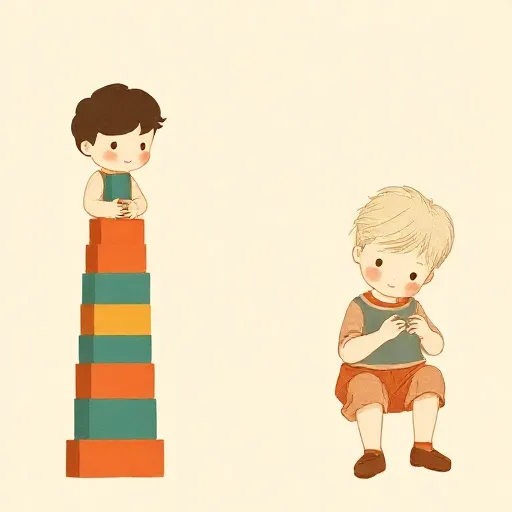
The clash between FA and AFA isn’t just about technical details. It reflects two grand styles of thinking. The iterative conception is bottom‑up: you start with the simplest objects and assemble them into larger and larger sets. The coiterative conception is top‑down: you define a system of equations and then solve for the objects that satisfy them, even if those objects contain circles.
This is like the difference between actually stacking blocks and describing a structure with a blueprint that already contains a little picture of the whole. In set theory, the bottom‑up approach feels safe and avoids paradoxes like Russell’s Paradox. The top‑down approach feels bolder — it says that if a definition is clear and consistent, the object should be allowed, even if it mentions itself.
AFA forces us to see that the top‑down picture can be made mathematically rigorous. The axiom tells us that every system of set equations has a unique solution. For instance, the equation x = {x} has a solution in ZFA — Ω — whereas in standard ZFC it has none. So the choice of axiom is really a choice about what kind of universe of sets you want to live in.
Why it still matters: truth and circles

You might wonder: who cares whether Ω exists? As it turns out, allowing circular sets helps with genuine puzzles. The philosopher Jon Barwise and logician John Etchemendy used hypersets in their 1987 book The Liar to study sentences like “This sentence is false” — a statement that, if true, says it’s false. Such self‑referential sentences have tied philosophers in knots for centuries. By modeling propositions as circular sets, Barwise and Etchemendy offered a new way to think about truth without having to climb an infinite ladder of statements.
Circular sets also appear in computer science, when you model systems that chat back and forth or data streams that never end. The top‑down approach gives designers a natural language: they can write down equations and let the math figure out the solutions. So even if you never leave the familiar world of standard set theory, the ideas from ZFA have shaped how people solve real problems.
The debate over circular sets is a reminder that mathematics is not written in stone. The rules you choose shape what you can say. Sometimes, to make sense of a question — whether it’s about an endless list or a sentence that mirrors itself — you might need to let a set point to itself.
Think about it
- If a set can contain itself, could there be a set of all sets? What would that mean?
- Does it feel more natural to you to build everything from simple pieces or to describe a pattern and let the whole exist? Why?
- If mathematicians can change the rules, does that make math less certain or more creative?