
Did Three Poets Invent a Whole Philosophy of Blackness?
The Spark in Paris: Three Students and a Word That Fought Back
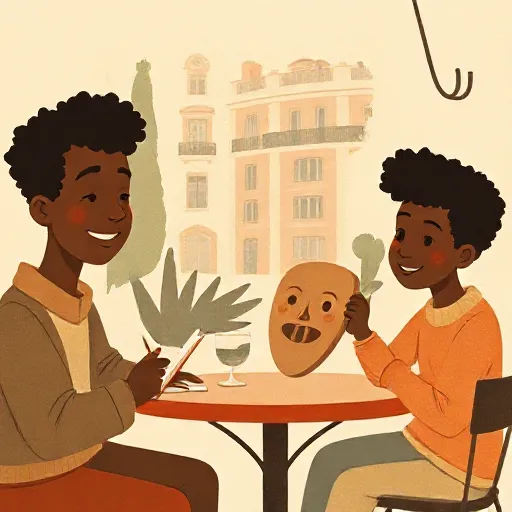
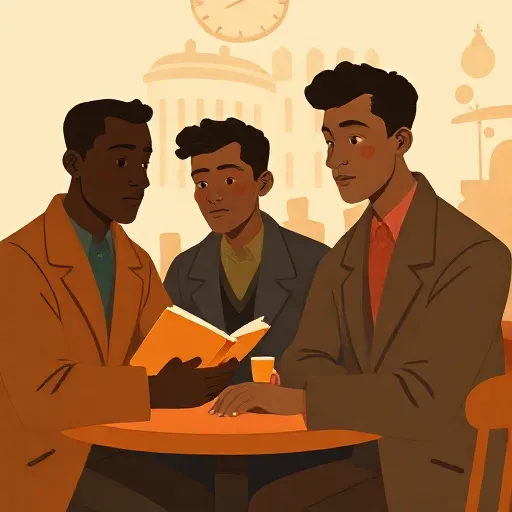
In 1931, a nineteen-year-old from Martinique named Aimé Césaire (1913–2008) arrived at a famous high school in Paris. On his first day he met a Senegalese student, Léopold Sédar Senghor (1906–2001), who had already been there for three years. Césaire later described it as friendship at first sight — and the meeting of Africa with the African diaspora. Soon they became a trio with another friend from French Guiana, the poet Léon Gontran Damas (1912–1978). All three were colonial subjects. The French empire told them their ancestors had no civilization, that their cultures were “pagan” and backward, that they needed France to become fully human. But in Paris they also discovered the Harlem Renaissance, a burst of Black American literature and art that shouted a different message: Black is beautiful, and Black culture matters.
Césaire, Senghor, and Damas set out to turn the ugliest racial slur into a battle cry. Around 1934–1935 they founded a student journal and Césaire coined the term Négritude. He took the French word nègre — an insult thrown at Black people — and spun it into a proud, defiant concept. The word was meant to irritate, to provoke, to say: “I, Negro, exist.”
A Poetic Scream or a Real Philosophy?

At first, Négritude was above all a poetry of revolt. Césaire and Damas wrote volcanic verses that smashed together French words and African rhythms. They wanted to make language itself feel the weight of slavery, colonization, and anger. In a 1978 speech, Césaire called it “a violent and staccato voice” that declared “for the first time: ‘I, Negro.’” It was a voice of resentment — but also a voice of freedom and recovered identity.
But from the beginning, a question hung in the air: was Négritude only a poetic scream, or did it contain a whole philosophy? Césaire and Damas leaned toward the scream. Senghor, however, insisted that Négritude was more. He called it “the sum total of the values of civilization of the Black World” — something like a complete system of thought about what exists, what is beautiful, and how we know things. So the movement was born with a tension: a passionate revolt on one side, a search for a distinctive Black way of being-in-the-world on the other.
The Kiss of Death: Sartre Says “Beautiful, But Fleeting”

In 1948 Senghor published an anthology of new Black and Malagasy poetry in French. The preface was written by the famous philosopher Jean-Paul Sartre (1905–1980). His essay, titled Black Orpheus, gave Négritude worldwide attention — and a backhanded embrace. Sartre compared the poets to Orpheus, the Greek musician whose song could conjure his lost wife Eurydice from the underworld, but with one cruel rule: she would forever vanish if he looked back.
Sartre argued that Négritude was a powerful myth created by poetry, an “anti-racist racism” that used Blackness as a weapon against white supremacy. He praised how the poets twisted the French language until it sounded foreign and explosive. But in the end, he said, Négritude was just a song of a particular race, a “subjective” identity. Only the universal struggle of the working class — the proletariat — could bring true liberation. Négritude had to die, like Eurydice, for history to move forward. Senghor and Césaire felt they had been kissed to death: praised into irrelevance.
Senghor’s Big Idea: Life Forces, Rhythm, and a Different Way of Knowing
Senghor refused to let Négritude be just a myth. He argued that African cultures share a deep ontology — a theory about what really exists. The world, he said, is made not of static things but of vital forces, a living energy that flows through gods, ancestors, humans, animals, plants, and even minerals. To exist is to be a force; to live well is to increase and share that force. This idea, which Senghor found partly in a book by the Belgian missionary Placide Tempels about Bantu philosophy, was at the center of Négritude’s content.
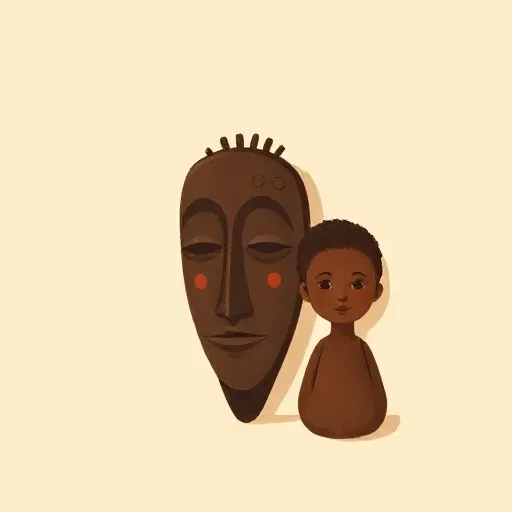
Césaire, however, reacted with sarcasm. He thought Tempels’ version of Bantu ontology was being used to make colonialism seem natural — as if Black people only cared about spiritual forces and not about decent wages or freedom. Still, Senghor pressed on. For him, African art was the purest language of vital forces. Masks and sculptures didn’t copy appearances; they expressed the hidden rhythms of life. Rhythm, Senghor wrote, is “the architecture of being,” the pulse that seizes you through the senses and connects you to the spirituality of an object.
This led to his most famous and controversial claim: “Emotion is Negro, as reason is Hellenic.” Senghor was not saying Black people can’t reason. He was pointing to two different styles of knowing. The ancient Greeks, he thought, perfected analytical reason, the kind that separates subject from object. African art and thought, on the other hand, showed a reason‑that‑embraces, a knowing that is immediate, emotional, and intuitive — what the philosopher Henri Bergson called “intuition.” For Senghor, emotion was not the opposite of thinking; it was a creative, supra‑intellectual force that gives birth to new ideas. So an African epistemology — a way of knowing — was really an extension of its aesthetics: art as the deepest kind of knowledge.
From Revolt to Politics: What Comes After the Cry?
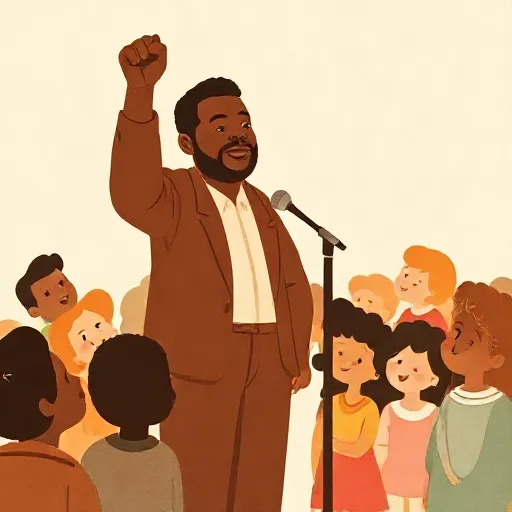
Négritude was never just about poetry. In 1956, Césaire wrote a fiery letter resigning from the French Communist Party. For over ten years he had been a communist mayor and a member of the French parliament. Now he argued that Black people could not simply melt into a universal working‑class struggle. Their history of slavery, deportation, and racism created a unique situation that no one else could understand. He demanded an “African variety of communism” — a politics at the service of Black peoples, not the other way around.
Senghor, who became the first president of independent Senegal, developed an “African socialism” based on a re‑reading of the philosopher Karl Marx. He took from the young Marx a focus on alienation — the feeling of being cut off from your own life force, trapped in a world that treats you like a thing. Liberation, Senghor said, meant restoring the full creative, artistic human being. He believed traditional African societies already lived by communal values that could grow into a modern socialism without having to copy Europe’s industrial path.
Then a new challenge arose. In the Caribbean, a movement called créolité declared that they were neither African nor European but a continuously mixed, hybrid people. They criticized Négritude for being too fixated on a single African root. Yet Senghor himself had always spoken of métissage (mixing) as central to his thought. He once enrolled the Spanish painter Picasso and the French poet Rimbaud under the banner of Négritude, showing that you did not have to be Black to be a “nègre” in spirit. At its most daring, Négritude was not an essence but a fight, a permanent refusal of racism.
Why It Still Matters: Who Gets to Belong?

For decades, critics have called Négritude an outdated essentialism. The idea of a single Black identity, they say, was a necessary weapon against colonial humiliation but has nothing to say in our mixed, globalized world. Yet that dismissal may miss something important. Césaire insisted that Négritude was not a prison of identity but a living heritage — something you can rework, reject, or transform, as long as you never abandon the fight against the real enemy: racism in all its seats. The same question Négritude raised echoes in today’s debates about who gets to call themselves Black, who counts as African, and whether solidarity across oceans is still possible.
Next time you hear someone say “you’re not really [fill in the blank] enough,” or see artists using old insults to build new pride, you’re stepping into the conversation that three students started in a Paris café. They showed that a word can be a weapon and a home, a poem and a philosophy. What you build with the pieces of your own history — that might be the deepest answer Négritude still offers.
Think about it
- If a group reclaims a hurtful word and fills it with pride, does that change the word’s power, or does it keep the original pain alive?
- Can a poem or a painting make someone feel more at home in their own skin? How?
- Who gets to decide what “Blackness” means — the individual, the community, or neither?