Why 'Not' Is the Trickiest Little Word in the World
A tiny word that changes everything

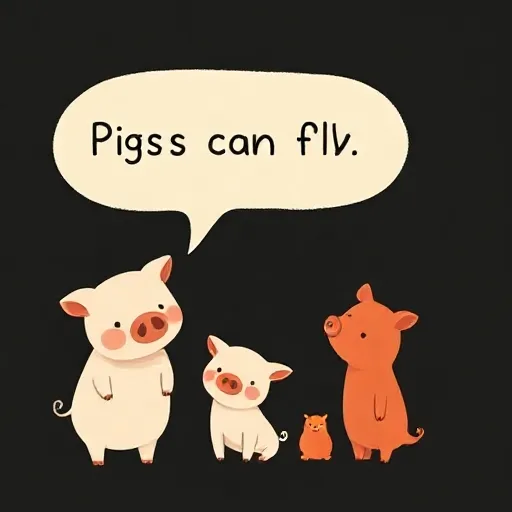
Imagine a friend tells you, “I think pigs can fly.” You answer, “I don’t think pigs can fly.” Your reply feels different from a simple statement. It’s not just offering a neutral fact — it’s pushing back against an idea that’s already been put in the air. That’s the hidden power of negation.
Negation is the little word “not” (or “no,” “never,” “nobody”) that turns a claim into its opposite. It’s part of every human language, but no animal communication system has anything quite like it. Yet as soon as we look closely, the simplicity shatters. From Plato to modern logic, thinkers have noticed that negative sentences are lopsided: they are harder to process, less informative, and strangely dependent on positive ones. The ancient Greek philosopher Plato (c. 428–347 BCE) wrote that negative sentences are less valuable, less specific, and less informative than affirmative ones. His student Aristotle (384–322 BCE) agreed: “The affirmative proposition is prior to and better known than the negative.”
Why would that be? Think of a piece of information you already know: “Paris is the capital of France.” That’s a solid, specific fact. Now compare it with “Paris isn’t the capital of Spain.” That second fact is true, but it’s thin — it tells you almost nothing about Paris. It gains whatever worth it has by correcting a possible mistake. In short, negation usually lives in the shadow of the positive statement it denies.
Philosophers and psychologists have measured this asymmetry. Negative sentences take longer to read, cause more errors, and are harder to remember than positive ones. Every known language has special markers for negation, but almost none has a marker that means “this is definitely positive.” The very shape of language seems to treat affirmation as the default and negation as the extra, heavier move.
What are you really denying?

If negation is naturally weaker, what good is it? Why would every language bother with it? The answer lies in what the Danish linguist Otto Jespersen (1860–1943) called its “chief use.” Most of the time, we use negation not to announce brand-new facts but to deny a proposition that is already floating around in the conversation — perhaps something someone just said, or something you secretly suspected.
Imagine you’re waiting with a friend for another friend to arrive. Your friend says, “I think she’s not coming.” You haven’t said a word, but the idea of her showing up was already in both your minds as a shared expectation. Negation bursts that bubble. As the philosopher P.F. Strawson (1919–2006) put it, the “standard and primary use” of negation is directed at a proposition that is already in or can be accommodated by the discourse.
This is why “My wife is not pregnant” is a weird thing to blurt out at a party unless someone first suggested she might be. The negative sentence only makes sense if the positive one was in the air. Psychologists have shown that people process a sentence like “The whale is not a fish” much faster than “The whale is not a bird” — because the first cancels a plausible mistake that a listener might be entertaining, while the second clashes with no obvious expectation.
This social, dialogue-driven nature of negation creates a deep puzzle. If a positive statement points to some real state of affairs in the world (a fact), what does a negative statement point to? Where is the “negative fact” that makes “The cat is not on the mat” true? Some philosophers have concluded that negation is not a reflection of reality at all, but a kind of mental move — an admission that we expected something and found it missing.
Contradiction vs. “kinda the opposite”

Logic textbooks teach that negation is simple: if a statement is true, its negation is false; if it’s false, its negation is true. This is contradictory negation — it splits all possibilities so that exactly one of the pair must be true, and the other false.
But ordinary language often marches to a different beat. Consider the word “unhappy.” It doesn’t mean merely “not happy.” Someone can be neither happy nor unhappy — just okay. “Unhappy” is a contrary of “happy”: the two cannot both be true at the same time, but they can both be false, allowing a middle ground. Aristotle already noticed this distinction. He called contradictory opposites (wise / not wise) a different animal from contrary opposites (wise / unwise). Contraries leave room for an “in-between.”
This tendency for “not” to slide into contrary territory is everywhere. If you say “I don’t like him,” you usually communicate something stronger than a mere absence of liking — you hint at dislike. The phrase “not uncommon” doesn’t mean “common”; it means something weaker, like “happens sometimes.” When a parent says “I don’t think it will rain,” they are almost always understood as meaning “I think it won’t rain,” which is a stronger claim. This habit, called neg-raising, has been noticed since at least the 12th century and appears in languages across the world.
Even double negation, which in logic cancels out (not not A equals A), behaves strangely in real speech. “I’m not not happy” is not the same as “I’m happy”; it’s more tentative, a reluctant admission. The double-wrap of negation, as the logician Gottlob Frege (1848–1925) noted, doesn’t change the underlying truth, but it certainly changes the feeling.
The king who isn’t there

There is a famous puzzle that shows just how tangly negation becomes. Consider the sentence “The present king of France is bald.” France is a republic; there is no king. So is that sentence false? If it’s false, then its negation — “The present king of France is not bald” — should be true. But that seems absurd. How can a sentence about a nonexistent person be true?
The British philosopher Bertrand Russell (1872–1970) offered a clever solution. He said that “The king of France is not bald” is secretly ambiguous. Read one way (narrow-scope negation), the sentence still assumes there is a king and says he isn’t bald — it’s simply false, because there is no such king. Read another way (wide-scope negation), the sentence denies the whole idea that there exists a unique king who is bald — and that claim is true, because there simply is no king at all. Russell’s analysis saved the law of excluded middle by unpacking hidden logical structure.
Not everyone agreed. Strawson argued that Russell missed the ordinary way we use language. When someone says “The king of France is not bald,” they are not making a hidden logical claim about existence; they are simply presupposing, for the sake of the conversation, that there is a king, and then denying his baldness. If the presupposition fails, the whole statement is neither true nor false — it’s a misfire, like asking “Have you stopped beating your dog?” when you never owned a dog. The deep disagreement between Russell and Strawson shows that even the smallest “not” forces us to ask what a sentence assumes before it even gets started.
Why “any” needs a “not” to feel at home

Try this: “I have ever eaten any kumquats at all.” The sentence feels broken, as if it’s missing something. Now add a “not”: “I haven’t ever eaten any kumquats at all.” Suddenly it flows. Words like ever, any, and phrases like lift a finger are negative polarity items — they only feel at home inside the special environment created by negation (or certain other negative-like contexts, such as “few” or “doubt”).
Why? Modern linguistics suggests that negation creates a downward entailing context. In an ordinary positive sentence like “I eat fruit,” if you substitute a more specific category (kumquats), the statement might become false. But in a negative sentence like “I don’t eat fruit,” the reverse holds: if I don’t eat any fruit, then I certainly don’t eat kumquats. Negation flips the direction of logical inference, and many words are sensitive to that flip. It’s as if negation builds a little shadowy zone in the sentence, and certain rare words — like any and ever — can only live there. This shows that grammar itself is shaped by the logic of negation.
Why it still matters

Negation pops up every day in ways that are far from simple. “I’m not saying you’re wrong” often means exactly that you’re wrong. “I couldn’t care less” and its sarcastic twin “I could care less” both signal the same indifference (and trip up logic). A friend who says “I don’t think we should see that movie” is really saying “I think we shouldn’t,” even though those two statements aren’t logically the same. And every time you pause to decide whether “not bad” means “good” or just “okay,” you’re negotiating contrary versus contradictory opposition.
The philosophical puzzles about negation still ripple through linguistics, psychology, and computer science. Understanding how “not” works helps us design artificial intelligence that can handle real human language, and it shines a light on the way our minds build meaning. More personally, paying attention to the many flavors of “not” can make you a sharper listener. Sometimes the most important thing someone tells you is what they choose to deny — and what they leave unsaid.
Think about it
- If a sentence like “I am not unhappy” is weaker than “I am happy,” can you think of a real-life situation where you would deliberately use the weaker phrase? What would it signal that the stronger one wouldn’t?
- If there is no present king of France, is the sentence “The king of France is not bald” true, false, or neither? How would you decide?
- The next time you hear someone say “I don’t think X” (where X is their opinion), try to decide: are they really reporting a lack of thought, or are they actually thinking the opposite? How could you tell one way or the other?