Can a Pot Appear Out of Nowhere? The Indian Fight Over Causes
No Causes Needed: The Cārvāka Radicals

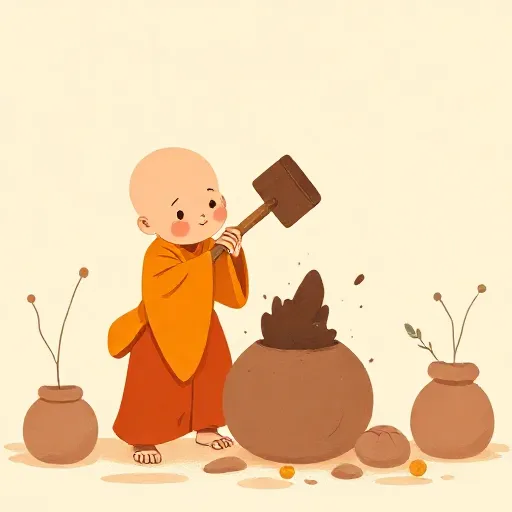
Around the year 1000 CE, a sharp Nyāya philosopher named Udayana (c. 975–1050 CE) posed a riddle. Imagine you see a clay pot appear right in front of you. No potter’s wheel, no hands. It just pops into being. Would you believe that a cause was needed — or could the pot simply happen? For Udayana, the answer was obvious: every new thing must have a cause. But a group of radical materialists known as the Cārvākas shook their heads and said, “No. Things can happen by their own nature.”
The Cārvākas were the most uncompromising naturalists in ancient India. They rejected anything you cannot see, hear, touch, taste, or smell — gods, souls, invisible forces, even atoms too small to perceive. For them, the world is made only of the four gross elements: earth, water, fire, and air. Living bodies and even consciousness arise when those elements mix in the right way, just as red colour appears when you chew betel nut and other ingredients that are not themselves red. The Cārvākas held a doctrine called svabhāvavāda — the view that each thing’s own nature (svabhāva) determines what it does. Fire is hot because that is its svabhāva. Sugarcane is sweet for the same reason. And just as a thorn is naturally sharp, a pot might simply exist because its nature is to be a pot. No potter, no cause — the very idea of a cause, they said, is something we never actually perceive.
Udayana challenged this with relentless logic. If an effect does not depend on a cause, he argued, then it could appear at any time, or never, or always. A pot that needs no potter could pop up right now in your bedroom — or on the moon. But pots appear only when a potter works clay. The fact that they happen only at certain moments proves they depend on something. The Cārvākas pushed back: the pot’s own occasional appearance is simply part of its nature. You don’t need a separate cause; the thing itself is enough.
Behind the argument about the pot was a deeper question: what does it take to explain the world without reaching for magic or gods? All the debaters agreed that supernatural wish-fulfillment is not a good explanation. They disagreed violently about what should count as a “natural” explanation.
Tiny Building Blocks: The Nyāya-Vaiśeṣika Atomists

The Nyāya and Vaiśeṣika thinkers took a different path. They insisted that every event must have a cause, and they built an entire picture of nature out of tiny, indestructible particles — atoms (paramāṇus). Atoms are eternal, round, indivisible, and impossibly small. They come in four kinds: earth, water, fire, and air. An earth atom has odour, a water atom has taste, a fire atom has colour, and an air atom has touch. None of them is visible on its own.
Nyāya-Vaiśeṣika philosophers offered a careful argument for atoms. Every visible thing is made of parts, they said. Even the tiniest speck floating in a sunbeam must have parts, because it is visible. But if you keep dividing a physical thing forever, you would eventually make a mustard seed and a mountain equal — both would have infinitely many parts, so neither would be bigger. That is absurd. Therefore, division must stop at indivisible, imperceptible particles: atoms.
Atoms combine in a fixed recipe. Two atoms of the same type link to form a dyad (dyaṇuka). Three dyads then bind into a triad (tryaṇuka) — and the triad is the smallest object you can see. To explain why triads are visible when atoms and dyads are not, the Nyāya-Vaiśeṣikas made a surprising move: the largeness of a triad is caused by its number of parts, not by the size of its parts. Triads then combine in different numbers to build up all the objects of the world, from grains of rice to elephants.
A puzzle remained: what pushes the atoms together in the first place? Here the Nyāya-Vaiśeṣikas introduced an unseen force — adṛṣṭa — the accumulated merit and demerit of individual selves. They also admitted God’s will as an efficient cause. This might sound like sneaking in the supernatural, but they saw it differently. The unseen moral force, they thought, is still part of a single causal chain that runs through the whole universe. Nature, for them, includes both matter and the invisible moral laws that steer it. That wider view of nature is a key feature of classical Indian naturalism.
Smooth Meets Rough: How Jainas Glued Atoms Together

Jaina philosophers also built the world from atoms — material particles called pudgalas. But they tried to explain atomic combination using only observable, everyday forces, with no divine push. Their central insight came from watching wet barley grains clump together into a single lump. When something smooth and viscous touches something rough and dry, they stick. From this, the Jainas formulated rules of bonding.
Atoms must be opposite in nature to combine: a smooth (snigdha) atom binds with a rough (rukṣa) atom. The opposing properties must be strong enough, and the intensity matters — an atom with very high smoothness can transform a less smooth atom, pulling it in. The result is a new lump with a single quality, not just a mixture like black-and-white yarn woven side by side. Modern interpreters have even compared this to positive and negative electrical charges, though the Jainas were imagining something simpler: just the sticky, grabby qualities of matter.
This view made nature self-organizing. No unseen adṛṣṭa and no god needed to glue atoms together — the atoms carry their own bonding power. A later Buddhist atomist, Śubhagupta (c. 8th century CE), likewise suggested that atoms have an inherent potency (dravyaśakti) that draws them near and holds them, rather like a mantra drawing a snake. The aggregates then influence one another, and new properties emerge that were not present in the single atoms — much as carbon compounds can transform into diamond, suddenly too hard to break apart. For these thinkers, naturalism meant giving atoms their own internal energy, making external commanders unnecessary.
The Universe as a Living Plant: Sāṃkhya’s Evolving Nature

Not everyone was an atomist. The Sāṃkhya school offered a rival vision. Instead of tiny particles assembling from the bottom up, they said the entire universe unfolds from a single, ever-active Ur-Nature — prakṛti. Prakṛti is an immense, uncreated whole, woven from three strands or guṇas: sattva (the principle of lightness, clarity, and pleasure), rajas (the principle of energy, action, and pain), and tamas (the principle of heaviness, rest, and indifference). Everything you experience — a chair, a thought, a thunderstorm — is just a particular knot of these three threads.
Sāṃkhya’s theory of causation was the opposite of the Nyāya view. They held that an effect already exists in its cause in a hidden form — a view called satkāryavāda. A statue, they would say, already lies inside the block of marble; the sculptor just reveals it. Their main argument was that if the statue were genuinely nonexistent before, no sculptor could ever bring it into being, because something cannot come from nothing. If there were no definite relation between seed and sprout, then a seed might just as well grow a pot as a tree. The world works because effects are lying latent in their causes, waiting to be made manifest.
Prakṛti evolves step by step. First cosmic intelligence appears, then the sense of “I,” then the organs of perception and action, then subtle elements, and finally the gross elements — space, air, fire, water, and earth. This whole process happens, they taught, for the sake of the pure self (puruṣa), which is a separate, conscious witness that never actually changes. The Sāṃkhya philosophers compared prakṛti to a non-sentient cow whose milk naturally flows for the nourishment of the calf. Just as rain clouds yield rain for the benefit of life without planning it, Ur-Nature unfolds to offer experience and, eventually, freedom to the self. This is a natural directedness — a proto-naturalistic teleology — not a conscious divine plan.
Karma: The Invisible Force That Ties the World Together

All these Indian schools shared one profound conviction: the universe is law-governed. That law is karma. Good actions produce good results; bad actions produce bad results. Every human being reaps exactly the fruit of what they have sown. If a kind person suffers while a cruel person prospers, the explanation is not that the world is unfair — it is that past lives are at work. Karma stretches across many births, like an archer’s quiver, full of arrows ready to fly. Some arrows (unavoidable karmic consequences) have already been shot. Some are in the hand about to be released (actions performed now). Some still sit in the quiver, untouched.
What makes karma part of nature, not a supernatural punishment? For the Nyāya, the accumulated moral force — adṛṣṭa — is a real causal factor that moves atoms and shapes the world you experience. It is invisible, yes, but so are many things in any science. The same chain of cause and effect that makes a mango fall from a tree also links your choices today to the circumstances you will face tomorrow. Moral events have causes, and those causes operate through the very same natural order as physical events. As one scholar puts it, nature is both natural and moral: the two orders coincide. This is a spacious, unhurried naturalism that includes human action and its consequences among the facts of the world, without appeal to whimsical gods.
Why the Cause Fight Still Matters (Especially When You Study)
The ancient argument between Udayana and the Cārvākas has not gone away. You are part of it every time you wonder whether your effort matters. If you study hard for a test and your score improves, you think, My studying caused the better grade. But what if the improvement was just a fluke — a one-time event with no cause, like the Cārvāka pot? Or what if it was already baked into your nature to do well, no effort required? Most people, like the Nyāya, trust that steady causes produce reliable effects, and they test that belief by acting on it: study again and see if the pattern repeats. That is exactly the method the Nyāya philosopher Vācaspati Miśra (c. 9th–10th century CE) described. A thirsty traveller who sees a lake from a distance may doubt his eyes. But if he walks to the water, drinks, and his thirst is quenched, he can finally trust his perception. Successful action ratifies the cause.
The Indian naturalists remind us that a world without causes would be unrecognizable — pots on the moon, feathers turning to stone, effort meaning nothing. But they also show us that “natural” does not have to mean “only physical.” Laws, even moral ones, can be woven into the fabric of the universe. You don’t need to believe in miracles to believe that your choices truly matter — but you do need a world where causes reach all the way through.
Think about it
- If you sometimes get lucky without preparing — say, guessing right on a quiz — does that mean studying doesn’t cause better results, or just that other causes are at work?
- Imagine a universe where things happen with no cause at all. Could you ever make a plan in such a world? Why or why not?
- Is it comforting or scary to think that moral forces might be a real part of nature, pushing events like gravity or wind?