Is Natural Selection a Force, a Cycle, or Just a Trick of Math?
The Wolves That Started It All
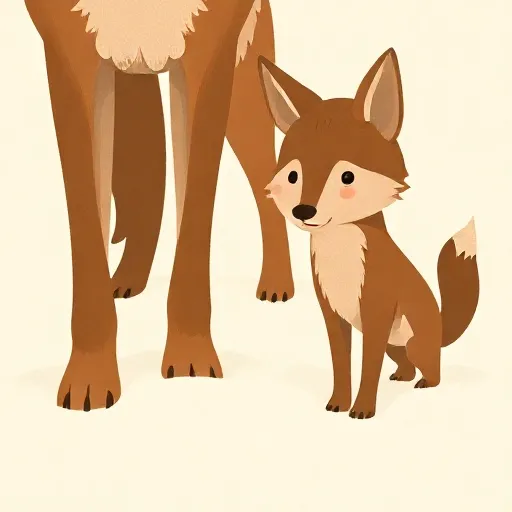
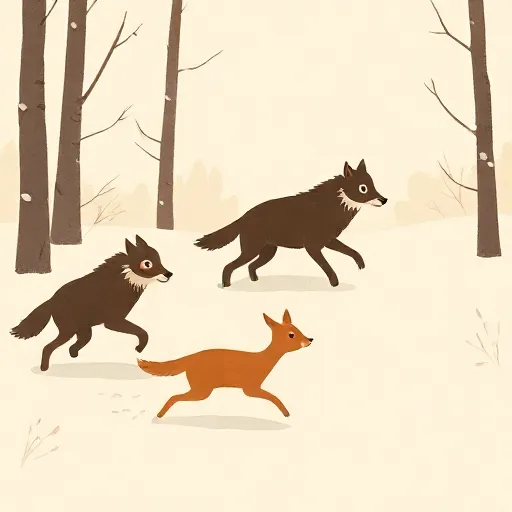
Imagine a pack of wolves in a snowy forest. Some have slightly longer legs than others. When the snow piles up, the longer-legged wolves can run faster and catch more deer. They survive. They have pups. And those pups inherit their parents’ longer legs. Over many generations, the whole pack changes.
This is the story of natural selection, the process Charles Darwin (1809–1882) described more than 160 years ago. It seems simple: traits that help organisms survive and reproduce spread through a population over time. But when philosophers and biologists look closely at this story, they discover something surprising. They cannot agree on what natural selection actually is.
Is it a single cause — like a filter that sorts organisms? Is it the entire cycle of variation, inheritance, and reproduction? Or is it something even stranger: a statistical pattern that only appears when we do the math? These questions aren’t just word games. They change what we think science can explain about the living world.
One Phrase, Two Meanings
Philosophers who study biology have noticed that “natural selection” gets used in two very different ways. They call these the focused sense and the capacious sense.
The focused sense zooms in tight. It picks out just one moment in Darwin’s process: the part where having a certain trait makes an organism more or less likely to reproduce. Roberta Millstein, a contemporary philosopher of biology, describes this as a “discriminate sampling” — some traits get sampled more often than others simply because they help their owners survive. In this focused sense, natural selection is separate from inheritance (how traits get passed down) and from mutation (how new traits appear). It’s just the sorting step.
The capacious sense, by contrast, takes in the whole cycle. Richard Lewontin (1929–2021), an influential evolutionary biologist, laid out three conditions for evolution by natural selection, and together they capture the full loop: first, individuals in a population must vary in their traits; second, different traits must lead to different rates of survival and reproduction; third, those trait differences must be heritable — passed from parent to offspring. In this capacious usage, natural selection includes variation, inheritance, and reproduction. It’s the whole machine, not just one gear.
Which usage is correct? Neither, exactly. They are different tools for different jobs. But the choice between them leads to real disputes, especially when scientists try to build mathematical models of evolution.
Does Selection Always Mean Change?

Here’s a puzzle: can natural selection happen without evolution? Most people think of evolution as change — a species transforming over time. But Darwin himself offered an example where selection seemed to keep things exactly the same.
He studied a plant condition called heterostyly, where some individuals grow long flowers and others grow short ones. Darwin believed both forms were maintained by natural selection because the variety encouraged cross-pollination, which he thought was healthier for plants. The population wasn’t evolving toward one flower type. It was staying balanced, with both types persisting. That stable mixture, Darwin argued, was itself an adaptation produced by natural selection.
This creates a headache for anyone who says evolution (change) is necessary for natural selection. Lewontin’s three conditions, for example, were meant to describe evolution by natural selection — they seem to require that the population changes. But if Darwin was right, a population can undergo selection while staying at a stable equilibrium.
Philosopher Peter Godfrey-Smith (born 1965) pointed out that stabilizing selection — where the middle-range trait does best and extremes get weeded out — might meet Lewontin’s conditions without causing any overall change. And Richard Dawkins (born 1941), who proposed that natural selection happens wherever there are active germ-line replicators (genes that influence their own chances of being copied), also allowed that selection could occur without evolution. A gene might cause itself to be copied more often, but if it’s already at equilibrium in the population, its frequency won’t shift.
Biologists now study many dynamics beyond simple directional change: cyclical patterns, stable polymorphisms, protected equilibria. All of these seem to fall within the scope of the same evolutionary theory. So why draw a sharp line at change?
When the Math Models Disagree

If you want to see the debate get really sharp, look at how scientists build mathematical models of evolution. Two formal approaches dominate the discussion, and they define selection in incompatible ways.
The first approach uses type recursions — equations that predict how the frequency of a trait will change from one generation to the next. In these equations, selection is quantified by fitness coefficients (the w variables). A fitness coefficient tells you, in the model, how well a particular trait type does relative to others. If the fitness values stay fixed across generations, the model treats selection as a constant, unchanging influence.
The second approach uses the Price Equation, named after geneticist George Price. The Price Equation breaks evolutionary change into two terms: one representing selection (as a covariance between a trait and reproductive success) and one representing transmission bias (how faithfully traits are passed on). Here’s the catch: in the Price Equation, the strength of selection changes as the population evolves. When a trait is rare but spreading fast, the covariance is high. When it’s common and barely changing, the covariance drops to zero.
Consider a population with heterozygote superiority, where having two different versions of a gene gives you an advantage. In the type-recursion model, fitness coefficients stay fixed — selection is operating the same way the whole time, even after the population reaches equilibrium. In the Price Equation, the covariance term shrinks to zero at equilibrium. So is selection still happening or not? The two models give different answers.
This isn’t just a quirk. The models treat randomness differently too. In type recursions, what counts as selection versus drift (random fluctuations in trait frequencies) is fixed by how the variables are set up. In the Price Equation, the same random event — a cold winter, say — could be classified as selection or drift depending on how the scientist sets up the expectations. The philosopher Samir Okasha argues that one way to reconcile this is to treat the Price Equation’s first term as measuring the extent of selection’s influence, rather than defining selection itself. But that solution comes with its own costs.
Is Selection a Cause, or Just a Pattern?
This brings us to the deepest question: is natural selection a cause, or is it just a statistical summary?
Many philosophers working with type-recursion models say selection is definitely a cause. They point to experiments where researchers can manipulate selection (by changing which traits lead to more offspring) and watch the population respond. This is exactly how you test for causation in other sciences: you tweak one thing and measure the effect. Roberta Millstein and John Beatty argue that selection is a “discriminate sampling process” — an actual causal filter. Jun Otsuka treats fitness coefficients as representing causal pathways from traits to reproductive success.
The opposing view comes from the statisticalists, including philosophers Denis Walsh and André Ariew. They argue that selection and drift aren’t distinct causes at all — they’re just different ways of summarizing the same data, and which one you use depends on the model you choose. In one famous example, Walsh, Ariew, and Mohan Matthen described a population where warm years favor one type and cold years favor another. They claimed this could be treated as either selection or drift, depending on your perspective.
But the situation is more complicated. If you model that population with type-recursion equations, the changing weather must be treated as selection — the fitness values change with the temperature. If you use the Price Equation, you have a choice: you can include the weather in your expectations (making it part of selection) or treat it as a deviation from expectation (making it drift). So the choice of model forces your hand — or leaves it free.
Peter Godfrey-Smith offers a compelling reason to think selection is causal. Imagine a trait that, purely by luck, happens to be more common among parents who have lots of offspring. The trait spreads, but it had nothing to do with causing reproductive success — it was just along for the ride. Godfrey-Smith says this isn’t natural selection in the focused sense. For selection to occur, the trait itself must causally influence reproduction. That sounds like causation to most ears.
Why It Still Matters
You might wonder: does any of this affect anything outside philosophy departments? The answer is yes — and it affects something you do all the time: decide what counts as a good explanation.
When you ask “why do giraffes have long necks?” you’re asking natural selection to explain something. But if natural selection is just a statistical pattern, it might not explain anything at all — it might just be a way of redescribing what happened. If it’s a genuine cause, then the explanation has real force: long-necked giraffes had more offspring because their necks helped them reach food, and that causal fact pushed the population in a new direction.
This matters for more than just giraffes. Some scientists have proposed that natural selection explains phenomena far beyond biology — the spread of cultural ideas, the behavior of the immune system, even certain processes in quantum mechanics. Whether those proposals make sense depends on what natural selection actually is. A statistical pattern in one domain doesn’t automatically transfer to another. A causal process might.
The dispute also reveals something about how science works more generally. Scientific theories often contain concepts — like “selection” — that seemed clear until someone asked exactly what they mean. Unpacking them leads to hard choices: between different mathematical formalisms, between different philosophical commitments, between different visions of what kinds of things exist in the world. That’s not a sign that science is broken. It’s a sign that it’s alive.
Think about it
- If two scientific models of the same population give different answers about whether natural selection is happening, could both models be useful? What would that tell us about what “natural selection” really means?
- Imagine a trait that helps an animal survive but, due to bad luck, never spreads through the population. Did natural selection act on that trait? Why or why not?
- Suppose you could rewind the history of life on Earth and press play again. Would you expect the same species to evolve? What does your answer say about whether you think selection is a cause or a pattern?