
Is Science Discovering Reality or Inventing It?
The Star That Wasn’t There

On a clear night, you see a small red dot. You say, “That’s Mars.” But Paul Natorp (1854–1924) would shake his head. For him, the real Mars—the one astronomy studies—is not the dot. It’s a set of mathematical laws and calculations. The glowing speck is just a private appearance, no more scientific than a dream.
Natorp was part of the Marburg School, a group of German philosophers at the end of the 1800s. After the giant systems of Hegel and other German Idealists collapsed, philosophy had a hangover. Scientists were making huge progress—Newton’s physics, chemistry, biology—but philosophy seemed lost. The Marburgers, led by Hermann Cohen (1842–1918), Natorp, and later Ernst Cassirer (1874–1945), turned back to Immanuel Kant (1724–1804) for a fresh start. They didn’t want to revive all of Kant’s ideas. They wanted to “philosophize in the spirit of Kant,” using his most important insight: the transcendental method.
But what is that? It’s not about how our brains work. The transcendental method asks: “What must be true about thinking for objective knowledge—like mathematical physics—to be possible?” It starts with the fact that we have reliable science (“facts”), and works backward to find the logical conditions that make it valid. Philosophy’s job is not to compete with science or to describe the mind. It’s to uncover the laws of reason that science itself depends on.
The Marburgers took this even further. They rejected two parts of Kant that they thought weakened reason’s independence. First, they got rid of intuition—the passive receiving of sense data. If knowledge begins with something just “given” to the senses, then reason is partly controlled by something outside itself. That would mean reason isn’t fully autonomous, not standing on its own feet. Second, they threw out the thing in itself, the mysterious something beyond all experience that Kant thought affected our senses. For them, a thing completely outside thought is a useless idea. If reason is to be the sole source of objectivity, nothing can be allowed that is alien to it.
Thus, philosophy becomes the logic of science—not a psychology of discovery, but an analysis of the pure activity of thinking that makes scientific laws possible.
Science Moves, Never Stands Still

Kant believed that Newton’s physics was the final, complete science. By 1900, that was clearly wrong. New theories about energy, electromagnetism, and the atom were emerging. The Marburgers said science is not a finished fact (in Latin, factum). It is a fieri—a “doing,” an ongoing process. So the essence of science can’t be a set of fixed truths. It must be its method.
Natorp gave a special meaning to method. The Greek word methodos means “pursuit” or “going-after.” Science is always heading toward a goal that never fully arrives: complete, law-governed knowledge of its objects. Every step forward is a hypothesis, but not in the sense of a guess you test once and then prove. Natorp took the word literally: hypo-thesis means “setting down” or “laying a foundation.” A hypothesis is an active positing of a law.
He compared it to walking. You must plant your foot firmly to take a step, but you immediately leave that stand behind to take the next one. Likewise, science posits laws as sure ground, but later theories may revise or replace them. The thing in itself, which Kant thought was a real-world object beyond reach, now became a limit-concept (Grenzbegriff). It’s not a hidden thing. It’s the idea of a completely exhausted, totally determined set of knowledge—something we can only approach asymptotically, forever drawing closer but never finishing.
So for the Marburg School, the object of astronomy isn’t the physical star you see. It’s the calculations that determine its motion with mathematical precision. The “scientific experience” they talk about is this active legislation, not the passive recording of sense data. The real Mars is the one you can predict.
How Thinking Builds Its Own Objects

If science doesn’t receive objects from the senses, how do scientific objects exist? Natorp answered: thinking builds them. He called this his genetic logic—a logic of the genesis (origin) of objective knowledge. All thinking is a kind of function, an act of unification.
Take space and time. Kant had called them “forms of intuition,” something your mind passively uses to organize sensations. Not for Natorp. He reinterpreted space and time as originary thought-acts—the very first operations that allow any object to appear at all. Space is a synthesis that creates an ordered manifold of points; time is a synthesis of ordered moments. Only by placing something into this framework can we then determine its quantity, quality, or causal relations.
This means the thing you normally think of as a real object—say, a tree—is actually two layers. Natorp distinguished between first-order and second-order phenomena. The first-order phenomenon is your private, subjective sensation: the green blur, the rustle, the smell. That’s just a “doxic appearance” (from the Greek doxa, opinion), and science can say nothing objective about it. The second-order phenomenon is the tree as a scientific object: a set of laws about photosynthesis, cellular structure, and growth patterns. This second tree is constructed by reason according to universal laws, so it’s valid for everyone—objective.
He compared the process to solving an equation. The unknown X is the object to be determined; the knowns are previously established laws. You never get an absolutely final solution (that would be the infinite task), but you get a more and more precise one. Thus, scientific knowledge is never a copy of an outside world; it’s the progressive construction of a law-governed network.
Why does this matter? Because it guarantees the autonomy of reason. If knowledge came from outside, reason would be just a passive mirror, not truly free. By making the laws of thinking the sole source of objectivity, the Marburgers turned science into the proud product of reason’s own activity.
Plato’s Ghost and the Rings of Science
The Marburgers didn’t believe history was just a sequence of events. They held that the history of science and philosophy reveals reason’s deep structure. And surprisingly, they found the purest early expression of their idealism not in Kant, but in Plato (427–347 BCE).
Natorp wrote a monumental book arguing that Plato’s famous Forms or Ideas are actually hypotheses in the Marburg sense—not mystical separate substances. When Plato talked about the Form of the Good, he was really talking about the supreme “law of lawfulness,” the principle that all knowledge must be organized by rational laws. Natorp claimed that Aristotle and most later readers misunderstood Plato as a supernaturalist, when in fact Plato was a deep criticist.
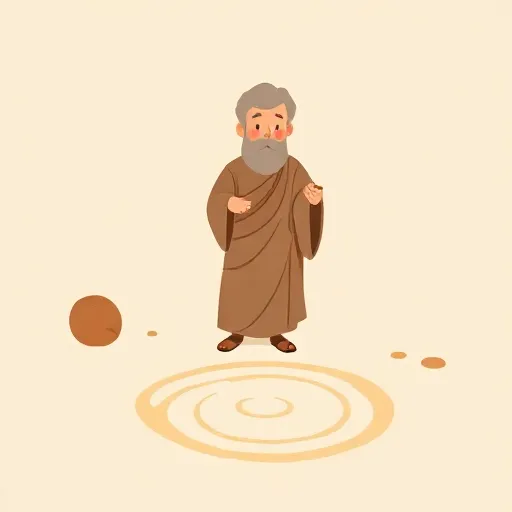
According to Cohen, the history of reason isn’t a straight line forward. It’s more like a series of concentric rings around a timeless core. The core is the transcendental method—the insight that science proceeds by laying down laws. This core was first glimpsed by Plato, then obscured for centuries, only to flash forth again in moments like Galileo, Newton, and Kant. Each “ring” is a rebirth of the same fundamental rational self-consciousness.
So for the Marburg School, studying history isn’t just recording facts. It’s a way of discovering the method itself. By retracing how science has actually progressed, philosophy can grasp the pure logic of thinking that makes it progress. The history of philosophy is the history of reason becoming aware of its own law-giving activity.
Why a 19th-Century Fight Still Echoes Today

This might sound like a dusty old dispute. But the Marburg ideas are very much alive. Whenever someone asks, “Is an electron a real particle or just a useful mathematical tool?” they’re stepping into Natorp’s world. Do scientific theories discover a pre-existing universe, or do they build a system of laws that we then call “reality”?
If the Marburgers are right, objective truth isn’t about matching an outside world. It’s about following the inner laws of reason. That means science can be objective without needing to photograph things in themselves. It also means science is always revisable—because every hypothesis is a step that can be left behind. That keeps us humble and curious.
The method extends beyond science, too. The Marburgers believed that morality, art, and religion also have law-like foundations that philosophy can uncover. So the same question arises in ethics: Are moral truths discovered, or are they constructed by reason? The Marburg School’s challenge is to think of human culture as a huge, ongoing project of building lawful meaning out of the chaos of immediate experience.
Next time you learn a scientific formula or wrestle with what “justice” really means, you might wonder: Who built this, and how? The Marburg philosophers would answer: reason built it, one hypothesis at a time.
Think about it
- If scientific facts are built by reason’s laws, does that mean there could be an alien civilization with a totally different but equally correct science? Why or why not?
- A scientist says electrons are real physical objects; another says electrons are just a good way to predict experimental results. Which view do you think the Marburg School would support, and would you agree?
- When you solve a math problem, do you feel like you’re discovering a truth that was always there, or inventing a rule? Could both sensations be right in different ways?