
Does Your Name Mean Something, or Is It Just a Tag?
A Name Like a Label?
Imagine your family names a new puppy “Moonlight.” That name seems to say something: it means light from the Moon. But what about ordinary names like “Alice” or “Leo”? Does the word “Alice” carry a hidden meaning the way “bachelor” means an unmarried man, or is it simply a label stuck onto a person?
The philosopher John Stuart Mill (1806–1873) thought names are exactly that: bare labels. He said a proper name has denotation — it points to its bearer — but no connotation . It doesn’t describe them or give you a definition. Mill compared a name to a chalk mark on a door. The mark identifies the house, but tells you nothing about whether it’s made of brick or wood. Calling someone “Zara” works the same way: the name hooks onto Zara without meaning anything about her. Like a library call number, it’s useful for finding the right book, but it’s not a summary of the story.
This view feels very natural. When you meet an Alice, you don’t expect her to be noble or brave because of her name. You’ve just learned to use “Alice” to talk about a particular person. But some philosophers spotted a puzzle: if names are only blank pointers, why does discovering that one person has two names ever feel like news?
The Hidden Definition Idea

To answer that, Gottlob Frege (1848–1925) observed that names with the very same real-world target can have distinct senses . Long ago, people used “Hesperus” for the evening star and “Phosphorus” for the morning star, not knowing both were the planet Venus. When astronomers finally announced “Hesperus is Phosphorus,” the sentence was a genuine discovery. If both names were just empty labels pointing to Venus, why wasn’t the statement instantly boring, like “Venus is Venus”?
Frege concluded that a name must carry a sense — a way of presenting its reference. The sense of “Hesperus” might be the brightest star visible at dusk, while “Phosphorus” gives the brightest star at dawn. Even though both latch onto the same chunk of rock, they package it in different descriptions. And Bertrand Russell (1872–1970) pushed this further: he argued that a proper name is really a disguised definite description. Saying “Aristotle” is shorthand for something like “the student of Plato who wrote the Nicomachean Ethics.” The meaning of the name just is that description.
On this picture, names do have hidden definitions after all. That explains why “Alice is the girl with the red sneakers” can be informative, and why the name guides you to a specific individual. It also seems to make sense of how we teach names: you often supply a description — “Alice, my cousin who plays the cello” — to help someone else latch on.
The Counterattack: Could Aristotle Have Skipped Teaching?
The description theory held sway for decades, but Saul Kripke (1940–2022) launched a famous assault. Suppose the meaning of “Aristotle” is the teacher of Alexander the Great. Then the sentence “Aristotle taught Alexander” would be a priori — knowable just by understanding the words, like “a bachelor is unmarried.” But does that feel right? We can easily imagine archaeologists discovering new documents proving that Alexander’s tutor was someone else entirely, and that tradition had been mistaken. If we wouldn’t accept that Aristotle taught Alexander as a sure thing before any evidence, then that description can’t be part of the name’s meaning.
Kripke pressed further with necessity. If a name’s meaning were a particular description, then in every possible way the world could have been, the person would have to fit that description. But consider possible worlds again: surely Aristotle could have decided to stay home and never teach Alexander. In such a world, the description “teacher of Alexander” wouldn’t apply to Aristotle, yet we’d still say he’s Aristotle. Kripke called names rigid designators — they pick out the same individual across all possibilities, no matter what descriptions that person satisfies. A name, he insisted, doesn’t secretly mean a bundle of facts; it rigidly tags a person.
What about the idea that a name’s meaning is a whole cluster of descriptions, like the philosopher who wrote certain books, studied with Plato, and taught Alexander? John Searle (born 1932) proposed that, and P.F. Strawson (1919–2006) had suggested something similar. But Kripke replied that even a cluster could fail — we could discover that none of the famous stories about a person are literally true, yet we’d still use their name to pick out the same historical figure. So the cluster theory, while clever, still gave a definition when what we seem to need is a more direct link.
The Chain That Binds a Name to a Person
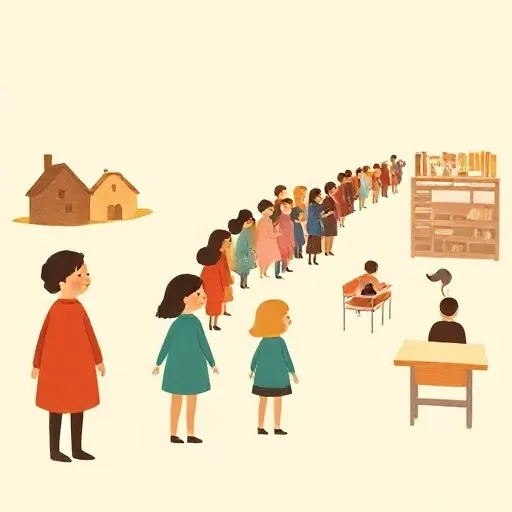
If names don’t have built-in definitions, what makes “Aristotle” refer to that long-dead Greek and not to his neighbor? Kripke offered a story: at some point, perhaps at a birth, the baby is given a name in a kind of “baptism.” That initial act fixes the reference. Then each person who learns the name does so by hearing it from someone else, intending to use it to talk about the same individual. Over time, a causal chain of communication links every later use of the name back to that original ceremony.
Think of it like a game of telephone. Your friend says “I met Alice.” You now use “Alice” intending to refer to whoever your friend was talking about, and so on backward. The chain doesn’t require you to have accurate beliefs about Alice. You could think she’s a champion swimmer when she actually hates the water. As long as the chain runs back to Alice herself, your words reach her. This is why we can successfully talk about Socrates even though much of what we “know” about him comes from stories — the name traveled through history, not through a definition.
Kripke’s picture changed the landscape. It shifted the job of connecting a name to the world from a meaning inside your head to the public history of how the name was used. The reference isn’t determined by a mental description; it’s earned by a real-world chain of events.
When a Name Rings Hollow

The debate doesn’t just cover famous Greeks. In the 1800s, the mathematician Urbain Le Verrier was convinced an undiscovered planet, which he called “Vulcan,” orbited close to the sun. He had a clear description. But no planet was ever observed. Here the description theory seems to have an advantage: “Vulcan” had a meaning (a particular set of conditions), and because nothing satisfied them, the name didn’t refer. But what does Kripke’s chain say? There was no initial baptism of a real object, so the chain was severed from the start.
Similarly, how do we handle fictional names like “Sherlock Holmes”? We use the name meaningfully, but no real detective stands at the end of any historical chain. Some thinkers try to extend the causal picture to include pretend-baptisms in storytelling. Others lean toward treating names as having a description-like sense, at least in fiction. The puzzle of empty names shows that the question of meaning isn’t just philosophical trivia — it affects everyday talk about things that might not exist, from proposed planets to characters in a book.
Why the Fight Over “Alice” Still Matters

You might not care about Aristotle’s teaching career, but this philosophical fight sneaks into your life. When your friend says “Alice cheats at cards,” and you reply “No, the Alice I know is totally honest,” you’re relying on the fact that a name can travel through a chain even if the descriptions get mixed up. If names were simply definitions, then whoever fit your friend’s description — someone who cheats — would be “Alice,” and you’d be talking past each other. Instead, you both trust that the name picks out a fixed person, and you argue about the right description.
The disagreement between the label view, the hidden definition view, and the causal chain view also shapes how we think about mistakes and lies. If every false belief about a person changed who their name refers to, communication would break down. The discovery that names might be rigid pointers, not miniature encyclopedias, helps keep our words tethered to the world even when our facts are shaky. And right now, as we chat with AI voices that sound exactly like real people, the question “What does a name hook onto — a description or a causal source?” is more than a classroom puzzle; it’s a practical tool for sorting reality from illusion.
Think about it
- If you woke up tomorrow with all your memories of a close friend completely erased, and someone handed you a card with their name on it, would you still be able to talk about the same person when you used that name? Why or why not?
- Suppose a famous explorer’s diary describes a lush island that oceanographers later prove never existed. Could the name in the diary refer to something real? What would it take for you to say the name still refers to a place?
- When you learn two different names for the same person — like a formal name and a childhood nickname — does the “new information” feel different from learning a fresh fact about what they did? Why might that be?