What Would Happen If There Were Two Supreme Beings?
A Shepherd’s Strange Rule: Worship Only One God
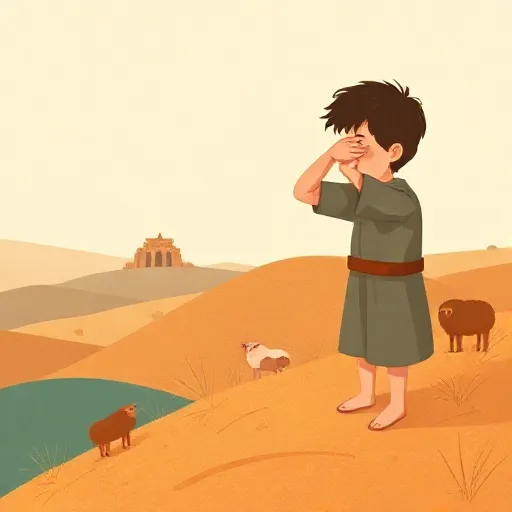
Imagine you live in the ancient Near East around 900 BCE. All your neighbors worship a crowd of gods—Baal the storm god, Astarte the goddess of love, the sun god, and many more. But your own people, Israel, have a different rule. You are told to worship only one god: Yahweh. No one says the other gods aren’t real. The rule is simply that Israel must not bow to them.
Scholars call this early Israelite practice monolatry: believing that many gods exist but worshipping only one. Over centuries, this idea grew sharper. The Israelites began to say that Yahweh was not only their special god but the creator of heaven and earth, the greatest of all gods, and the one who demanded exclusive loyalty. Eventually, many Jews reached the conclusion we call monotheism: there is exactly one God, and no other divine beings are real.
This shift didn’t happen in Israel alone. In polytheistic cultures like ancient India and late Greek paganism, worshippers sometimes heaped so many praises on one god that they treated that god as unlimited and supreme, pushing the others into the background. The religious attitude of total devotion has a kind of inner logic: the more you magnify the being you worship, the closer you get to saying that only one such being exists.
But is that logic airtight? Can there be only one God, or is that just a habit of some religions? Philosophers from the Middle Ages onward have offered several arguments that there cannot be two gods. The three most compelling arguments rest on God’s sovereignty (being the total cause of everything else), omnipotence (all‑powerfulness), and the demand for total devotion. Let’s look at each.
The First Argument: Only One Can Be the Total Cause

Think of God as the being whose will is the necessary and sufficient cause of every other thing that exists. If God wills that a universe with oceans, stars, and people exists, then that universe must come into being because of God’s will. Nothing else needs to happen.
The medieval philosopher John Duns Scotus (c. 1266–1308) argued that this idea makes two gods impossible. Suppose there were two gods, each of whom is the necessary and sufficient cause of all other things. Then, first, God‑A would be a sufficient cause of everything. But if God‑A’s willing alone makes everything exist, then God‑B isn’t needed for anything—God‑B’s willing is not necessary. And at the same time, God‑B would be a necessary cause, so nothing would exist without God‑B’s willing. Yet if God‑A is already sufficient, then God‑B isn’t actually required. The two claims contradict each other. So Scotus concluded it is impossible for two gods to exist if both are the total cause of everything.
This argument works only if God’s willing is sufficient in a very strong sense—meaning that God’s willing all by itself, with no help from any other free choice, makes things happen. But many theists think God gives human beings free will, and that some events (like your choice to help a friend) also require your free decision, not just God’s will. In that case, God’s will alone isn’t sufficient for everything else to occur. So the argument may not convince everyone. Still, for theists who believe that God’s creative will is the only source of everything outside God, Scotus’s argument is a powerful reason to hold that there can’t be two such beings.
The Second Argument: Two All‑Powerful Beings Would Clash
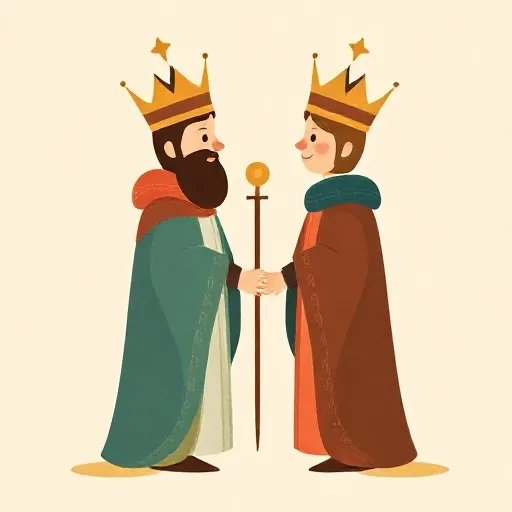
The Persian philosopher al‑Ghazali (1058–1111) asked what would happen if two omnipotent beings existed side by side. Omnipotence means having the power to do anything that is logically possible. Now picture two beings, each with this unlimited power. Could their wills ever disagree?
Suppose one wants a bright, sunny day and the other wants a thunderstorm over the same spot at the same time. If the first being is truly omnipotent, the second being’s will is thwarted—so the second being is not all‑powerful after all. And if the second being’s will wins, then the first isn’t omnipotent. If both give way, neither is omnipotent. So the idea of two distinct, all‑powerful beings leads to a contradiction whenever their wills could conflict.
Someone might object: “What if the two beings have wills that can’t ever conflict? They always want the same thing.” But then, are they really two separate persons? Philosophers have pointed out that for two persons to be distinct, it should at least be possible for them to want different things. Even if they never actually clash, the mere possibility of conflict seems part of being a distinct person with a will of your own.
A further problem: even if one wills only differently rather than oppositely, that difference can rob the other of power. Imagine Being‑A wills that a certain flower is red. Being‑B doesn’t will “not‑red,” but it wills to have the option to make the flower blue. The moment Being‑A wills red, Being‑B loses the power to choose blue. That means Being‑B is not all‑powerful after all, because something beyond its control—Being‑A’s will—has taken a possibility out of its hands. So two distinct and essentially omnipotent beings simply cannot coexist.
The Third Argument: You Can’t Be Totally Devoted to Two
The philosopher William of Ockham (c. 1287–1347) thought about what the word “God” means. He suggested that God is a being “that than which nothing is more noble and more perfect.” But he also noted that God is, by definition, a being worthy of total devotion and unconditional commitment—what we call worship. That idea, all by itself, may rule out a second god.
If two equally perfect, equally supreme beings existed, then each would deserve the same absolute worship. You would be obligated to be totally devoted to Being‑A and totally devoted to Being‑B. But can you be totally devoted to two distinct beings at the same time? Total devotion requires that you center your entire life on the object of your worship. You can center your life on a pair of things (like mother‑and‑father), but you cannot center your life on A and also center your life on B, because that would split your ultimate loyalty. The devotion that God requires seems inherently indivisible.
An objection arises: could the two beings always make the exact same demands on you, so that you could worship them as a single unit? But then there is the problem of distinct persons again. If they really are two separate persons, their wills could, in principle, come apart. And if they might someday require different things of you, you could not be unconditionally committed to each individually—your commitment would have to be conditional on their staying in harmony. That is not the kind of unconditional commitment that “God” implies. So only one being can fill the role of the supremely worship‑worthy.
But What About the Trinity and Hindu Gods?
If these arguments are sound, how do we make sense of religious traditions that seem to include more than one divine person? Two famous examples are the Christian doctrine of the Trinity and the Shri Vaishnava tradition of Hinduism, which closely links the supreme god Vishnu with his consort Lakshmi.
Christians maintain that God is three “persons”—Father, Son, and Holy Spirit—yet still one God. How do they deal with the arguments above? In the Western tradition, the three persons share a single will and a single divine nature; there aren’t three separate creative wills that could clash. In other Christian traditions, the persons each have a will, but their wills are necessarily in perfect harmony—they never disagree. And Christian worship is directed to the Trinity as a whole, not to one isolated member. So, according to Christian thinkers, the sovereignty, omnipotence, and total devotion arguments don’t rule out their one‑in‑three God.
Among the Shri Vaishnavas, the philosopher Ramanuja (1017?–1137?) taught that Brahman (the ultimate reality) is personal and is to be identified with Vishnu. Vishnu is supremely powerful, all‑knowing, and without rival. Yet the scriptures also place Lakshmi at his side, describing her as sharing his qualities and acting as a mediator. Later thinkers developed two ways to keep this picture monotheistic. Lokacarya (1213–1323) emphasized that Lakshmi is wholly dependent on Vishnu and subordinate, so she is not an independent divine being. Venkatanatha (1268–1369) went further: Lakshmi is an inseparable attribute of Vishnu, not a separate substance. The Lord and his consort form a single reality. So when a devotee worships one, they worship both in the one God. In both cases, the tradition claims that there is still only one ultimate reality.
These examples show that the arguments for God’s uniqueness don’t automatically rule out complex religious pictures—but they do force believers to explain very carefully how their picture remains monotheistic.
Why This Debate Still Matters

You might not spend your days wondering how many gods exist. But the philosophical questions behind this ancient debate touch your life in surprising ways. Think about the things you care about most deeply. Could you be totally devoted to two ultimate commitments that might someday pull you in opposite directions? If your deepest loyalty were divided, would either commitment really be ultimate?
The arguments about sovereignty and omnipotence also nudge us to ask whether the universe has a single, unified origin or many independent sources. And the puzzle over apparently plural divine persons—like the Trinity or Vishnu‑and‑Lakshmi—raises a broader issue: what does it really mean for something to be “one”? Is a tightly united community ever “one” in a way that counts?
These questions are far from settled. The thinkers we’ve met—Scotus, Ghazali, Ockham, the Jewish mystics, Christian theologians, and Hindu philosophers—all grappled with them seriously. Their arguments are still studied today because they challenge us to get clear about what we mean by the most important, most powerful, most worthy reality there is. And that challenge doesn’t belong only to religious traditions. It belongs to anyone who thinks about the nature of the ultimate.
Think about it
- If you had two friends who both demanded your complete loyalty and one day they asked you to keep a secret from the other, could you be loyal to both? What does that tell you about the idea of total devotion?
- Imagine a universe where two all‑powerful beings exist but never disagree. Would you call them two separate beings? What might make them distinct, if anything?
- Some people say that the deepest reality isn’t a single person but a perfect community. Could a community be “one” in a way that still counts as monotheism? How would you decide?