

Before You See Anything, You Feel Yourself Alive
A Philosophy Born in Hiding

In 1943, at the height of the Second World War, a twenty-one-year-old French philosophy student named Michel Henry (1922–2002) was hiding in the mountain forests of the Haut Jura. By day, he carried messages for the French Resistance. But even in the constant danger and darkness, a question burned in his mind: Is seeing — looking out at the world — really the only way things show up to us?
At the time, nearly every major philosopher, from Edmund Husserl to Martin Heidegger, answered yes. They believed that consciousness is always intentionality — a reaching-outward toward something. But Henry, sitting in the cold, listening to his own breathing and the steady knock of his heartbeat, began to suspect that there was another, deeper kind of appearing. An appearing that happens not in front of your eyes, but inside you, in the simple, wordless feeling of being alive. He would spend his entire career trying to prove that this inner life is not a side-effect of experience, but its very foundation.
Looking Outward: The Usual Story

To understand Henry’s revolution, you first have to understand the picture he was pushing against. Imagine you are looking at a tree. According to most phenomenologists — philosophers who study how things appear to us — your consciousness is not a passive mirror. It actively reaches toward the tree. This reaching is intentionality. When you see the tree, your mind is “of” or “about” the tree. It projects outward, and that outward stretch is what makes the tree present to you.
This outward structure is sometimes called ek-static appearing — from a Greek word meaning “standing outside itself.” It always puts the thing at a distance, as an object you observe. Husserl, the father of phenomenology, spent decades mapping how intentional acts like seeing, remembering, or imagining shape the world for us. Henry did not deny that intentionality works beautifully for explaining how tables, mountains, and faces appear. But he spotted a problem that nobody had fully taken seriously: What about the act of seeing itself?
Here’s the puzzle. You see the tree, but you don’t see your seeing. When you turn your attention inward to catch your own consciousness at work, you don’t find an object like a tiny movie screen. You find — well, something harder to name. A quiet alertness. A sense of effort. A familiar thrum of you being you. Henry insisted that if this inner dimension didn’t appear to you somehow, you wouldn’t even be able to reach out toward the tree. Yet it doesn’t appear in the same way the tree does. That meant, he argued, that intentionality cannot be the only mode of appearing. There must be a mode that is invisible and non-intentional — and it must be the one doing the real foundational work.
The Inner Glow: When Feeling Feels Itself

Henry called this hidden mode auto-affection, or simply life. The word “life” here has nothing to do with biology — no cells, no heartbeats in a medical sense. It is a purely phenomenological idea: the self-appearing of appearing. In auto-affection, the self is not separated from itself like a viewer looking at a painting. Instead, the self is given to itself immediately, as a kind of inner weight or warmth. You feel yourself without any distance. Henry sometimes used the Greek word pathos for this self-experience — not just sadness, but the whole range of passive feeling that comes from being unable to escape being you.
To see why this matters, think about a flashlight. The beam lets you see the tree, but the flashlight itself isn’t lit up by its own beam. Yet you know the flashlight is present because you feel its weight and warmth in your hand. That feeling is not “about” a far-away object; it’s a direct, non-visual contact. Henry believed that all intentional experience — all seeing, touching, thinking about the world — rests on a similar kind of inner contact. Before you can be aware of any object, you must already be given to yourself in a way that isn’t ek-static. You must be living through your own transcendental affectivity: a primal layer of suffering and joy that never switches off.
This leads Henry to a bold conclusion. If the act of seeing itself is not seen, then intentionality cannot ground itself. If you tried to build reality out of nothing but ek-static appearances, you’d face an infinite regress: each act of appearing would need another act to make it appear, and so on forever. The only way to stop the regress is to admit a kind of appearing that is its own light — a self-revelation. And that, for Henry, is exactly what your inner life does. It doesn’t point outward; it undergoes itself. And in that undergoing, everything else finds its footing.
The Two Ways Things Show Up
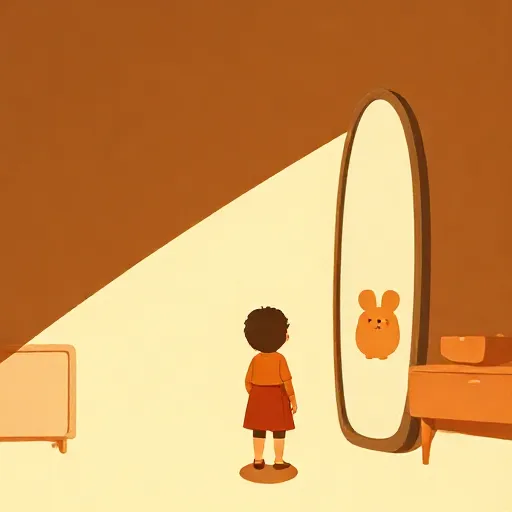
So there are, Henry argued, two completely different modes of appearing — what he called the duplicity of appearing. First, there is the intentional, ek-static appearing that shows you objects in the world: chairs, clouds, other people’s faces. Second, there is the affective, invisible appearing of life itself, which never displays anything outside itself. Henry called this second mode immanent because it stays enclosed within itself. It is a pathos you cannot step outside of, a tone that colors everything whether you notice it or not.
The two modes are not rivals running parallel. For Henry, one is the transcendental condition of the other — the necessary underground that makes the visible world possible. A biology student can stare at a microscope all day, but the patterns of light on the lens will only appear to her because she is already a living, self-feeling subject. If that inner aliveness were erased, the microscope and the cells would vanish into nothing for her. In a sense, the most elaborate scientific knowledge floats on a sea of invisible self-experience.
This double structure also explains why moments of deep emotion feel so unlike staring at a traffic sign. When a piece of music moves you, you aren’t just registering a sound object. The music seems to touch you directly, altering the texture of your own existence. That directness, Henry thought, is a clue that the inner mode has been awakened — that for a moment you are feeling life intensify rather than merely looking at another thing in the world.
Art and the Flight from Ourselves

If life is the foundation of everything, why do we spend so much time ignoring it? Henry believed that modern culture has fallen into a kind of forgetting — a condition he called barbarism. Barbarism, for him, doesn’t mean violence alone; it means practices that drain your inner powers instead of developing them. He pointed to the way television and digital screens bombard you with an endless stream of images, each one disappearing before you can truly absorb it. This constant flicker makes deep contemplation almost impossible. It teaches you to keep fleeing yourself.
Art, on the other hand, can do the opposite. Henry was deeply inspired by the abstract painter Wassily Kandinsky, who said that colors aren’t just properties of objects — they are “inner resonances.” When you see a brilliant red, the red doesn’t exist in the world as a feeling; it exists first as a subjective sensation. Great painting, Henry argued, doesn’t copy the world. It intensifies life by arranging forms and colors that reverberate inside you, much like music. A baroque façade, a dancer’s motion, a poem’s rhythm — all can bypass the ek-static surface and touch that invisible core.
For Henry, this is why art is not a luxury. It is an ethical task. Art reminds you of the bond between your individual self and the deeper current of life that runs through everything alive. When you stand before a work that truly holds you, you are not just looking — you are being given back to yourself. And that experience, he thought, is one of the few forces strong enough to resist the barbarism of a world that wants you to forget you have an inside at all.
Why It Matters: The Quiet Hum of Being Alive

Michel Henry’s philosophy can feel strange at first. It asks you to take seriously something that has no shape, no color, and no name — the bare fact that it feels like something to be you. Yet once you start looking for it, you might notice that this hum is always there. It’s present when you’re waiting for the bus, when you’re bored, when you’re laughing so hard you forget to breathe. It’s the background your whole life plays out against.
Henry didn’t invent this feeling. He just insisted that philosophers had neglected it for too long, hypnotized by the bright world of objects. Whether you agree with his whole system or not, he offers a powerful reminder: the most familiar thing in your life is also the easiest to overlook. In a culture that prizes speed, visibility, and constant connection, slowing down to feel your own existence can feel almost subversive. But for Henry, that quiet self-contact isn’t a retreat from reality — it is the root from which every reality grows.
Think about it
- If you turned off every screen and sat with your own feelings for a whole day, do you think you would discover something about yourself that you usually miss? What might you find?
- When a song gives you goosebumps, does the feeling come from the notes in the air, or from something already inside you that the music wakes up?
- Is it possible to be alive but not really feel alive? How would you know the difference?