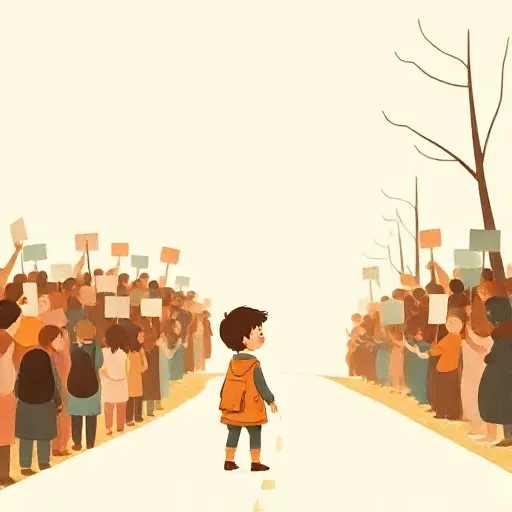

Do You Need to Know What's in Someone's Head to Explain a Crowd?
The Path That Nobody Planned

Imagine you are walking through a forest. There is no trail at first — just trees, ferns, and fallen branches. You pick your way carefully, stepping where the ground feels easiest. A few others pass through later, and they naturally follow your route because the trampled leaves are now a tiny bit flatter. After dozens of people, a clear dirt path forms, winding between the trunks. Nobody drew a map. Nobody gave instructions. Yet there it is.
How do you explain that path? You could say “the forest made a path,” but that feels strange — forests don’t decide things. This puzzle is at the heart of a big idea in the philosophy of social science: methodological individualism. The term sounds like selfishness, but it’s not about greed. It’s a rule about how to explain social life: big-scale facts, like a path or a stock market crash, should be explained by looking at individual people and what they do for their own reasons.
The clearest early version of this rule came from the sociologist Max Weber (1864–1920). Weber noticed that we often talk about groups — nations, companies, social classes — as if they were giant persons with plans and feelings. That’s fine in everyday chatter, he said. But when you do real sociology, you must treat those collectives as nothing more than the results of many individual people acting. Only human beings have intentional states: the thoughts, beliefs, and desires that let them say why they did something.
Weber drew a sharp line between plain behavior and action. Coughing is behavior. Saying “sorry” right afterward is an action — you do it for a reason, and someone else can understand that reason. Because actions are motivated by states we can interpret, Weber argued that sociological explanations must privilege the level of individual action. If we never ask why people did what they did, we never truly understand the social pattern. So methodological individualism was, from the start, a demand to explain things from the inside of someone’s head.
Hayek’s Warning: The Planner’s Mistake

The economist Friedrich Hayek (1899–1992) took Weber’s insight and aimed it at people who wanted to run whole economies from a desk. Hayek’s worry was that if you forget the individual’s point of view, you start seeing ghosts — treating something like “the price level” as a force that acts by itself.
He used an everyday example. Suppose you notice that every year, just after the first frost, the price of wheat goes up. A purely statistical researcher might say “frost causes wheat prices to rise” and leave it at that. But you have not really understood the story, Hayek insisted, until you know what farmers, bakers, and shoppers are doing. The frost cuts the harvest; less wheat means sellers can raise prices; buyers compete for the smaller amount. The price movement is the unintended side‑effect of thousands of individual decisions. Hayek called this kind of pattern a spontaneous order — order that appears without anyone planning it, just like the path in the woods.
Crucially, Hayek was not saying that people are perfectly rational calculators. On the contrary, he thought they act on very limited information. A person in a shop does not respond to something called “the interest rate”; they see a price tag on a can of beans and decide whether to buy. If we only talk in big abstract nouns like “unemployment” or “inflationary pressure,” we might start to believe we can turn a dial and fix everything. But those are just the messy net result of millions of small choices. According to Hayek, ignoring the individual’s perspective leads to overconfidence in planning — and to real‑world mistakes.
When “Half‑Way” Stories Seem Good Enough

The philosopher Karl Popper (1902–1994) and his student J.W.N. Watkins pushed the rule even further. They said that any social explanation that does not trace down to individual actions is only “half‑way” — and scientists should aim for “rock‑bottom” explanations that name exactly who did what for what reason.
Take a real debate. In the 1990s, violent crime dropped sharply in the United States. Criminologists hunted for causes: more police, different tactics, tougher sentences, the end of a drug wave. Suppose the best data showed that the drop was mostly due to a simple demographic shift — there were just fewer young men in the population, and young men commit a large share of violent crimes. That is a perfectly honest, evidence‑based explanation. It doesn’t tell you what any particular criminal was thinking; it just says a group got smaller, so the behavior became rarer.
Would Watkins say this is incomplete? Yes — you haven’t reached rock bottom until you can describe the intentional state behind each crime. But many social scientists reply: sometimes those individual‑level details are random noise, or simply don’t add anything useful. If every offender has different, unique motives but the overall pattern holds, the demographic story still gives us real knowledge.
Philosophers now often talk about supervenience — the idea that higher‑level facts can stay the same while the lower‑level details swap around. A classic example is “democracies don’t go to war with one another.” That pattern holds across so many different leaders, voters, and cultures that trying to explain it by listing every diplomat’s thought would bury the key insight. The large‑scale explanation is not scientifically broken; it’s just answering a different question.
Why the Fight Still Matters — and What It Can Teach You

So does all this mean methodological individualism is useless? Not at all. It works like a safety check against a very common mistake. A group may share an interest — lowering wages, winning a war, keeping a park clean — but that doesn’t mean any single member has a reason to do the hard work. This is the free‑rider problem: when a benefit is shared, each person can hope that someone else will suffer the cost, so nobody acts.
The philosopher Jon Elster used this to challenge a once‑popular Marxist idea. Many thinkers argued that capitalists keep a “reserve army of the unemployed” to hold wages down. But look at the individual boss, Elster said. Every factory owner gets an extra profit from hiring one more worker — so each has a temptation to keep hiring while the others hold back. The group interest does not magically create an individual incentive. If your theory ignores what is going on in people’s heads, you may end up believing in invisible forces that push history along without any human motor.
At the same time, zooming in too close can mislead you just as badly. Imagine a town where 60 % of people say they believe in God — and next year it’s still 60 %. You might think belief is stable. But maybe 10 % lost their faith while a different 10 % had a conversion; the individuals changed a lot, even though the percentage stayed flat. If you never look at the crowd from above, you can miss patterns that only appear when you add people up.
Methodological individualism is not a fixed answer; it’s a standing question: how low do we need to dig to understand society? Sometimes you need the story of every single person; sometimes the numbers alone tell you enough. The best social thinkers learn when to climb inside a single mind and when to see the forest without counting every leaf.
Think about it
- If a winding path appears in a park without anyone planning it, is it fair to say “the park created the path”? Why might someone argue that only the walkers made it, and why might someone say the path itself is a real thing?
- Your class agrees by vote to host a pizza party, but nobody writes a sign‑up sheet because everyone hopes a friend will do it. How is that like a free‑rider problem? Can you design a solution that does not rely on a teacher stepping in?
- Game designers can predict that thousands of players will follow a certain quest, even though each player has completely personal reasons — boredom, curiosity, a dare from a sibling. Should the designer care why you play, or only about what you actually do? When might the reason matter?