Why Do We Call Someone a Gorilla? The Strange Power of Metaphor
What happens when you call someone a gorilla?

Picture this: in the middle of a loud schoolyard, someone jabs a finger toward a classmate and says, “You’re such a gorilla!” Nobody calls a zookeeper. Nobody expects the classmate to start peeling bananas. Everyone knows the speaker doesn’t really believe the kid is a gorilla. Yet something is communicated — an insult about being brutish, loud, or clumsy — and it lands with surprising force.
This is metaphor. A metaphor happens when we talk about one thing as if it were another, even though the two are wildly different. The person being called a gorilla is the primary subject, and gorillas are the secondary subject. We speak of the primary subject (the classmate) in terms of the secondary one (gorillas), treating them as if they belong to the same category. The effect is not just a comparison; it’s a kind of temporary, imaginative fusion. Philosophers have spent centuries trying to explain exactly how that fusion works — why a few words can feel so vivid, and whether you can ever pin down what they really mean.
Aristotle’s puzzle: how “old age” became “evening”
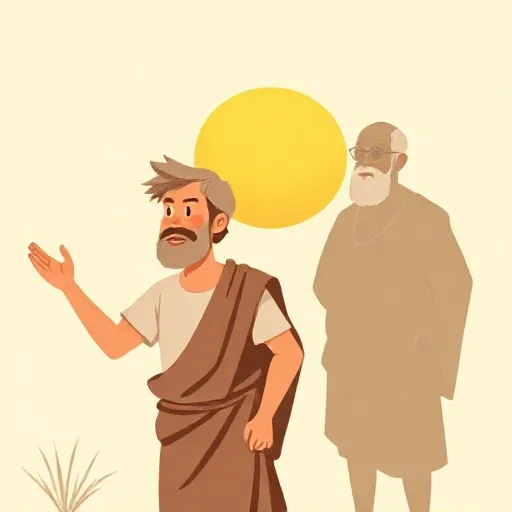
The earliest careful study of metaphor comes from Aristotle (384–322 BCE). He thought of metaphor as a transfer — a word that normally stands for one thing is, on a special occasion, made to stand for another. For example, the poet Empedocles once used the phrase “old age” when he was clearly talking about the course of a single day. Old age itself doesn’t belong to days, so why the odd word?
Aristotle’s answer: the listener’s mind leaps to solve an analogy. Old age is the final stage of a human life; evening is the final stage of a day. So, old age is to a life as evening is to a day. By calling evening “old age,” the poet invites us to map the whole rich structure of a human lifetime onto a single day — the way powers wax and wane, the way dawn feels fresh and sunset feels tired. The metaphor doesn’t just rename evening. It forces us to see evening through the lens of a long life, making the familiar strange and instructive. That mental workout, said Aristotle, is part of why metaphors are so pleasurable and powerful.
Can you ever really explain a metaphor?

If metaphor is so slippery, can we put its meaning into plain words? This is the paraphrase debate. Take Romeo’s famous line: “Juliet is the sun.” The philosopher Stanley Cavell (1926–2018) offered a paraphrase: Romeo means that Juliet is the warmth of his world, that his day begins with her, that she is the source of his growth — that other lovers’ pale moonlight is dead by comparison. And then Cavell added, “and so on.”
Those three words, “and so on,” are crucial. They signal that a good metaphor is pregnant — it keeps suggesting new interpretations. Some thinkers, like the literary critic Cleanth Brooks (1906–1994), argued that a metaphor cannot be fully translated into a literal statement without losing the very thing that makes it a metaphor. Poetry, they say, is what gets lost in translation. Others, like Cavell, agree you can never finish the paraphrase, but insist you must be able to start one: if you couldn’t give any explanation, we’d suspect you didn’t really understand the metaphor at all. The debate remains open: metaphors seem both endlessly rich and oddly specific.
Shortcut, secret message, or lens? Three big ideas
Modern philosophers have offered three main ways to understand what is really going on when a metaphor works.
The comparison shortcut. The ancient Roman teacher Quintilian (c. 35–100 CE) said a metaphor is simply a shortened simile. Saying “Juliet is the sun” really means “Juliet is like the sun” — but with the comparison word left out to make the thought more striking. On this view, you interpret the metaphor by figuring out which features of the secondary subject are relevant: Juliet shares the sun’s warmth and life-giving presence, not its enormous size or surface temperature. The shortcut captures why metaphors often feel like comparisons, but it struggles to explain why reversing them is so odd. “A gorilla is that kid” doesn’t work as a metaphor in the same way, because we take the second subject as the lens through which we see the first.
The secret message. The philosopher Paul Grice (1913–1988) argued that metaphor is a clever bending of conversation. When someone says, “You’re the cream in my coffee,” they are literally saying something obviously false. That blatant violation of the norm of truthfulness is a signal — a conversational implicature — that the speaker really means something else: perhaps that the listener is a comfort that has become a daily necessity. The actual words are just a vehicle; the metaphor’s force lies in the hidden message the listener works out. The trouble, critics point out, is that different listeners often arrive at different messages, and it’s hard to say which one is the correct meaning.
The lens, not the message. Donald Davidson (1917–2003) rejected the idea that metaphors communicate any special hidden content at all. For him, a metaphor is more like a photograph or a joke — it doesn’t state facts, it creates a framing effect. Hearing “Juliet is the sun” simply prompts you to notice likenesses you hadn’t seen before, much as looking through a new lens changes how you see a landscape. A metaphor, he wrote, is like a dream: interpreting it tells you as much about yourself as about the words. On this view, there is no final paraphrase because there never was a secret message — only a fresh way of looking.
Your brain on metaphors: why you think in comparisons

You might think metaphors belong only in poetry. But the linguist George Lakoff (born 1941) and his colleagues showed that metaphors are woven into everyday thought. We understand abstract ideas by mapping them onto more concrete experiences. This is called conceptual metaphor.
A classic example: love is a journey. You can hear it in phrases people use without thinking: “Our relationship has hit a dead-end street,” “Look how far we’ve come,” “We’re at a crossroads.” Nobody imagines literal roads. Yet the journey mapping — lovers as travelers, difficulties as obstacles, goals as destinations — structures how we reason about love. When a couple argues, they might ask, “Where is this going?” That question only makes sense because they already think of their relationship as a path. Conceptual metaphors are so automatic that we don’t notice them, but they quietly shape what seems obvious or logical to us. Our schools, our politics, even our computers run on metaphors: arguments are wars, time is money, files are folders. The gorilla insult works because we habitually use animals as a template for human traits — and because the mapping is built deep into our cognitive furniture.
The power of calling a problem a wall
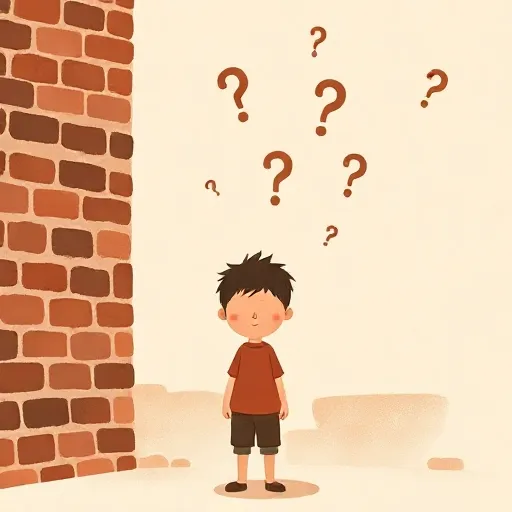
The ancient puzzle remains alive. Metaphor is not just decoration; it’s a mental tool. When you say a problem is a “wall,” you’re not merely describing it — you’re framing it as something solid that blocks your way. Thinking of it as a wall might make you search for a ladder, a sledgehammer, or a way around. But if you thought of it as a “puzzle” instead, you might sit down and calmly look for patterns. The metaphor you choose changes how you respond.
Philosophers still argue about whether metaphors really mean something extra, or whether they just show things. The comparison view, the secret-message view, and the lens view each capture a piece of the truth, and none quite settles the matter. What is certain is that metaphors are everywhere in your head — shaping how you talk, how you argue, and how you handle the hard stuff. Noticing them is the first step toward thinking with care about what your own words are doing.
Think about it
- If someone says “Time is a river,” what does that make you notice about time? Can you invent a different metaphor for time that would make you feel differently about being late?
- Why might it be harder to explain a metaphor to a computer program than to a friend? What does a program lack that you use when you interpret a metaphor?
- You probably use metaphors without planning them — calling an exam a “nightmare” or a friend a “ray of sunshine.” Pick one you used today. What real-life similarity was it leaning on? Could that metaphor become dangerous if you forgot you were using it?