You See With Your Whole Body, Not Just Your Eyes
A Soldier’s Strange World

In the 1920s, a soldier named Schneider survived a shrapnel wound to his brain. After his recovery, doctors noticed something odd. Schneider could still do everyday tasks: button his shirt, scratch a mosquito bite, or make wallets at his job. But if you blindfolded him and said, “Point to your nose,” he would freeze. He would wiggle his finger, guess, miss, and then piece together the movement as if he were solving a math problem. He had lost a silent skill that the rest of us use every second without thinking.
Maurice Merleau-Ponty (1908–1961), a French philosopher who studied cases like Schneider’s in depth, saw that this injury held a huge secret. It showed that normal perception is not like a camera recording the world, and it is not like a computer program calculating what’s out there. Instead, your body already “knows” how to find your nose, catch a ball, or feel the mood of a room — before your thinking mind ever gets involved. Merleau-Ponty spent his life mapping that bodily knowledge and showing why philosophy had been getting perception wrong for centuries.
The Old Theories: Your Mind as Camera or Calculator

For a long time, thinkers fell into two camps. The empiricists said perception is like dots of color hitting a screen. Sensations arrive as tiny atoms, and your mind glues them together by habit. When you see a dinner plate, you are really just picking up patches of white and round edges, then linking them to past meals.
The intellectualists thought that was sloppy. They said you can’t get a unified plate from stray sensations unless your mind already has a built‑in concept “plate” and actively judges what you see. The mind adds the structure, like a detective solving a case.
Merleau-Ponty argued that both sides make the same hidden mistake. They pretend the finished, solid object — the “real” plate — is already there, just waiting to be assembled. But before we ever name or judge a plate, we experience a Gestalt: a meaningful whole that arranges itself all at once, with a figure standing out against a background. Look at a vase‑or‑faces illusion. You don’t first see squiggles and then think “aha, a vase!” Your perception instantly organizes the shapes into either a vase or two faces — and you can’t have both at the same moment. The world shows up already patterned, and your body is what makes that patterning possible.
Your Body, the Secret Architect
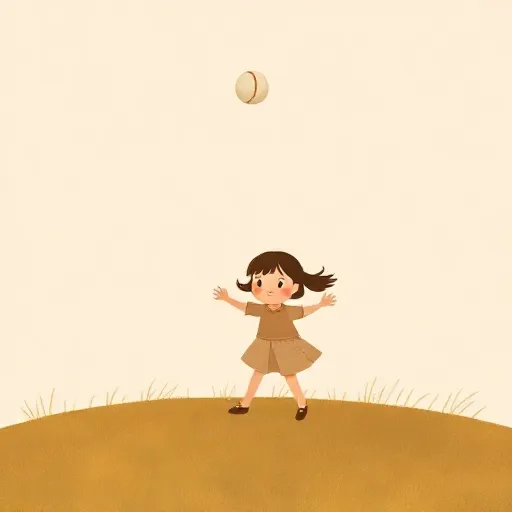
So what does your body contribute? Schneider’s trouble points to the answer. He could still perform concrete movements tied to familiar situations, like scratching an actual itch. But he had lost virtual movements — the ability to point to a spot in empty space, mime an action, or imagine where his limbs were without looking. Merleau-Ponty said that healthy bodies operate with a body schema, a pre‑conscious map of your posture, your possibilities, and your grip on the space around you. You do not need to think “rotate my shoulder 15 degrees”; your body simply reaches for the doorknob as an “I can,” not an “I think.”
He called this forward‑leaning orientation the intentional arc. It projects your past habits and your future aims into your surroundings, so that you are always already in a situation. When you ride a bike, lean into a curve, and suddenly straighten to avoid a pothole, your body is not following a set of rules — it’s living in space. Even time gets folded in: your habit‑body remembers how to ride, and your present body adjusts instantly. That is why phantom limbs happen, too. A person who has lost an arm may still feel it reaching for a cup, because the body schema has not yet re‑woven itself; the lived body’s “I can” persists after the physical limb is gone.
The Flesh of the World: Touching and Being Touched
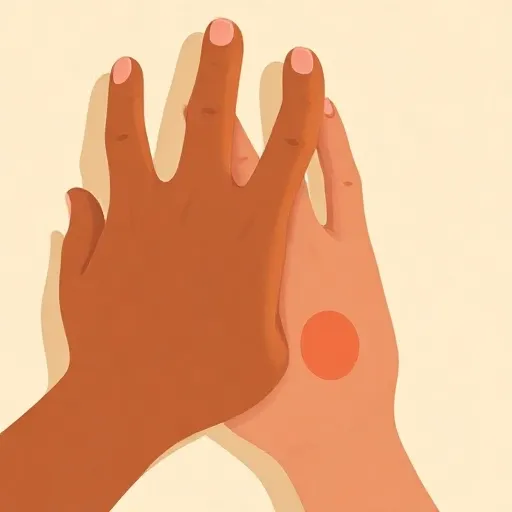
Try a simple experiment. With your eyes closed, touch your left hand with your right hand. You feel your left hand being touched — smooth, warm, solid. But at the same moment, your right hand feels itself touching. It is impossible to be purely the toucher or purely the touched; you are both, at once.
Merleau-Ponty took this everyday mystery and built his deepest philosophy from it. He said that this chiasm — a crossing‑over, like the X‑shaped crossing of optic nerves — belongs not just to your body but to the whole world. Your flesh and the world’s “flesh” are made of the same stuff. The tree you see is not a picture inside your head; you and the tree are both visible, part of one shared fabric. When you look at a mountain, your vision is somehow “over there” with the mountain, even while it remains yours. The body is not a wall separating you from the world — it is the very place where the world becomes visible and touchable.
Language and art grow from the same intertwining. Merleau‑Ponty studied painters like Cézanne, who did not copy a mountain but tried to capture the birth of perception — the moment seeing happens. A melody is not just a list of notes; it is a whole that can make you feel sad without a single word. When you speak, your words are not code for pre‑packaged thoughts. They are expressive gestures, like a handshake, that reach out and touch another person’s experience. Meaning is never stuck inside your skull; it lives in the body, the voice, the canvas, the shared air.
Why It Still Matters: You Are Not a Brain in a Jar

Schneider’s tragedy taught philosophy a permanent lesson: if your body’s silent grip on the world breaks, the world itself changes. The same is true in everyday life. When you walk into a room and sense that people are tense, you don’t first analyze their eyebrows — your body resonates with their posture and silence. When you learn a dance move, your muscles “get it” before your tongue can explain it. Merleau‑Ponty’s view reminds us that we are never just floating minds watching a movie. You are a living body‑subject, entangled with a world that is not a cold object but a familiar place full of meaning.
His ideas challenge the fantasy of a brain in a vat — the notion that you could be nothing but a mind stimulated by wires. For Merleau‑Ponty, that image makes no sense, because thinking arises only inside a body that moves, senses, and has a history. Even the most abstract mathematical idea carries a trace of the hand that wrote it and the space the thinker inhabited. The world is not a riddle you solve from the outside; it is the atmosphere you breathe, the ground you walk on, the flesh that sees and is seen.
Think about it
- When you learn to ride a bike, your body seems to “know” how to balance even if you can’t explain it. Can a thinking mind ever exist without a moving, sensing body, or is all thought bodily?
- If you could swap your brain into a robot, would you still be you? Merleau‑Ponty would likely say no — why might a body‑world connection be essential to who you are?
- When you watch a dancer, do you sometimes feel the movement in your own muscles? What does that tell you about how we really understand other people?