What Counts as a Real Piece of a Thing?
The Cake and the Crumb
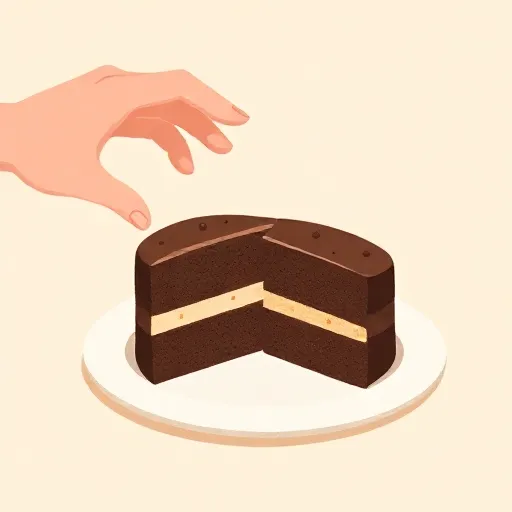
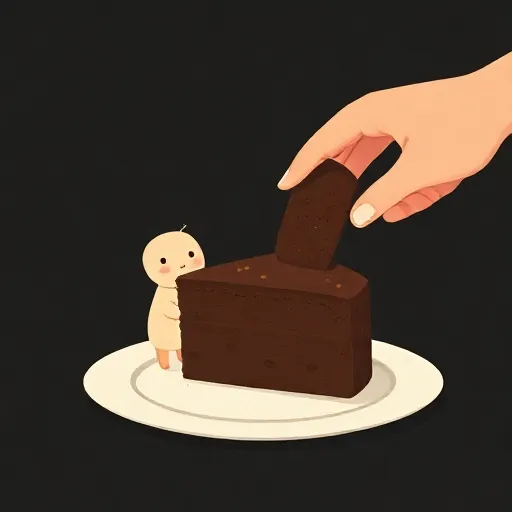
You and a friend split a cake. You cut it straight down the middle and lift away the left half. “This is my part,” you say. But is that half really a part? What about a single crumb stuck to the plate? Or the frosting on top? We use the word ‘part’ all the time. Yet when philosophers try to write the rulebook for parts and wholes—a field called mereology (from the Greek meros, “part”)—things get tricky fast.
Ordinary language lets ‘part’ mean many things: the handle of a mug, the cutlery that is part of the tableware, the first act of a play, even the clay that makes up a statue. Philosophers want to find the rules that apply in every case, no matter what kind of object we talk about. In 1916, the Polish logician Stanisław Leśniewski (1886–1939) built the first formal mereology. Later, Nelson Goodman (1906–1998) and Henry Leonard (1905–1967) created a “calculus of individuals.” Today thinkers like Peter van Inwagen (born 1942) and Peter Simons (born 1950) push the debates forward. The central question is deceptively simple: when a whole exists, what ties it to its pieces?
Three Rules for Parts
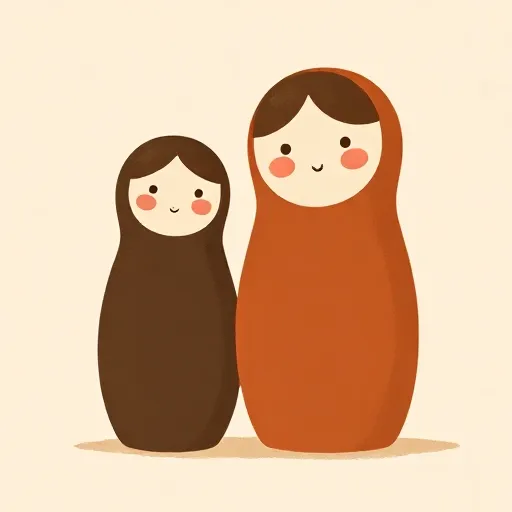
Philosophers start by agreeing on some basics. First, they distinguish a proper part from the whole itself: your hand is a proper part of your body, but your whole body is not a proper part of itself. With that in mind, three rules for proper parthood seem obvious.
Irreflexivity. Nothing can be a proper part of itself. Your left hand is a proper part of you, but it isn’t a proper part of your left hand.
Transitivity. If A is a proper part of B, and B is a proper part of C, then A is a proper part of C. The tip of your fingernail is a proper part of your finger, your finger is a proper part of your hand, so the tip is a proper part of your hand. Transitivity connects the whole chain.
Asymmetry. If A is a proper part of B, then B cannot be a proper part of A. Your heart is a proper part of you, but you are not a proper part of your heart. Two distinct things can never be proper parts of each other.
These three rules form what is often called Minimal Mereology. Almost every philosopher accepts them as the starting point—though some puzzles with time travel and looping stories challenge them. Still, they seem to fit everything from cakes to galaxies.
A Whisker, a Soul, and the Missing Remainder
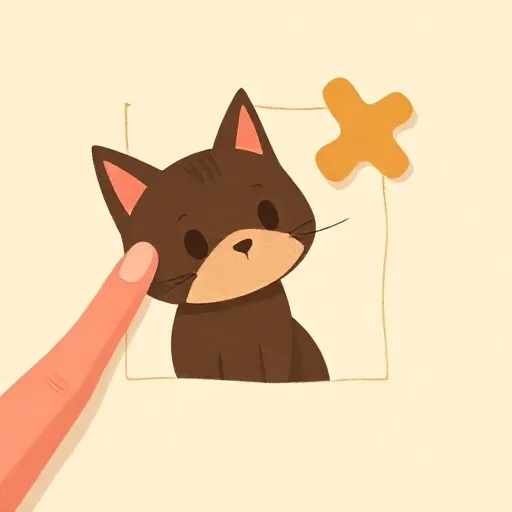
If your hand is a proper part of your body, then the rest of you—your feet, your head, your other hand—must also exist. A whole cannot be built out of a single proper part. This idea is called Supplementation. It says: whenever something has a proper part, there must be another, disjoint part that makes up the remainder.
Intuitively, that makes sense. If you pull a puzzle piece out of a jigsaw, a hole remains. But is Supplementation a necessary law for everything? Some philosophers have pointed out puzzles where a whole seems to have only one proper part. Imagine a mind and a thinking mind: the mind is a proper part of the thinking mind, yet there is nothing else—no extra “thing” to fill the gap. Or consider Tibbles the cat. Suppose Tibbles loses his tail. If the tailless cat is exactly the same as the lump of flesh that remains, then the tail was a proper part of the original cat with no separate remainder—the remainder is just the cat itself after the loss.
These examples put pressure on Supplementation. Many philosophers, including Peter Simons, think Supplementation must be part of our basic understanding of parthood. Others reply that the scenarios are genuine counterexamples, showing that the rule isn’t universal. The debate remains wide open.
When Does a Pile Become a Castle?
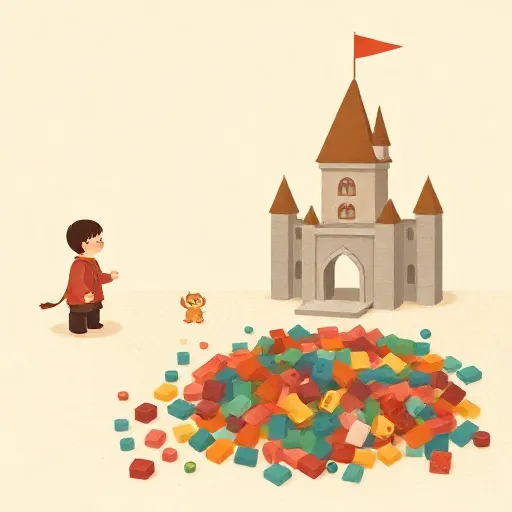
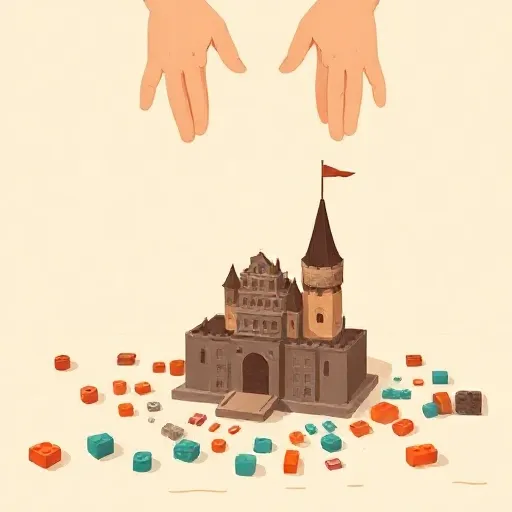
Take a heap of sand. Is it an object, or just a collection of grains? Now shape that sand into a castle. Did a new thing come into existence? The question of when parts compose a whole is what van Inwagen calls the Special Composition Question.
One extreme answer is mereological universalism: any collection of parts, no matter how scattered, composes something. Your nose and your thumbs form a genuine object, even though it’s not something we normally name. David Lewis defended this view. He argued that any attempt to draw a line—saying some collections count as objects and others don’t—would be hopelessly vague. Why would seven arranged bricks count as a house but six not? Since no sharp cutoff exists, the only non-arbitrary rule is that every collection makes a whole.
The opposite extreme is mereological nihilism: no collection of parts ever composes a genuine object. There are only simple, partless things (if any exist); tables and cats are not real wholes, just many simples arranged table-wise or cat-wise. Van Inwagen himself defended a middle path: only living organisms compose something. For him, a cat is a genuine whole, but a sandcastle is not.
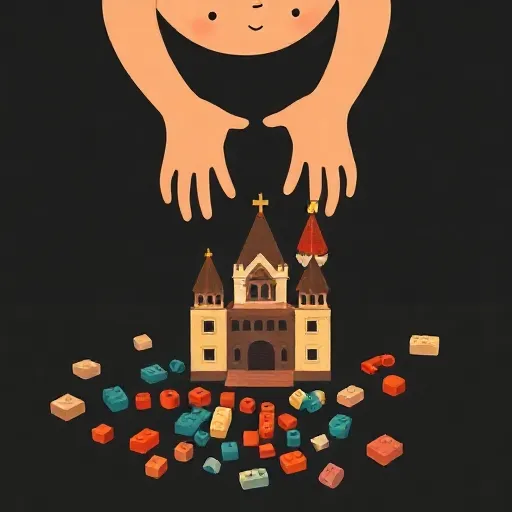
The debate is far from settled. It forces you to ask: when you look at a Lego castle, are you seeing one thing or a swarm of bricks? Your answer changes what you think exists.
The Statue, the Clay, and You Over Time
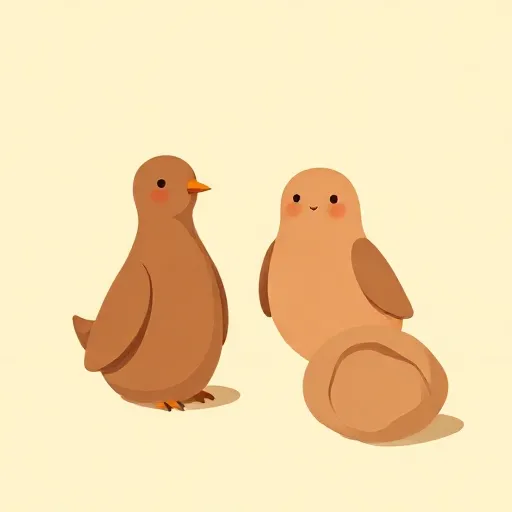
Consider a clay statue. At this moment, the statue and the lump of clay it is made of share exactly the same proper parts—every tiny bit of clay is part of both. If two objects have all the same proper parts, must they be identical? That principle is called Mereological Extensionality.
Many philosophers say yes: if the parts are the same, the whole is the same. But here’s the trouble. The lump of clay could survive being squashed into a ball; the statue could not. That suggests they have different properties, so they must be two distinct things even though they share their parts right now. This puzzle appears whenever an object is made of some material.
Extensionality also runs into problems with change. Suppose Tibbles the cat loses a whisker. Before the loss, Tibbles-with-whisker had a whisker as a proper part; after, Tibbles-without- whisker does not. If identity required the same proper parts, then the cat would be a different entity after losing even a single hair. But we think a cat can survive small changes. So either we abandon strict extensionality, or we rethink how objects persist through time.
These puzzles show that the rules of parts interact deeply with questions about what it means to be the very same thing from one moment to the next.
Zooming In, Zooming Out: What Are You Made Of?
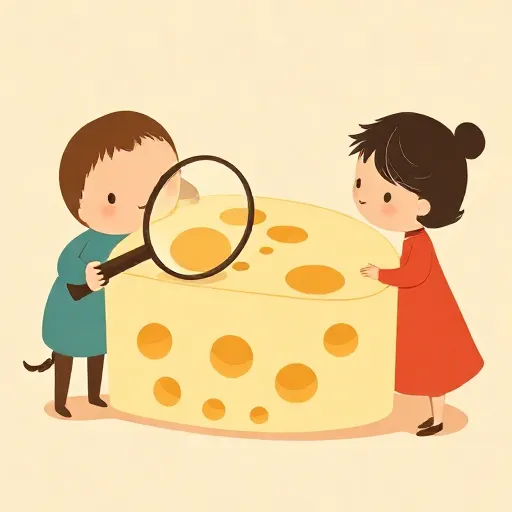
Now take your own hand. Is it made of cells? Are those cells made of molecules, and those molecules of atoms? Philosophers ask whether this dividing ever stops. An atom in mereology is not a physical atom with protons and neutrons; it is simply something that has no proper parts at all—a truly simple thing. Atomism is the view that everything is ultimately composed of such simples.
The rival view is that matter is gunky: you can divide any part into smaller proper parts forever. There is no bottom level. In a gunky world, any slice of cheese, any hair, any drop of water contains infinite smaller parts. Is that possible? Many philosophers think so. Some even imagine that the universe is “junk”—things keep composing larger and larger wholes without end, so there is no single biggest object.
Whether the world is atomistic or gunky matters for how you think about what you are. If you are made of gunk, then you are an endlessly nested set of parts within parts—never resting on a firm foundation. That doesn’t make you any less real, but it changes the picture of what lies beneath your skin.
Mereology doesn’t hand you a final answer about atoms or gunk. It gives you the tools to ask the question clearly. The next time you look at your hand, you can wonder: is it a single thing, a bundle of cells, or an unending cascade of ever-smaller parts? That’s a deep question, and it’s still being argued about.
Think about it
- If you replace every single brick of a Lego castle one by one with a new brick, is it still the same castle at the end? Why or why not?
- Could there exist an object made of two completely separate things—like your left shoe and a star in another galaxy? Would you call that a single object?
- Imagine a world where nothing has parts—everything is just a simple, partless blob. Would you still be you? What would change?