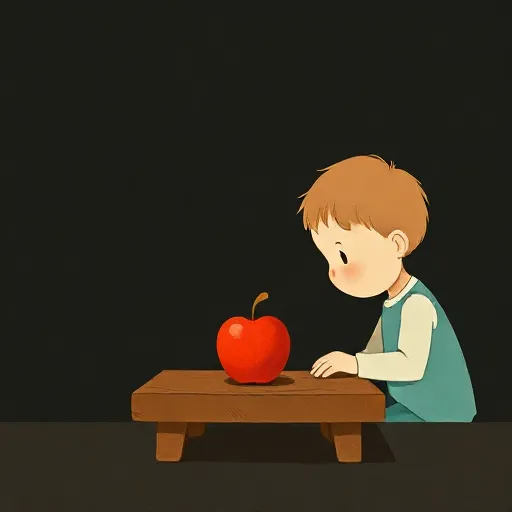

What Happens When You Close Your Eyes and Picture an Apple?
A Glimpse of an Apple That Isn’t There

Close your eyes for a moment and picture a shiny red apple. Do you “see” something — a faint image floating in your head? Maybe you almost sense its smooth skin, even though no apple is in front of you. That inner flicker is mental imagery: a sensory experience your brain creates without any input from the outside world. It is not just about vision; you can have auditory imagery (a song stuck in your head), tactile imagery (the feeling of sand), or even the taste of lemon.
Scientists define mental imagery as perceptual representation not triggered directly by sensory input. In plain words, your brain runs the same kind of simulation it uses when you really see, hear, or touch something — but there is no actual apple, no real sound, no skin contact. The early sensory cortices light up as if the world were right there, even though your eyes are shut.
Not everyone has the same inner world. Some people, called aphantasics, report no conscious mental images at all. When they try to visualize an apple, they see only darkness. Yet even many aphantasics may have unconscious mental imagery — their visual cortex still responds, but the experience never reaches awareness. It is like people with blindsight, who cannot consciously see an object but still react to it. So mental imagery is not always something you feel; it can work under the surface.
Mental imagery is different from imagination. Imagination is usually something you do deliberately: “Now I will imagine a castle.” But mental imagery can be involuntary. Think of the tune you can’t shake off, or a sudden flashback to an embarrassing moment. Those earworms and flashbacks are mental imagery, not imagination — they pop up whether you want them or not.
The Cat Behind the Fence: Filling In What You Can’t See

Look at a cat lounging behind a picket fence. You only see slices of fur between the slats, but your mind doesn’t treat the hidden parts as mysterious gaps. It automatically “fills in” the cat’s full shape. This is amodal completion — your brain represents the parts you cannot actually see, and it does so inside the very early visual cortex. No light from the cat’s hidden tail lands on your retina, yet your visual system builds a complete cat.
Philosophers have long wondered whether perception always leans on mental imagery this way. Immanuel Kant (1724–1804) argued that imagination is “a necessary ingredient of perception itself.” What Kant likely meant, in modern terms, is that mental imagery partly builds your everyday seeing. When you look at a coffee mug, you see only the front and sides — but your brain completes the back surface without you even noticing. That is mental imagery woven into ordinary perception, not just daydreaming.
Amodal completion is not a guess or a belief; it is a genuine perceptual process that happens fast and early in the brain. Because it is triggered indirectly (the visual input from the visible slats triggers the representation of the hidden shape), it fits the definition of mental imagery. So perception itself turns out to be a blend of outside stimulation and imagery that fills the gaps.
How Imagining a Growling Dog Makes Your Heart Race

Picture a snarling dog right under your desk, snapping at your feet. You know the dog is not real, but your heart may pound a little faster. Mental imagery and emotion are a two-way street. Imagery can spark genuine feelings — and your mood can decide which images pop into your head. If you are already anxious, scary imagery surfaces more easily; if you are happy, cheerful scenes come more readily.
This link even reaches into memory. Episodic memory — the kind where you re-live a past experience, like your last birthday party — depends heavily on mental imagery. When you recall the party, your brain reactivates sensory areas, almost replaying the cake, the music, the voices. That is why losing the ability to form imagery often weakens the ability to remember personal experiences vividly.
Emotions can also “rub off” on places through imagery. Imagine a huge argument in the school corridor. Later, just walking down that same corridor may give you a shiver — the negative feeling from your mental imagery has clung to the real location. The same effect works with purely imagined events, not only with real ones.
Why You Choose Chocolate Cake Over an Apple
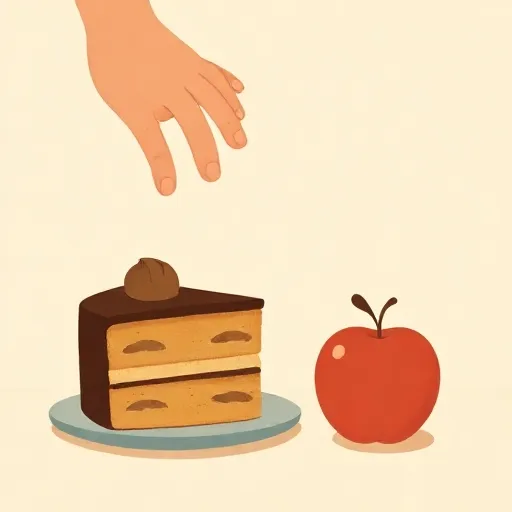
When you are deciding between two snacks, the option that calls up the most vivid mental imagery often wins. A piece of chocolate cake paints a rich, detailed picture in your head — melting frosting, sweet smell. A plain apple brings a hazy, dull image. That difference can tip your choice, even if you rationally want the apple.
Mental imagery lurks behind some of our unthinking biases, too. In well-known experiments, people are more likely to mistake a harmless object for a gun when a Black person is holding it than when a white person is. Researchers suggest that a biased mental image of a gun gets triggered automatically, influencing perception and action without conscious awareness. Because the imagery does not have to be conscious, it can steer behaviour before you notice.
The good news: if mental imagery can steer us wrong, it can also be used to steer us right. Deliberately picturing a detailed, calm scene (like a rose garden) can reduce cigarette cravings. Training people to reshape their imagery has been shown to weaken implicit racial bias. So mental imagery is not just a behind-the-scenes puppeteer — it is something you can learn to direct.
When Movies Borrow Your Mind’s Eye
Artists and filmmakers have long known how to hijack your mental imagery. In the 1950 film Harvey, the main character insists he has a six-foot-three rabbit companion. We never see the rabbit, but the camera frames every shot as if a giant creature stands beside him. Your imagery fills the empty space. Alfred Hitchcock and Ridley Scott famously showed their monsters only sparingly, because what you imagine is scarier than what you see.
Music plays with mental imagery, too. When you hear the opening “Ta-Ta-Ta” of Beethoven’s Fifth Symphony, your brain forms an auditory image of the fourth note — the mighty “Taaam” — before it sounds. That expectation is auditory temporal mental imagery. If the real note arrives late or off-pitch, you feel the mismatch, and that’s what makes the music gripping. In the installation Earth-Moon-Earth, Beethoven’s Moonlight Sonata is played with random notes missing. Listeners who know the piece automatically fill the silence with mental imagery.
Writers, too, depend on your imagery. Marcel Proust showed how a character’s name triggers a visual image that grows sharper as you read, and Roberto Bolaño once described a character for 80 pages before revealing he was African-American — forcing readers to confront their own unconscious images. In conceptual art, Marcel Duchamp drew a moustache on the Mona Lisa, then later displayed an unmarked Mona Lisa titled “shaven.” To see it properly, you have to mentally picture the missing moustache.
Why Your Inner World Matters

Mental imagery is not a magic side-show; it is embedded in nearly everything you do. It sculpts your memories, colours your feelings, nudges your choices, and brings art to life. Next time you get a song stuck in your head, or you can’t decide whether to keep scrolling or do homework, mental imagery is in the driver’s seat.
Because imagery is so powerful, philosophers ask: can it give you new knowledge? Imagine wrapping a chocolate box in paper. You picture the paper needed, and the image surprises you — it is much larger than you assumed. You just learned something from mental imagery alone. That raises a deeper issue: if perception itself is partly imagery (filling in the cat, completing the backs of objects), can we always trust our own eyes? The answer is not settled, but the question matters every time you “see” something that isn’t fully there.
Finally, knowing that some people — aphantasics — live without conscious imagery reminds us that inner worlds vary wildly. Your friend may not “see” the same apple you do, or any apple at all. That difference doesn’t make anyone wrong; it makes mental imagery a deeply personal, still-mysterious part of being human.
Think about it
- If you could switch off all mental imagery for a day, how would your memory of your best friend change? Would you still know them as clearly?
- Your brain fills in the hidden parts of a cat behind a fence automatically. Could that everyday filling-in make eyewitness testimony less reliable? Why or why not?
- Think of a time you felt scared just from imagining something. If the image in your head makes your heart pound, is that fear as real as fear caused by a real event? How could you tell the difference?