
Is the Apple Real? The Surprising Debate Over Seeing
The Apple and the Veil

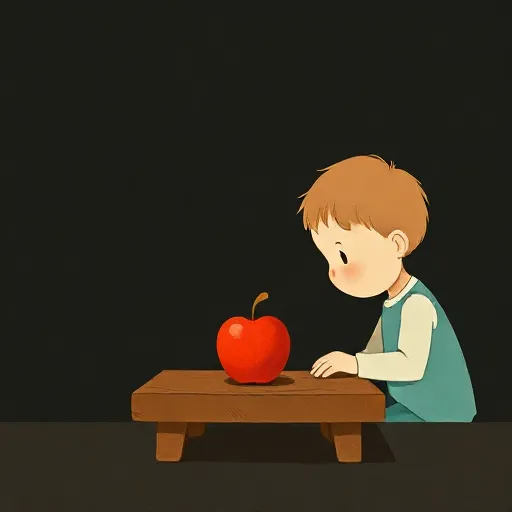
You open your eyes and see a red apple on the table. Almost instantly you believe there is an apple there. But what exactly is happening inside your mind? And does that mental event give you a good reason — what philosophers call justification — for your belief? For centuries, thinkers have argued that the nature of your visual experience changes everything. If your experience is like a private screen flickering inside your head, then the real apple might be forever out of reach. If it’s only a raw tingle without any message about the world, then it may not justify your belief at all. But if your experience already says something about the apple — the way a map says “there is a hill here” — then maybe your belief is directly supported. This is not just an abstract puzzle. It haunts courtroom testimony, everyday trust in your senses, and even whether you can know anything at all.
A Private Screen in Your Mind? Sense‑Data and the Veil of Ideas

In 1932, the British philosopher H. H. Price (1899–1984) knelt beside a tomato and concluded that, even if he doubted everything else, he could not doubt that “there exists a red patch of a round and somewhat bulgy shape” presented to his consciousness. According to sense‑datum theories, every successful visual experience puts you in contact with such a mental object — a sense‑datum. If it seems to you that a red thing is present, a red thing really is present — this red mental patch. The trouble is that in many illusions or hallucinations, there is no ordinary red object around. So sense‑data must be either strange mental items or weird non‑physical objects.
This picture creates a famous problem called the veil of ideas. If you only ever see your own sense‑data, how can you ever know anything about the real apple beyond the veil? The 18th‑century Irish philosopher George Berkeley (1685–1753) and the Scottish philosopher Thomas Reid (1710–1796) both attacked the theory on these grounds. They insisted that we do have knowledge of the world, so sense‑datum theory must be false. But a sense‑datum defender might try a rescue: maybe your experiences justify your apple‑belief when you add a further step of reasoning — an inference to the best explanation of why those sense‑data appear. The philosopher Bertrand Russell (1872–1970) explored this route. Yet many feel that experiences should give us non‑inferential justification — support that does not need extra beliefs as a bridge, the way a sharp pain directly justifies you in believing you are in pain. The veil‑of‑ideas suspicion is that, if your mind only ever contacts its own data, direct support for beliefs about the world is impossible.
When Seeing Is Just Feeling: Raw Feels and the Skeptic’s Challenge

At the opposite extreme, some philosophers have held that experiences are raw feels — mere sensations with no content about the world at all. Think of the phrase “seeing stars” after a bump on the head; you don’t literally see stars, and your experience isn’t of anything out there. The 20th‑century American philosopher Donald Davidson (1917–2003) used this idea to reach a skeptical conclusion. He argued that a sensation can only cause a belief, like a shove, but cannot justify it. Justification, he thought, requires that the source be propositional — something that can be assessed as true or false, like a sentence. A raw feel, being neither true nor false, can never be a reason for a belief.
If Davidson is right, then our visual experiences cannot justify our beliefs about external objects at all. But the British philosopher John McDowell (b. 1942) and others took the opposite path. They accepted the same linking principle — that a justifier needs propositional content — but refused to abandon the idea that experiences do justify beliefs. So they concluded that experiences must have such content. The argument can be put as a trilemma: experiences justify beliefs about the world; if they do, they must have truth‑assessable content; but experiences are raw feels without such content; something has to give. Davidson rejected the first claim; McDowell rejected the third.
Yet raw feel theorists might push back against the linking principle itself. Even a raw feel, they say, can justify you in believing that you are having it — think of a toothache. And if background beliefs are allowed, you could infer from a particular raw feel that a specific condition of the world exists, just as you might infer fire from the smell of smoke. Some modern defenders of raw feel approaches, such as the American philosopher Laurence BonJour (b. 1943), explore exactly that structure. Others, like the Finnish philosopher Katalin Farkas and the late American philosopher Tim Crane, argue that experiences might relate you to the world in non‑propositional ways, like a map being accurate without being true or false. So the link between raw feels and skepticism is not yet forced.
Built‑In Content: How Experience Might Justify on Its Own

Most philosophers today think visual experiences have some kind of content — they present the world as being a certain way, even if that way is not put into words. A natural idea then is that having an experience with a certain content is enough to give you defeasible justification for believing that content — justification that holds unless you have specific evidence that things are not as they appear. This is the sufficiency thesis, defended by contemporary thinkers such as Jim Pryor (b. 1968) and Michael Huemer (b. 1969). If true, it would mean that simply having an experience as of a red apple gives you a reason to believe there is a red apple, unless you know you’re in a house of mirrors.
But there is a famous problem: the speckled hen. Suppose a hen has many speckles, and you glance at it in good light without counting. Your experience might have a very precise content — loosely, “the hen has exactly 17 speckles.” Yet it seems you are no more justified in believing that than you would be by guessing. If the sufficiency thesis were correct, you would have justification automatically. So the hen case challenges the thesis. Some reply that your experience is actually silent about the exact number until you count. Others suggest that you do have justification for the detail, but the justification is somehow defeated because you know your quick glance is unreliable. The debate remains lively, and it raises deep questions about how finely grained your experience really is.
Foggy Mornings and Fading Evidence: Do Experiences Come in Degrees?

Imagine a snowy morning in the park. At first a thick fog hides everything; you can barely make out a blur. As the fog thins, a snowman emerges, and your confidence grows. Your justification for believing “there is a snowman” seems to come in degrees, rising step by step. The contemporary philosopher Jessie Munton has argued that this fact forces us to say visual experiences themselves are degreed — they have something like the structure of credences, or graded degrees of belief. Just as you can be 70% confident that a die will land on four, perhaps your visual experience can be a “visual credence” that a snowman is there, growing stronger with the clearing fog.
The argument works by a familiar triad. If experiences give immediate justification to varying degrees, and that variation is best explained by a variation in the experiences themselves, then experiences must be degreed. Critics try to block the second premise. Perhaps your experience presents not only the snowman but also the fog, and the foggy detail defeats the strength of justification without the experience itself having any graded feel. So even under a traditional non‑degreed picture, the same outcome might occur. Still, the idea of degreed experience opens up a whole new menu for thinking about perception — maybe your visual life is less like a snapshot and more like a dimmer switch, constantly adjusting the weight of evidence it offers.
Why You Should Care: Eyewitnesses, Courtrooms, and Everyday Trust

All these debates land closer to your life than they first seem. If a sense‑datum veil cuts you off from reality, then every time you rely on your eyes you are making a leap of faith. If experiences are bare feel‑states with no built‑in message, then you always need extra background beliefs to justify what you see — a shaky foundation that an evil‑demon scenario might collapse. And if experience’s content doesn’t automatically justify, then quick judgments in a courtroom or on a foggy street corner might be far weaker than they feel. The next time you see a friend across the playground, pause and ask: does your visual experience itself speak for the world, or are you always interpreting a private show inside your head? How you answer shapes what you think a witness really knows, and what you yourself are entitled to believe.
Think about it
- If you’re watching a magic trick, you have a vivid experience of, say, a coin vanishing. Does that experience give you a reason to believe the coin really vanished? What would each of the theories from this article say about that reason?
- Suppose you glance at a jar of marbles and your mind seems to say “38 marbles,” but you haven’t counted. Do you have any justification for believing there are exactly 38? If not, why does the number feel so present?
- Imagine a photo of a snowy park slowly coming into focus. Does your visual experience itself strengthen, or does only your confidence grow? How would you design an experiment to tell the difference?