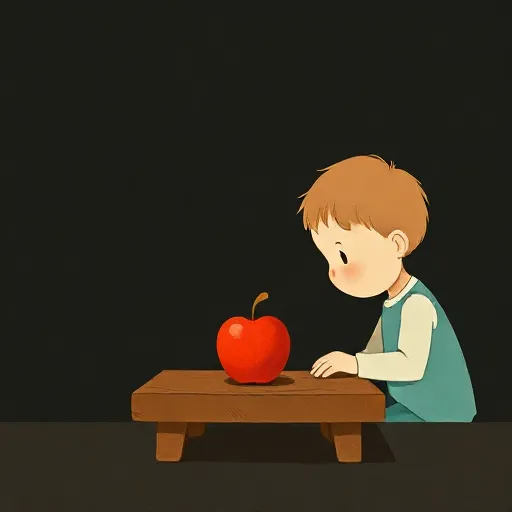

Is Seeing an Apple the Same as Just Dreaming One?
What Do Seeing and Hallucinating Really Have in Common?

Suppose you look at a bright red apple on the table. Light hits the apple, enters your eyes, and you see it — you know it’s there, you could grab it. Now imagine you have a perfect hallucination of that same apple. Your eyes are closed, but you seem to see it just as vividly. You cannot tell the difference.
A natural thought is: the seeing and the hallucinating must have something in common — a core conscious experience that is exactly the same in both cases. Many philosophers accept this. They say that veridical perception (when things are as they appear), illusion (when you misperceive something), and hallucination (when you experience something not there at all) all share the same basic kind of mental event. Call this the common kind claim.
A view called disjunctivism says no. Disjunctivists deny that you are having the same fundamental kind of conscious experience when you genuinely see an apple and when you merely hallucinate one. To them, the two episodes are as different as a door that really opens to the outdoors and a door in a painted backdrop — even if they look identical from where you stand.
This is not just a weird technical point. If disjunctivism is right, it changes what it means to really perceive the world, and it changes how we can know anything about it.
J. M. Hinton and the First Disjunctivist Move

The philosopher J. M. Hinton (1921–1998) is often credited as the first clear disjunctivist. In the 1960s and 1970s, he noticed something about how we talk about our experiences. When you are not sure whether you are really seeing something or just hallucinating, you might say, “I seem to see an F” — for example, a traffic light.
Philosophers before Hinton assumed that this kind of neutral report picks out a single type of mental event that is present whether you are truly seeing or just seeming to see. Hinton argued that we should instead treat such a report as equivalent to a disjunctive statement: “Either I am seeing a traffic light, or I am having that illusion of a traffic light.”
A disjunctive statement does not describe a common thing running through both situations. It just lists two very different possibilities without claiming they share an inner nature. Hinton’s point was that the default view should be the disjunctive one. If you want to insist there is a common element shared by seeing and hallucinating, you need to prove it — you cannot just assume it because the two feel the same from the inside. Your inability to tell the difference might not be a sign that the experiences are identical, but only that your introspection has limits.
McDowell’s Key: How You Touch Reality

John McDowell (born 1942) took up disjunctivism to defend a very practical idea: that we can genuinely know the world around us through perception. He worried about a tempting skeptical argument.
The skeptic says: Since a hallucination can feel exactly like a real perception, whatever is going on inside your head when you perceive must be the same as when you hallucinate. And if what is inside your head is the same, then your grounds for believing there is an apple in front of you are no better in the real case than in the hallucination case. So you never truly know whether you are perceiving or just hallucinating.
McDowell responded by denying the move. He said we can accept that a hallucination is subjectively indistinguishable from a perception, but we do not have to conclude that the two experiences have the same nature. Instead, we can think of an appearance that such-and-such is the case as being either a mere appearance (a hallucination) or the world itself making a fact perceptually manifest to you. When a fact becomes perceptually manifest, the external world is not something blankly outside your mind; it actually shapes your experience in a way that gives you direct knowledge. This makes a real perception epistemologically better than a hallucination — it puts you in a position to know things, even if you cannot always tell that you are in that position.
For McDowell, claiming you cannot know something unless you can also tell that you are in a position to know it is a mistake about self-knowledge. You can see that there is an apple and thereby know it is there, even while you lack an internal guarantee that you are not dreaming.
Martin’s Window: When the World Enters Your Experience

M. G. F. Martin (born 1965) offers a different motive for disjunctivism. He defends naïve realism, the view that when you veridically perceive, the actual objects in the world — the apple, the table, the cat — are constituents of your conscious experience. They partly determine its phenomenal character, what it feels like from the inside.
Think about what it is like to look at an apple. According to Martin, introspection suggests that you are directly aware of the apple itself, not just a mental picture of it. The apple seems immediately present to you, and your experience feels like it includes the apple — not like it merely represents it. This is called the transparency and immediacy of perceptual experience.
Since a hallucination does not connect you to any real apple, a naïve realist cannot say that a hallucination has the same phenomenal character as a real perception. They must be different kinds of mental events. Martin argues that this is actually the best error theory: we admit that hallucinations fool us into thinking they have a character they lack, but we preserve the deeply held sense that when we truly perceive, the world itself is present to our minds. If we reject naïve realism, we would have to say that even genuine perceptions never actually put us in touch with objects in the way they seem to.
Martin also argues that his approach is more epistemically modest than the common kind view. The common kind theorist has to claim that whenever two experiences are indistinguishable from the inside, they must share the same phenomenal properties. That assumes our introspection can always detect the absence of a property — a very strong power. Disjunctivism does not require such a superpower. It simply says that being indistinguishable from a real perception does not mean being the same kind of thing.
The Brain Trick: Objections and Puzzles
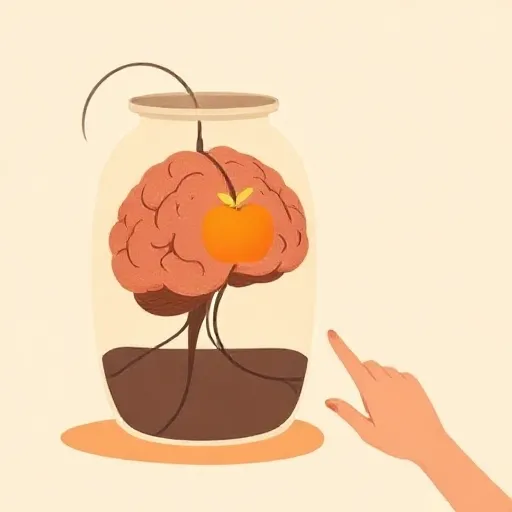
Naturally, many philosophers push back. A major objection is the causal argument. If we could activate exactly the same brain processes that occur during veridical perception and thereby produce a hallucination, shouldn’t the resulting experience be of the same fundamental type? After all, the immediate neural cause is the same. Disjunctivists reply that in genuine perception, the perceived objects are not just causes but essential constituents of the experience — so the same brain state alone cannot produce the same kind of mental event.
Another pressure comes from explaining what a hallucination actually is. If it does not have the same phenomenal character as a perception, can we say anything positive about it? Martin’s answer is that there is nothing more to the phenomenal character of a perfect hallucination than its property of being introspectively indiscriminable from a real perception. Critics find this unsatisfying: they say such a negative property cannot explain how hallucinations can feel like something, or how they let us know what it would be like to see a real apple.
Still, disjunctivists can point to the undeniable fact that your whole body and mind react in similar ways to both real seeing and perfect hallucination. You duck when a rock seems to fly at you, hallucination or not. But that behavioural similarity may be explicable simply because you cannot tell the two apart, not because they are the same mental kind.
Why It Still Matters: Are You Really Looking at This?

You are reading this article now. You see black marks on a screen, and that seeing seems to give you direct access to what is in front of you. But right now, you could also be dreaming this whole moment. If disjunctivism is correct, the experience of reading while awake and the experience of dreaming that you are reading are not the same type of thing at all. One hooks you into the real world; the other does not.
If disjunctivism is wrong, then even your most vivid perceptions are, at their core, just a kind of mental movie whose true connection to reality always remains a step removed. That does not mean knowledge is impossible, but it forces you to build a bridge from the inner movie to the outer world — a bridge that skepticism threatens to burn. Disjunctivism tries to erase the gap altogether for genuine perception.
Philosophers still disagree fiercely. But the debate touches something very close to home: when you trust your eyes, are you ever really in contact with the world, or are you always trapped inside your own head? Disjunctivism offers one way of believing that the world really can get through to you.
Think about it
- If you could be a brain in a vat, fed perfect virtual experiences, would you ever know you were not seeing real things? Would that matter to you?
- A friend swears they saw a ghost that nobody else could see. If they cannot tell the difference between seeing and hallucinating, does that prove that seeing and hallucinating are the same kind of mental event? Why might it not?
- Imagine eating your favorite food, then later having a vivid dream of eating it. Even if the dream feels identical, would you say the two experiences are of the same kind? What, if anything, could be missing?