Why Aristotle’s Perfect Logic Broke Down When You Added “Necessarily”
All Humans Are Animals: The Perfect Logic Machine

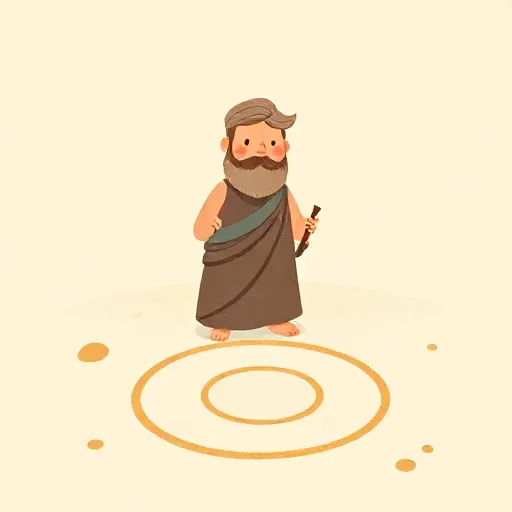
You’re a student at the University of Paris in the year 1250. Today’s lesson is logic. The master draws three circles on the blackboard and writes:
- Every human is an animal.
- Every Greek is a human.
- Therefore, every Greek is an animal.
This is a syllogism — a three-sentence argument invented by Aristotle (384–322 BCE). A syllogism has two premises and a conclusion. The middle term (here “human”) connects the premises. If the premises are true and the pattern is valid, the conclusion must be true. Aristotle found that only certain patterns work. The pattern above is called Barbara. It’s as solid as a brick wall.
For centuries, logicians were happy. The theory of the syllogism seemed like a perfect, finished machine for reasoning about facts. But there was a hidden crack. Aristotle himself had tried to expand the machine to handle words like “necessarily” and “possibly.” And that’s when the trouble began.
The Trouble with “Necessarily”: A Puzzle That Broke the Rules
Try this. Suppose you know two things:
Argument 1
- All humans are necessarily animals.
- Socrates is a human.
- So, Socrates is necessarily an animal.
Almost everyone agrees: that sounds right. Being an animal is part of what makes you human. Now flip the placement of “necessarily”:
Argument 2
- All humans are animals.
- Socrates is necessarily a human.
- So, Socrates is necessarily an animal.
Here, the second premise says that Socrates couldn’t have been anything but a human. Does it follow that he couldn’t have been anything but an animal? Not so fast. Aristotle himself accepted the first argument but rejected the second. The patterns are almost identical — only the word “necessarily” moves from one premise to the other. Why would one work and the other fail?
Medieval logicians called this “the problem of the two Barbara syllogisms.” They saw that modal syllogistic — logic that mixes words like “must” and “maybe” with ordinary facts — was full of such puzzles. A perfect machine had a deep flaw, and fixing it became one of the great projects of the next several hundred years.
Kilwardby’s Fix: Only What’s Essential Counts
Robert Kilwardby (d. 1279) thought he could save Aristotle’s system by looking closely at the kinds of things necessity attaches to. He drew a sharp line between two types of necessity.
First, there is per se necessity (Latin for “through itself”). A statement is per se necessary when the predicate is part of what the subject is. “A triangle has three sides” is per se necessary because three-sidedness is built into the very idea of a triangle. In Kilwardby’s view, “All humans are necessarily animals” is per se because being an animal is part of the definition of being human.
Second, there is per accidens necessity (“by coincidence”). A statement like “All literate beings are necessarily human” is true in the real world — if you can read, you’re human — but it’s not per se. Being literate is not part of the definition of being human. It’s a fact that happens to hold, not one that must hold by the very nature of the things.
Kilwardby argued that Aristotle’s modal syllogisms were meant only for per se necessary sentences. Conversion rules (like turning “No B is A” into “No A is B”) work only if the link between the terms is essential. In the two Barbara arguments, the second one fails because the minor premise “Socrates is necessarily a human” is not a per se predication in the required way. It involves an individual (Socrates) and a universal (human), and the connection isn’t purely essential.
By restricting modal logic to statements about essences, Kilwardby managed to salvage many of Aristotle’s results. But not all. Even his clever solution couldn’t make every accepted mood come out right. The effort to save Aristotle by appealing to essences was brilliant, but incomplete.
Buridan Rewrites the Rules: What Words Really Stand For
John Buridan (c. 1300–1361) eventually decided that trying to rescue Aristotle’s exact system was a dead end. Instead of asking what Aristotle meant, he asked a more basic question: what do the words in an argument actually stand for, and how are they distributed?
His key idea was supposition. Take the sentence “All dogs are mammals.” The word “dogs” supposits for (stands for) every actual dog — past, present, and future. Now add “possibly”: “All dogs are possibly mammals.” For Buridan, the modal word “possibly” does something special: it ampliates the subject. That means “dogs” now stands not only for actual dogs, but for possible dogs too. This one move cleared up a lot of confusion about modal sentences.
He also introduced the concept of distribution. A term is distributed in a sentence if it refers to absolutely everything it stands for without exception. In “All dogs are mammals,” “dogs” is distributed. In “Some dogs are brown,” “dogs” is not distributed — the sentence only talks about part of the group. Buridan gave simple rules: universal quantifiers (“all”) distribute the subject; negative verbs distribute the predicate.
With distribution on the table, checking a syllogism’s validity became almost mechanical. The middle term must be distributed at least once. Premises can’t both be negative. And so on. Using these rules, Buridan was able to prove many more valid moods than Aristotle had — including patterns with indirect conclusions and tricky arrangements of terms. He didn’t bother with four figures; he treated the fourth figure as just the first figure with the premises swapped.
Moreover, Buridan folded syllogistic logic into a larger theory of consequences (if-then relationships). This allowed him to handle composite modal sentences (where the modality applies to a whole statement, like “It is necessary that every human is an animal”) with the same rules as assertoric logic, and to treat divided modal sentences (where the modality attaches to the copula, like “humans are-necessarily animals”) with his ampliation and distribution method.
The result was a powerful, unified system. For the first time, the rules for reasoning with “necessarily” and “possibly” were as solid as the rules for reasoning about plain facts.
Why This Still Matters: From Medieval Logic to Your Own Thinking

You might never sit in a candlelit classroom chanting “Barbara, Celarent.” But you use syllogisms every day. When you think, “If it rains, the game is canceled; it’s raining; so the game is canceled,” you’re running a valid argument. When you weigh possibilities — “I could take the bus, but that might make me late” — you’re doing modal logic.
Buridan’s breakthroughs helped turn logic into something far more systematic than Aristotle had imagined. His ideas about distribution and consequences paved the way for later thinkers who built the symbolic logic that runs modern computers. The core question — how do we reason correctly about what must be true and what might be true? — is still alive in philosophy, mathematics, and artificial intelligence.
The medieval struggle over those two Barbara syllogisms was not just a dusty historical puzzle. It was the beginning of a transformation that turned logic from a closed book into an open toolbox. And every time you figure out what follows from what, you’re reaching into that toolbox yourself.
Think about it
- If you say “All dragons breathe fire,” is that a necessary truth? Could there be a creature called a dragon that doesn’t breathe fire? How would you decide?
- A robot uses strict logical rules to decide what to do next. Should its programming allow for “possibly” and “maybe,” or only for “must” and “never”? What might go wrong either way?
- Design your own two short syllogisms using “must” — one that feels clearly valid, and one that feels shaky. What is it about the shaky one that makes you doubt it?