
Can the Bible Say One Thing and Mean Another?
A Letter That Started a Secret Book

In the late 1100s, a brilliant rabbi named Moses Maimonides (1138–1204) received a desperate letter. A young student was torn. The Bible described God sitting on a throne, reaching out a hand, or speaking — but reason said God cannot have a body, a place, or a voice. How could both be true? Maimonides didn’t fire off a quick answer. He spent years writing the Guide of the Perplexed, a book that still makes readers scratch their heads. The student’s worry is your worry too: what do you do when a holy text says one thing, and your mind says another?
Maimonides lived in the Islamic world and devoured the works of Muslim thinkers like al-Farabi (c. 872–950), Avicenna (980–1037), and Averroes (1126–1198). They had already been wrestling with a similar problem: the Quran sometimes talks about God in human terms. Their solution shocked many. They argued that scripture has an outer, story-like layer for everyone, and an inner, philosophical layer for those who can handle it. Maimonides took that idea and ran with it — straight into Judaism.
A God Beyond Words

Imagine trying to describe the sun to someone who has only ever known a candle. You might say “it’s not small,” “it’s not weak,” “it’s not yellow like a flame.” You could pile up a thousand “nots” without ever capturing the sun’s actual brilliance. That’s exactly how Maimonides’ God works. He is so perfectly one, so absolutely simple, that no label fits. This is called negative theology, or apophasis — talking about God by saying only what He is not.
For Maimonides, any sentence that starts “God is…” (merciful, wise, powerful) falls apart. Why? Because every description splits a thing into two pieces: a subject and a quality. But God has no pieces. He is pure unity, pure existence itself, not a being who happens to exist. Maimonides picked up this idea from Avicenna, who taught that God is the one “necessary being” — the only thing that must exist, whose essence and existence are identical. In God, there is no “what” separate from “that.”
If God is pure unity, Maimonides argued, then God cannot have a body or emotions. Those Bible verses about God’s mercy or anger? They don’t describe God’s inner life. Instead, they describe the effects of God in the world. When a baby develops perfectly in the womb, protected and nourished, that looks like the result of mercy — so we call God merciful. But the word points to a wise design, not to a divine feeling. Al-Farabi and other Islamic philosophers had paved this path, blending Aristotle’s idea of God as a self-knowing intellect with the Neoplatonic sense of God as the purest, most unified being.
God as intellect is another piece of the puzzle. Maimonides wrote that God is “an intellect in act” — always fully knowing, never learning, never forgetting. Because God’s knowing isn’t like yours: you need a brain, a subject to learn about, and time to do it. God’s knowing is God. The knower, the act of knowing, and the thing known are all one identical reality. This isn’t just an abstract claim; it means you can’t picture God as a mind sitting somewhere, thinking thoughts. There is no “somewhere” and no sequence.
The Overflowing Cosmos

How does the world connect to a God who can’t be described? Maimonides answered with an image that had already swept through Islamic philosophy: emanation. Think of sunlight streaming from the sun. The sun doesn’t decide to shine each morning; shining is what it does, naturally and eternally. In a similar way, God’s goodness “overflows” and produces reality. This isn’t God snapping fingers to create things in time; it’s more like a constant, necessary outpouring.
Maimonides described a ladder of ten cosmic intellects, each one flowing from the one above it. At the very bottom sits the active intellect — the intellect that governs our world below the moon, gives form to matter, and touches every human mind. For al-Farabi and Avicenna, and for Maimonides, when you understand something, it’s because a light from that active intellect reaches your own intellect and wakes it up. Knowledge isn’t just information you gather; it’s a kind of spiritual illumination.
Here’s where things get tricky: Maimonides also said he believed in creation ex nihilo — the world made from nothing, in time, by God’s free will. But many sentences in the Guide sound like eternal emanation. He admitted there’s no airtight proof either way. Scholars still argue fiercely: was Maimonides secretly an eternalist, hiding his true view? Or did he truly believe in a beginning? This uncertainty mirrors debates among Islamic thinkers. Avicenna held that the world is eternal but still caused; Averroes insisted the world is “generated ab aeterno” — neither beginning nor ending, always springing from God. Maimonides left his own position veiled, perhaps on purpose.
The Prophet’s Double Duty
If truth comes through the active intellect, how does it reach everyone else? Maimonides drew a sharp line between a philosopher and a prophet. A philosopher may conjoin her intellect with the active intellect and grasp real truths — but she can’t move a crowd. A prophet can do both. The prophet’s rational faculty is perfectly actualized, and her imaginative faculty is at its peak. That second gift lets her wrap difficult concepts in stories, laws, and rituals that sink into people’s hearts.
For Maimonides, following al-Farabi, this is why religion exists. Philosophy demonstrates the truth with cold logic; religion persuades with warm, powerful images. The average person (Maimonides called them the “multitude”) can’t handle pure abstraction. They need God described as a king, a father, a judge. Those descriptions aren’t literally accurate, but they steer behavior toward goodness. The prophet-lawgiver — Moses above all — crafted the Torah as a masterwork of persuasion, full of what Maimonides called “words fitly spoken.”
This view makes prophecy a natural human capacity, not a supernatural interruption. A person with the right natural disposition and training can receive the overflow from the active intellect. However, Maimonides added an odd twist: he said God can “veto” a prophet, miraculously blocking someone who seems perfectly qualified. Whether that’s his real view or another strategic layer is hotly debated.
Golden Apples in Silver Filigree

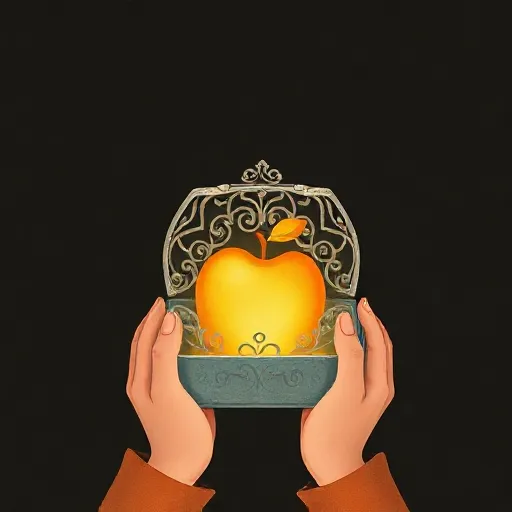
Maimonides loved a line from Proverbs: “A word fitly spoken is like golden apples in silver filigree casings.” The silver work is beautiful and catches your eye. But if you look through the tiny gaps in the lattice, you glimpse the gold inside. The Bible, he argued, works the same way. Its stories of God walking in the garden or smelling a pleasing aroma are the silver filigree — vivid, imaginable, and designed for people who think in pictures. The gold is the pure philosophical truth: God has no body, no place, no change.
This is allegorical interpretation, and Maimonides didn’t invent it. Al-Farabi and Averroes had already described scripture as having an outer sense (ẓāhir) for the masses and an inner sense (bāṭin) for the wise. Averroes even warned that explaining the inner sense to ordinary people could make them stumble into unbelief. Maimonides mostly agreed — though he insisted that everyone, even the simplest believer, must be told explicitly that God has no body. That put him at odds with Averroes, who thought it was safer to let regular folk picture God as they pleased.
The Guide itself is built like a filigree case. Maimonides announced at the start that the book would contain deliberate contradictions. Sometimes he states a view and then seems to say the opposite later. He listed seven reasons authors do this, and said he used the fifth (teaching step by step) and the seventh (concealing deep matters while dropping hints). So reading Maimonides is a bit like solving a puzzle where the clues are scattered on purpose. That’s why his real opinions on creation, prophecy, and immortality are still anyone’s guess.
Why the Hidden Meanings Still Matter

You’ve probably been told something “wasn’t meant literally.” Maybe a friend described a test as “impossible” when it was just tough, or a parent said “I’m so hungry I could eat a horse.” You had to figure out what they really meant. Maimonides’ big idea is that whole sacred books might work that way — and that’s okay. What matters is not the picture on the surface, but the understanding it points toward.
This raises a real-life question: is it ever right to hide the whole truth from someone for their own good? Parents, teachers, and governments do it all the time, simplifying dangers or complex ideas. Maimonides would say yes — if the goal is to lead someone toward a better life they couldn’t reach by raw facts alone. Others have argued that keeping the truth from anyone, however kind the motive, treats them like a child. That tension between honesty and care hasn’t gone away.
Maimonides also leaves you with a challenge about your own mind. He thought your intellect is the part of you most like God — a spark that can connect to something cosmic. But connecting isn’t automatic; it takes training, effort, and learning to see past the silver casing. In a world filled with catchy images and clickbait headlines, the discipline to look for the gold inside is still worth practicing. The Guide might be 800 years old, but the question it asks is fresh: when you read, listen, or believe — are you holding the apple, or just admiring the filigree?
Think about it
- If a holy book describes God as a king sitting on a throne, should we take that literally even if it clashes with logic? Or should we look for a hidden meaning? Who gets to decide which meaning is the right one?
- Maimonides thought some truths are too difficult for most people, so they need picture-language. Is it ever okay to deliberately shield someone from the whole truth? What would you lose if you were the one being shielded?
- Suppose your best ideas really could come from a cosmic source outside your own brain. Would you still need to study and work hard to understand things? What would be the point of learning if knowledge were a gift that some people just receive?