
Can You Love a God You Can't Even Describe?
The Boy Who Read Too Well

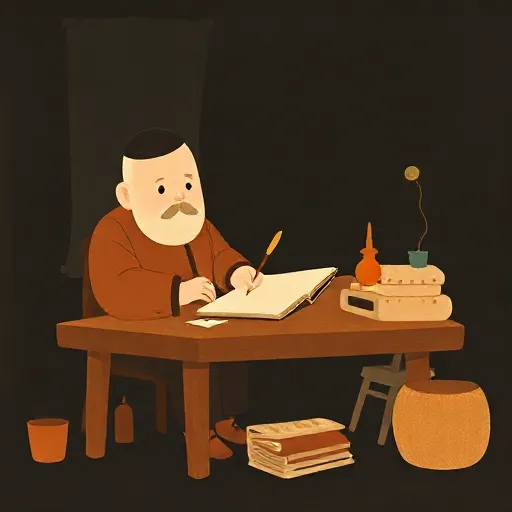
Moses ben Maimon — we call him Maimonides (1138–1204) — was born into a dazzling, dangerous world. His hometown, Cordoba in Spain, was a center of science, poetry, and trade where Muslims, Jews, and Christians swapped ideas. But when he was ten, a fanatical group called the Almohads invaded and gave non-Muslims a terrible choice: convert, run away, or die. His family fled. For years, they lived as refugees, moving from one city to another across Spain and North Africa.
That experience could have made anyone narrow and fearful. Instead, Maimonides became the most famous Jewish philosopher of the Middle Ages. As a rabbi and a doctor, he spent his days treating patients and his nights writing. His biggest puzzle: what do you do when a perfect, timeless sacred book seems to disagree with the hard-won discoveries of science and philosophy? His answer was so bold that some rabbis banned his books — and readers still argue about it today.
Maimonides was convinced that Judaism and real philosophy are the same truth, just spoken in two different ways. He saw the Bible not as a collection of simple stories but as a guidebook pointing toward the deepest realities about the universe and the mind. The problem was that most people couldn’t handle those realities. So, he argued, the Bible speaks in parables — stories whose surface meaning is for beginners, and whose hidden, philosophic meaning is for those who study long enough to find it. You just have to be willing to dig.
Not a Man in the Sky

Here is the mistake Maimonides thought most people make: they read the Bible literally and imagine God as a big, powerful human being. They picture a king on a throne, a mighty hand, a booming voice. For Maimonides, this was a disaster. Not only is it wrong, he said, it is actually a form of idolatry — worshipping a made-up being instead of the real one. To worship God under a false description is not to worship God at all.
He launched a full-scale campaign to “demythologize” religion. When the Bible says the elders of Israel “saw” God, Maimonides counters: it means they had an intellectual insight, not that their eyeballs detected a divine shape. It’s the same “seeing” you do when you suddenly grasp the solution to a geometry problem. When the Bible says God is “near,” it doesn’t mean standing close — it’s like when a scientist says she is “close” to a cure. When Jacob dreams of a ladder with angels going up and down, Maimonides says the ladder stands for the structure of the physical universe, and climbing it represents the path a philosopher takes from studying nature to understanding that God exists.
This sounds wild, but his rule was simple. If a literal reading of scripture ascribes to God a doctrine that is demonstrably false — like having a body — the reading is wrong. Period. If science and philosophy make genuine discoveries, we have no choice but to return to scripture and re-read it so that both agree. Anything else, he thought, was intellectually dishonest. This wasn’t about watering down religion to please philosophers. Maimonides believed this had been the true, original meaning of the tradition all along, passed down from the patriarchs to Moses, but lost during centuries of persecution and exile.
The Silent Palace

If we can’t talk about God in ordinary human terms, how can we talk at all? Maimonides gave one of history’s most severe answers, called the via negativa, or the negative way. He argued that you can never properly say what God is. You can only say what God is not.
Why? First, because God is not one thing among many. If I say, “That dog is loyal,” I am picking out one quality among many — the dog is also furry, hungry, and fast. But God, Maimonides insisted, is a perfect, indivisible unity. If you say “God is wise” and “God is powerful,” you sneak in two pieces, a little crack of plurality in something that can’t be divided. Second, even if you could say “God is wise,” you’d be comparing divine wisdom to human wisdom, as if they were on the same scale. They aren’t. A candle flame and the sun both give light, but it’s perverse to say the sun is just “a much bigger candle.”
So what can you say? You say, “God is not lacking in power.” But even that is tricky. This doesn’t mean God lifts heavy things like a weightlifter without getting tired. It means God’s mode of power is so totally different from ours that the word “power” becomes almost useless. God’s “power” to create a universe is so far beyond the “power” to turn a page that any comparison misleads you.
In Maimonides’s most famous metaphor, he describes a king’s palace. Most people wander outside the walls. Religious people who follow the rules are inside the courtyard. Philosophers who have mastered logic and science are walking through the halls. But the ones who actually enter the king’s innermost chamber are those who have proven what can be proven — and then realized that they are still standing at the edge of an infinite mystery. He quotes a psalm: “Silence is praise to You.” The highest praise isn’t a clever description; it’s the honest, stunned quiet of someone standing before something too big for words. All the positive talk in prayer — merciful, compassionate, slow to anger — is just describing the effects of God’s actions in the world, not God’s inner essence. It’s like saying fire is “soft” because it softens wax, and “hard” because it hardens clay. The fire itself is neither.
Did God Choose to Make the World?

There was another giant fight Maimonides waded into: is the world eternal, or was it created? The Greek philosopher Aristotle (384–322 BCE) said the world has always existed. It flows from God the way light radiates from a flame — not by a choice, but as a necessary, automatic consequence of what God is. There was never a moment when God said, “Okay, now I’ll make a universe.”
Maimonides wanted to believe in creation — the “Mosaic” view that God, by a free act of will, brought the world into being from absolutely nothing. Why? Because if the world is eternal and necessary, it’s harder to see God as a lawgiver who issues commandments. A necessary god does what it must; a god who commands must be able to choose.
But Maimonides didn’t just declare his opponents wrong. He was a careful thinker, and he admitted a humbling fact: you cannot prove, using pure logic alone, either that the world was created or that it is eternal. All you can do is tip the scales. So he tried to tip them. Some thinkers argued that creation was impossible because change always comes from something else — a chick from an egg, a tree from a seed. Maimonides shot back: that’s how things develop now. Who says the original act of creation has to follow the same pattern? The origin of a thing might be completely different from its later development.
His main attack, though, was on the heavens. Medieval Aristotelians believed that God’s simple, perfect thought produced a sequence of ten cosmic “intelligences,” which in turn produced the nine nesting, rotating spheres carrying the stars and planets. This whole chain was supposed to be a necessary, automatic process. But Maimonides looked at the night sky and said: really? If the whole system is necessary, why do some spheres move faster than others with no logical pattern? Why are some regions of the sky crowded with stars and others nearly empty? Why do planets shine with different amounts of light? These facts looked arbitrary — like choices, not logical necessities. Since science at the time couldn’t explain them, Maimonides thought creation by a free will was more reasonable than an eternal, necessary cosmos. He knew this wasn’t a slam-dunk proof. Science could, in theory, make progress. But on this point, he was willing to bet, aligning himself with Moses while graciously saying that the view of Plato — a god creating the world from pre-existing stuff — was an acceptable backup.
The Wise Person and the Pious One

If the highest goal is to contemplate God in silent awe, how should you actually live? Maimonides, like many ancient and medieval thinkers, believed that morality is mostly about finding a healthy balance. The soul can be sick or healthy, just like the body. The right amount of generosity, honesty, or courage is a mean — a midpoint between two extremes. A wise ruler, like a doctor, prescribes habits to bring a person’s soul into equilibrium. That’s why Jewish law is full of detailed rules about diet, charity, holidays, and anger. It’s a training program designed to create calm, thoughtful people with the time and health to study philosophy.
But then Maimonides seems to change his mind, almost within a single page. He writes that a person who stays perfectly balanced in every character trait is called a wise person (hakham). But a person who overshoots the mean, who goes to an extreme of humility or patience, is called a pious person (hasid). And he says this — going beyond the letter of the law — is a higher standard.
Take anger. For Aristotle, the right person gets angry at the right things, in the right amount. Not getting angry when someone insults you is slavish. Maimonides disagrees bluntly: anger is an “extremely bad trait.” A person should train themselves not to get angry, even about things it would be proper to be angry about. The model here is Moses, described in the Bible not just as meek, but as very meek. Similarly, when a person studies the vastness of the cosmos and the pure, immaterial intelligences, Maimonides says they won’t feel balanced and proud. They will feel like “a vessel full of shame, dishonor, and reproach, empty and deficient.”
So which is it? A healthy, balanced life, or an extreme life of humility and awe? Maimonides seems to think they are stages on a journey. You need the balance and the practical rules to function in the world and learn to think clearly. But as your intellect grows and you come closer to grasping what God is (or more importantly, isn’t), your attachment to everyday goods loosens. You spend more time in silent contemplation. The things people normally chase — money, reputation, power — start to look like sheer fantasy. The balanced, healthy self is the price of admission to the palace. The silent, self-effacing self is the one who actually gets to stand inside.
The Secret of the Guide

From the moment it appeared, Maimonides’s great work, The Guide of the Perplexed, has sparked a huge question: did he mean everything he wrote literally, or was he hiding dangerous truths for only the smartest readers to find? He practically tells us he is doing the second thing. In his introduction, he warns that the book contains intentional contradictions. Even more provocatively, he says that on very obscure matters, “the vulgar must in no way be aware of the contradiction; the author accordingly uses some device to conceal it by all means.”
This is deep-level esotericism — the practice of writing a public, obvious meaning and a hidden, secret meaning between the lines. Why do this? Because the truths Maimonides was guiding people toward — a God beyond praise, a cosmos that might be eternal, a religion interpreted so philosophically it barely resembles the simple faith of daily life — could ruin that faith for someone not ready for it. It’s like teaching a sixth-grader quantum mechanics; it wouldn’t make them a physicist, it would just shatter their understanding of sixth-grade science and leave them with nothing.
For centuries, scholars have fought over how to read Maimonides. Leo Strauss, a famous twentieth-century thinker, argued that the more evidence Maimonides seems to pile up for a view, the less likely he actually held it — he was just building a convincing cover story. Take creation versus eternity. Does Maimonides really believe the world was created? Or, if you strip away the cautious surface, is he secretly a full-blown Aristotelian who thinks the world is eternal? Perhaps he gave the strongest public defense of creation he could manage, while leaving enough subtle clues for his best student to see the cracks.
These days, the esoteric reading has lost some of its popularity, but the tension it points to is real. Maimonides was walking a razor’s edge, trying to honor a tradition he loved while knowing that tradition’s deepest truth was, in a way, terrifying and empty to the ordinary person. His project was not to replace religion with philosophy, but to show they were the same — and then to carefully limit the audience for that news.
Why Silence Still Matters
So, what do we do with a philosopher who thought the highest praise is silence and that the God of the Bible is utterly beyond our comprehension? You might wonder if there’s anything left worth holding onto. A later thinker named Baruch Spinoza (1632–1677) thought Maimonides was halfway to a really good idea but chickened out. If science eventually filled the gaps Maimonides relied on — explaining the odd motions of the planets, for example — Spinoza said you’d have to abandon creation, free will, and a personal God entirely and accept the universe as a single, necessary substance. The Bible’s value would only be in its moral lessons, not its cosmic secrets. For Maimonides, that would have been a disaster.
For an atheist, his project looks like a slow-motion dissolution. Once you remove every anthropomorphic quality from God — no body, no emotions, no real comparison to anything we know — you risk removing all content. You end up with an unknowable something that can’t be described, only pointed at in silence. What’s the difference between that and nothing at all?
But here is where you might find Maimonides strangely relevant. Think about the most impressive thing you know — the size of the galaxy, the complexity of a single cell, the sheer, humming strangeness of the fact that anything exists at all. When you hit the edge of your own understanding and realize how small your knowledge is compared to the immensity of what you don’t know, what do you feel? Maimonides thought the right response is a kind of profound awe mixed with humility. He would say that the person who can sit honestly with the limits of human knowledge, who doesn’t pretend to have easy answers about ultimate reality, is closer to wisdom than someone who chatters on confidently about a God they’ve reduced to a manageable size. The silence at the end of the journey isn’t a failure. It’s the whole point.
Think about it
- If you can only describe what something is not, do you really know anything about it? How would you explain a color, like blue, to someone who has been totally blind their whole life?
- Is it better to have a clear, easy-to-picture belief that might be a bit wrong, or a more accurate belief that is so complicated and vague you can barely describe it?
- If a brilliant teacher knows a truth that might deeply upset a student, do they have a responsibility to hide it — or to share it anyway?