Did We Make God in Our Own Image?
What If God Is Just the Best Version of You?
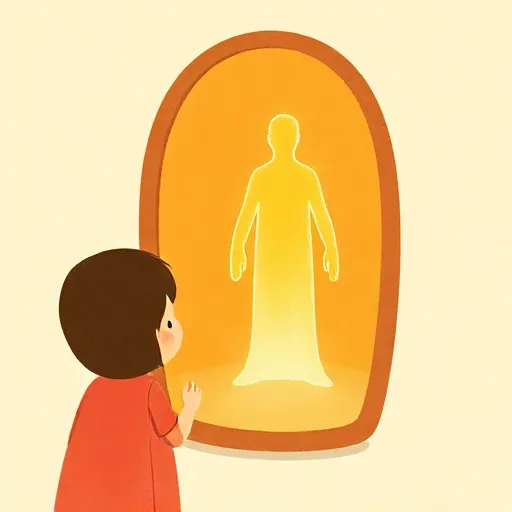
Imagine you sat down and wrote a list of everything you wish you could be: endlessly patient, knowing the answer to every question, never afraid. Now picture a being who has all those perfect qualities, but who is not you—a separate, all-powerful mind who listens to your thoughts and judges your actions. That, the German thinker Ludwig Feuerbach (19th century) argued, is exactly how human beings invented God.
Feuerbach began as a student of theology, but soon fell under the spell of the philosopher G.W.F. Hegel, who taught that history, thought, and even religion move toward a grand spiritual purpose. Hegel believed that Christianity, in its deepest sense, expressed the same truth as philosophy: that the divine spirit lives in humanity. Feuerbach was initially drawn to this vision, but he would eventually turn it inside out.
In 1841 he published The Essence of Christianity, a book that electrified and outraged readers. His core claim was simple but explosive: theology—the study of God—is really anthropology, the study of humankind. Every quality believers assign to God, he said, is actually a quality of the human species-essence (the sum of the best possible traits of the whole human race, such as infinite love, unlimited knowledge, and perfect power). By imagining these traits as belonging to a separate divine person, people unknowingly alienate their own nature: they treat their own finest capacities as something outside themselves, then feel small and sinful in comparison.
Why Would Anyone Turn Their Own Goodness Into a God?
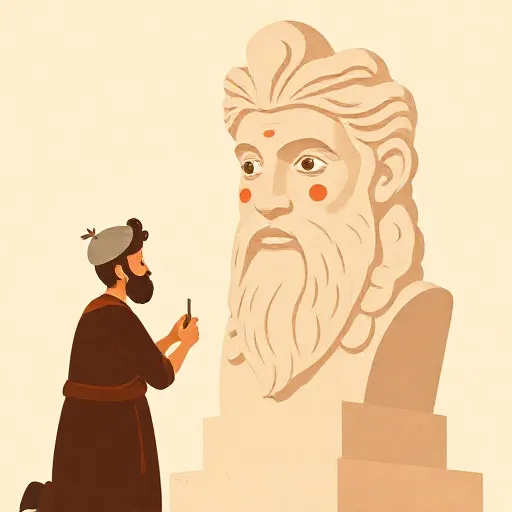
If God is just a projection of human greatness, why would we do that? Feuerbach’s answer: because being human is hard. We are limited, fragile, and deeply aware of what we lack. I scold myself for cowardice only because I know others are brave; I feel my stinginess only because I know generosity exists. That painful awareness, he argued, proves I have a species-consciousness—a sense of what the whole human species is capable of, even when I fall short. Rather than simply admire that ideal, I push it out of my mind and give it a name: God.
For Feuerbach, religious believers relate to God like a lover separated from their beloved. They pour all their hope, trust, and adoration onto a being who seems to possess what they themselves lack. The Christian doctrine that God became a human in Jesus is, on this view, a tearful confession that the divine heart is really a human heart. If God had to become flesh to feel compassion, then the compassion was human to begin with.
Feuerbach’s early version of this idea still used concepts from Hegel: the “species-essence” was something shared by all human minds across history. But over time, his thinking took a sharper turn.
From Ideas to Bodies: Feuerbach Dethrones Pure Thought

Feuerbach had once defended Hegel’s view that reality is ultimately a web of ideas unfolding toward absolute spirit. By the early 1840s, he publicly broke with that system. “Thought comes from being, but being does not come from thought,” he wrote. The real world—of dirt, bread, flesh, and weather—is not a pale shadow of a higher spiritual realm. It is the only reality, and our thinking bodies are part of it.
This shift made him emphasize sensuousness—the fact that we know the world through our five senses, not through pure reason alone. He even joked, “Man ist, was man ißt”—“You are what you eat”—to insist that our physical makeup shapes who we are. A thinking self is not a ghost in a machine; it is a living organism with needs, desires, and limits.
That led him to a new explanation of religion. Instead of focusing on the grand perfection of the species, he began asking what makes an ordinary human being cry out for a god in the first place.
The Wish Behind the Prayer

In books he wrote during the 1850s, Feuerbach traced religion to a feeling of dependence on nature. You cannot live without air, water, food, or the turning of the seasons. You did not choose to be born, and you cannot stop yourself from dying. That immense powerlessness, he argued, is the root of all worship. Early peoples sacrificed to the sun, the rivers, and the earth because those forces could destroy them or bless them—and they wished desperately for blessing.
But dependence alone is not enough. A plant depends on the sun without having religion. What makes humans different is the drive‑to‑happiness—the powerful urge to be well, to flourish, to escape suffering. When this drive meets a frightening limit (a drought, an illness, the fear of death), it generates a theogonic wish: a wish so strong that it gives birth to a god.
Feuerbach pored over ancient Greek poems and the Hebrew Bible to find examples. In Homer’s Iliad, whenever a warrior begs for help and the gods appear, the god’s actions fulfill exactly what the human wishes for but cannot do alone. The gods are, in effect, the wish made visible. The Christian hope for eternal life, he argued, is the same process: faced with the fact of death, the human heart reaches for a being who can promise endless happiness. Faith, Feuerbach said, is trust that your deepest desire will be met—and God is the guarantor of that trust.
Does Happiness Make Right and Wrong?

If religion boils down to human needs, what about ethics? In his final years, Feuerbach tried to build a moral theory from the drive‑to‑happiness. He argued that every living thing seeks its own well-being. That is not selfishness in a mean sense; it is just what life does. But because we live among other people who have the same drive, we quickly learn that harming them tends to bring harm back to us. Conscience, Feuerbach suggested, is not a voice from another world—it is the voice of the other person’s happiness inside you, making you flinch at their pain.
He called this natural sympathy Mitleid (compassion). You care about someone else’s suffering partly because you know what your own suffering feels like. Thus morality is not about crushing your desires; it is about harmonizing your drive-to-happiness with everybody else’s. “My right is the legal recognition of my own drive-to-happiness,” he wrote, “my duty is the drive-to-happiness of the other that demands recognition from me.”
This picture of ethics is thoroughly earthy. There is no command from above—just creatures with bodies, feelings, and a need for one another.
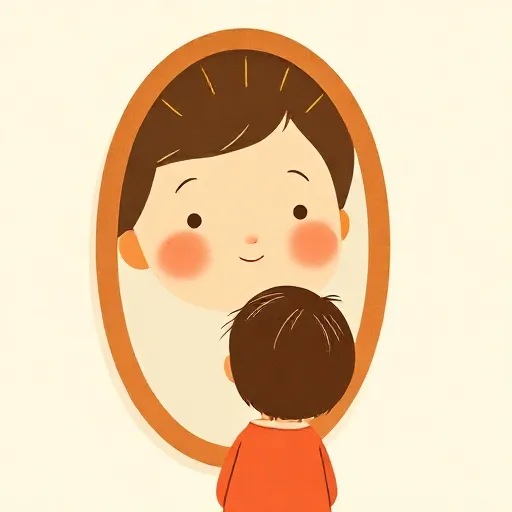
Why Feuerbach’s Mirror Still Matters

Feuerbach’s ideas sent shockwaves through 19th-century Europe. Karl Marx used his critique of religion to argue that changing society requires attention to real human needs, not heavenly promises. Later, thinkers like Nietzsche and Freud would develop their own versions of the idea that God is a human creation. Even today, when someone says “God is love,” they are using a word that belongs to human relationships—and Feuerbach would smile and ask, “So what does that tell you about who you really are?”
His work raises a question that cannot be settled by science alone. If every religion across history fills the same empty spaces in the human heart, does that prove there is nothing more, or does it hint that our desires are shaped by something real beyond us? Feuerbach’s mirror forces you to look at yourself honestly before you look up at the sky.
Think about it
- If people from many different cultures describe gods with loving qualities, could that mean those qualities point to a real divine being, or could it just mean all humans share similar hopes?
- Suppose you discovered that your sense of right and wrong came entirely from your own need for happiness. Would that change how you act toward others?
- Can you think of something you deeply wish for that feels bigger than yourself? How might that wish shape what you believe about the world?