Can a Poem About Atoms Cure Your Fear of Death?
A Cure in Verse

Rome, around 55 BCE. The poet Lucretius (about 94–53 BCE) is writing a very long letter in verse to his friend Memmius. But this is no ordinary letter. It’s a 7,400‑line poem called De Rerum Natura—On the Nature of Things—and it contains a single, astonishing promise: that understanding the hidden world of tiny particles can actually cure your deepest fears.
Lucretius was not inventing the ideas himself. He was a devoted follower of the Greek thinker Epicurus (341–270 BCE), who had died two centuries earlier. Epicurus had taught that the worst things in life—fear of death, fear of angry gods, endless worrying—come from ignorance about how nature works. Fix the ignorance, and you fix the panic. Lucretius took that mission and dressed it in the music of Latin poetry, hoping to slip a life‑changing lesson past his Roman readers like sweet honey hidden over bitter medicine.
The Smallest Things You’ll Never See
Lucretius’s cure rests on one big idea: everything—trees, dogs, thoughts, your own body—is nothing more than atoms moving in empty space. He never uses the Greek word “atomos” (meaning “uncuttable”). Instead he calls them first‑beginnings or first bodies. These atoms are solid, indestructible, and too small to see. They have only three permanent properties: shape, size, and weight. Everything else—color, heat, sensation, life—emerges only when atoms combine into larger compounds.
The second ingredient is void—pure, empty space. Without void, nothing could move. Atoms shoot through this emptiness at dazzling speeds, bumping and hooking together to form all the shapes we know. A plank of wood feels solid only because its atoms are tightly packed, like a crowd of tiny people pressed into a full elevator.
This picture has a radical consequence. If your mind and soul are made of atoms (and Lucretius spends a whole book arguing they are), then when your body dies, the atoms scatter and your consciousness simply stops. There is no ghost, no afterlife, no underworld. That sounds harsh, but Lucretius believed it was actually the most liberating thought in the world.
The Sweet Medicine of Poetry
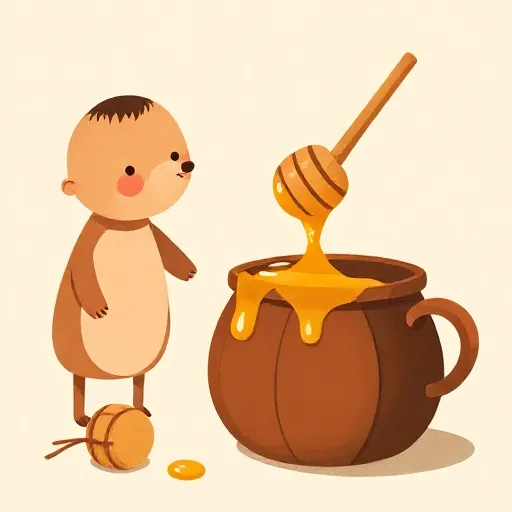
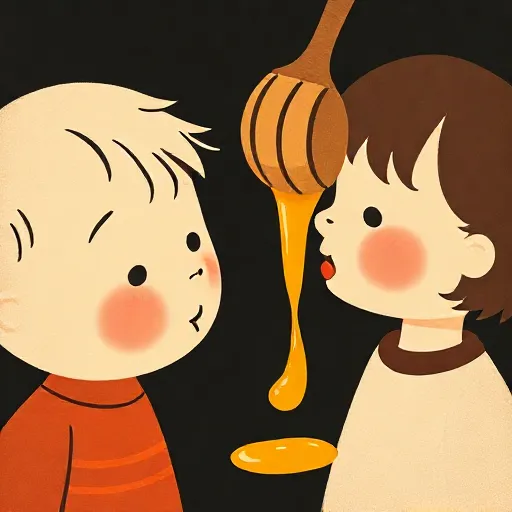
Why write a poem about physics and death? Lucretius answers this question with his most famous image, the honey and wormwood simile. Imagine a doctor who needs to give a child a bitter but life‑saving medicine. The doctor smears the rim of the cup with sweet honey so the child, tricked by the taste, drinks down the cure. In the same way, Lucretius says, his philosophy often seems harsh to newcomers—it denies gentle illusions and takes away comforting stories. So he wraps it in the honey of verse, making it beautiful enough to swallow.
By the time he reaches book 3, Lucretius even describes himself as a bee feeding on Epicurus’s “golden words.” What was once bitter medicine has itself become the honey. The goal isn’t to show off or win applause. The poem is a rescue mission: to bring his audience to a calm, unshakeable peace of mind, which Epicurus called ataraxia.
The Swerve: A Cosmic Glitch That Sets You Free
In book 2, Lucretius reaches a puzzle. All atoms have weight and fall through the void at the same mind‑boggling speed, like drops of rain. If they simply traveled straight down forever, none would ever overtake another and no collisions would happen—so no compound objects, no worlds, no you. To break the endless parallel fall, he introduces the swerve (in Latin, clinamen): an almost‑too‑small‑to‑imagine sideways shift that happens at no fixed time or place.
That one‑in‑a‑billion wobble was enough to start the cascade of bumps that built the universe. But Lucretius goes further. He argues that the swerve is also what makes free choice possible. If every motion followed a rigid chain of causes stretching back forever, our minds would be nothing but dominoes. A tiny, uncaused break in the chain, he suggests, gives the mind enough slack to be genuinely responsible for its own actions.
Scholars still argue over exactly how this works. Some think a swerve is involved in every voluntary action; others think it just opens up a small window of freedom over time. Either way, Lucretius plants a bold flag: you are not a puppet, and physics does not have to turn you into one.
Why You Shouldn’t Fear the Dark (or Death)

The longest stretch of the poem, book 3, focuses on a single target: the terror of death. Lucretius first offers thirty arguments that the soul is mortal. He then shifts to his real work—not just proving the point, but dissolving the dread.
The key move is a cool, logical one. Death, he says, is simply the end of all sensation. When you are dead, you will not be there. You won’t feel the worms, you won’t miss your family, you won’t suffer any punishment. Fearing being dead is like being afraid of what it felt like the thousand years before you were born—it felt like nothing, and nobody loses sleep over that. This is often called the symmetry argument: the time after our life should disturb us no more than the time before it.
Lucretius doesn’t just argue; he also puts arguments in the mouths of imaginary speakers. One even imagines Nature scolding us for clinging to life so greedily, since all things must return to the atoms they came from. The combination of logic and poetry was meant to hit readers in the head and the gut at the same time—and it still lands hard.
The Gods Who Live Far Away

People in the ancient world (and many today) worry that thunder, disease, or disaster is a sign of angry gods. Lucretius spends much of book 5 and 6 arguing that no god ever lifts a finger in our world. Epicurean gods are real—they have incredibly fine bodies made of the smoothest atoms—but they live in perfect peace, far beyond our reach, utterly uninterested in human affairs. They don’t need our prayers, feel no anger, and never cause storms or plagues.
We come to know them only through simulacra—gossamer‑thin films of atoms that constantly stream off all bodies, including divine ones. These images enter our minds and give us a faint glimpse of what a blissful, untroubled existence looks like. The real danger, Lucretius says, is not that the gods will punish us, but that we will imagine they are furious. That false belief disturbs our peace more than any real threat ever could. True piety means approaching the gods with a calm heart, not a terrified one.
Why a Roman Poem Still Echoes Today
Lucretius’s poem was nearly lost forever. It survived through only two fragile ninth‑century copies, then burst back into view when it was rediscovered in 1417 by a book‑hungry Italian scribe. That rediscovery helped feed the Scientific Revolution. Thinkers like Montaigne, Gassendi, and later modern scientists found in Lucretius a vision of a world that runs by natural laws, not divine whims.
The questions he raised haven’t grown old. Can knowing more about atoms and biology really quiet your anxiety? If your decisions are just atoms following a path, is it fair to hold people responsible? Does the idea of an indifferent universe terrify you or set you free?
Lucretius would probably smile and point at his own poem. He already gave his answer: the universe is made of tiny things in motion, death is nothing, and a calm mind is the greatest treasure. The honey is still in the cup, waiting for you to taste it.
Think about it
- If you knew for certain that after you die you simply stop existing—no feelings, no memories—would that change how you live right now?
- Can scientific knowledge really free you from fear, or do we always find something new to worry about?
- Does a random microscopic swerve inside your brain seem like a solid basis for free will, or would true freedom require something more?