The World Is Made of Atoms and Void. So Why Does Honey Taste Bitter?
Why Does Honey Taste Bitter When You’re Sick?

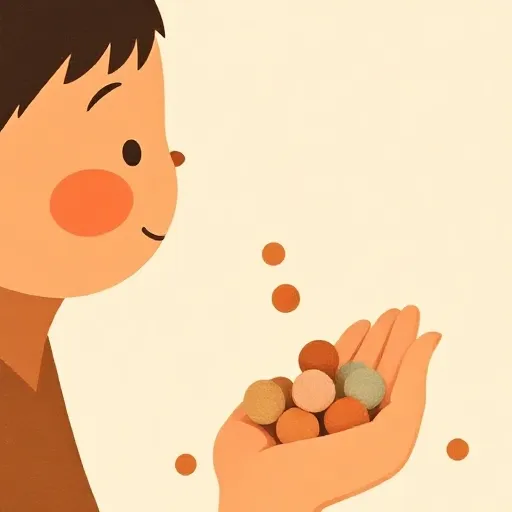
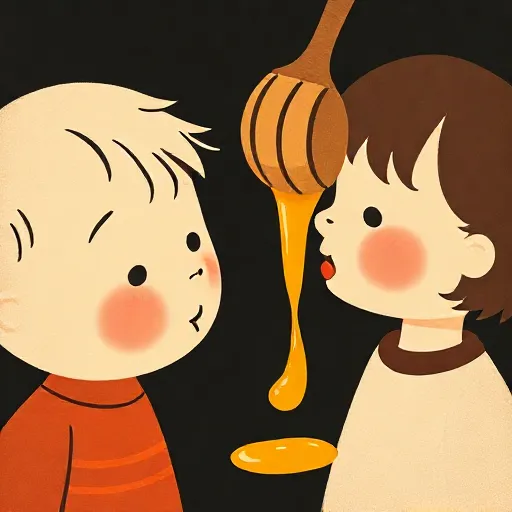
Imagine you’re home with a cold. You dip a spoon into a jar of golden honey and take a taste. But instead of sweetness, the honey hits your tongue bitter and strange. How can the exact same honey taste so different? For the Greek thinker Democritus (c. 460–c. 370 BCE), a puzzling everyday moment like this was a clue that the world we see, taste, and touch might not be what it seems.
Democritus lived in the city of Abdera, a younger contemporary of Socrates. He studied with the mysterious Leucippus (5th century BCE) and then spent decades building a whole system to explain the universe. His answer was shockingly simple: everything is made of two things — atoms and void. Atoms are tiny, unbreakable, invisible particles. Void is simply empty space. That’s it. Rocks, rain, honey, your own body, even your thoughts are just clusters of these particles moving through the emptiness.
This wasn’t just a wild guess. Democritus was trying to solve a problem that an earlier philosopher, Parmenides, had thrown at the ancient world: how can anything really change? If something new appears, it seems to come from nothing — and nothing can’t exist. Democritus’s teacher Leucippus proposed a clever way out. Change isn’t creation from nothing; it’s just atoms rearranging themselves. Atoms themselves are eternal and never change, but the clusters they form can grow, shrink, shift, and fall apart. The honey doesn’t transform into a new substance. Instead, the atoms that make up its flavor are meeting your tongue in a new way.
Atoms and the Void: The Real Stuff of Everything
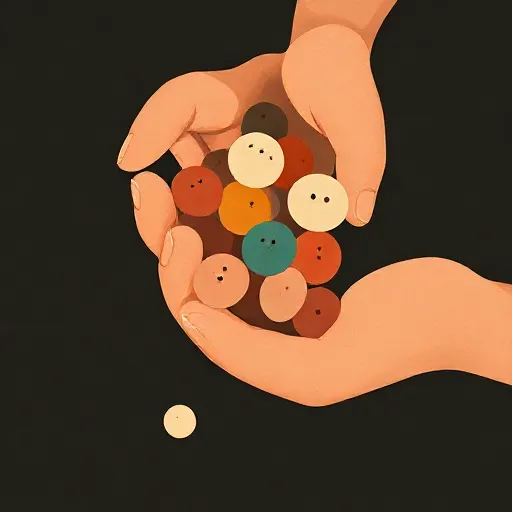
The word atom comes from the Greek atomos, meaning “uncuttable.” Democritus argued that atoms are perfectly solid, with no empty space inside them, which is what makes them impossible to split. They come in infinitely many sizes and shapes — some smooth and round, others hooked, jagged, or spiky. There is no smallest or largest atom, though in our world they’re all far too tiny to see.
Atoms don’t stand still. They constantly move, collide, and rebound in the infinite void. Because they have no internal gaps, they can’t break or wear out. When they bump into each other, their surfaces resist; some lock together when their irregular shapes and tiny barbs catch, forming the solid-seeming objects around us. But make no mistake: a table or a hand isn’t one solid thing. It’s a buzzing, vibrating swarm of particles with empty space between them.
Democritus faced a tricky question. If atoms zoom around randomly, why do they sometimes gather into orderly clusters instead of staying scattered? He found an answer in nature itself. Just as a sieve sorts grain by size or the tide sorts pebbles on a beach, atoms of similar size and shape tend to drift together. When a whirl of atoms forms in the void, like a cosmic tornado, the rounder ones collect in one place and the hook-shaped ones in another — all without any purpose or plan. This like-to-like sorting, he thought, explains how worlds, stars, and even living bodies arise from mindless motion.
There’s a famous alphabet analogy — Aristotle tells us Democritus used it. Just as the letters A and N differ by shape (schēma), the words AN and NA differ by arrangement (taxis), and the letter N differs from Z by rotation (thesis), so objects differ by the shapes of their atoms, how the atoms are lined up, and how they’re turned. The same few kinds of atoms can make a million different things, the way a handful of letters makes a library of books.
But here’s the really wild part. Democritus drew a sharp line between what’s truly real and what’s merely “by convention.” He wrote: “by convention sweet and by convention bitter, by convention hot, by convention cold, by convention color; but in reality atoms and void.” The atoms themselves have shape, size, and maybe weight — but not color, not flavor, not heat, not cold. Those qualities are something that happens when atoms bump into your sense organs. The world you experience is already partly a show.
Ghostly Films and Shifting Colors

So if atoms have no smell or taste, why does honey taste sweet? Democritus’s answer was a theory of images (in Greek, eidōla). Every object is constantly shedding extremely thin films of atoms from its surface, like a snake peeling off a layer of skin. These films are exact, though delicate, copies of the object’s shape. They fly through the air until some drift into your eye, nose, or mouth. When a film hits your sense organ, its shape pokes you in a particular way, and that poking is the sensation.
Taste becomes a geometry lesson. Sweetness, said Democritus, comes from large, smooth, round atoms that roll gently over the tongue. Bitterness comes from small, sharp, hooked atoms that scratch and tug. Honey mostly contains round atoms, but it also has a few scratchy ones mixed in. When you’re healthy, your tongue’s passages are open just enough that the smooth atoms glide through and the rough ones don’t get much attention. When you’re sick, your passages twist and tighten, letting the hooked atoms scrape harder — and suddenly the honey tastes bitter.
Color is even more surprising. Atoms have no color, not even in a film. Instead, the way atoms are arranged in a cluster makes light bounce off in a certain way, and that bouncing affects your eye. Democritus used the term turning (tropē) to describe how atoms can shift their position without changing their shape. When the sea’s surface flips from deep blue to frothy white, the atoms haven’t been painted; they’ve just turned. A pigeon’s neck seems to shimmer purple and green because the feather-atoms are tilting in different directions as the bird moves. The same atoms, only rearranged, produce all the colors you see.
No magic, no secret color juice inside things — just geometry, motion, and contact. Aristotle sometimes criticized this by saying that Democritus reduced everything to touch, but for Democritus that was a strength: every sense is really a kind of touching through atomic films.
Can We Trust Our Senses?

If honey can taste sweet one day and bitter the next, and if colors are really just tilting atoms with no color of their own, a troubling question emerges. How can we ever know what the world is truly like, if we only meet it through senses that give us a made-over picture?
Democritus saw the problem clearly. The senses are our only windows onto the world, yet they report qualities — sweet, red, hot — that don’t exist in the atoms themselves. We’re like people watching shadows move across a wall; the shadows are caused by something real, but they aren’t copies of the real thing’s color or texture. We know atoms exist, but we know them only by guessing from what we can perceive, by analogy.
In one striking fragment, Democritus imagines the senses turning on the mind itself. The senses speak, perhaps in frustration:
the senses scolded the mind for taking its evidence from them only to overthrow them, saying that to overthrow the senses would be the mind’s own downfall
The mind depends on the senses for everything it knows. If it condemns the senses as liars, it saws off the only branch it’s sitting on. Yet the senses still deliver confused, conflicting reports. Later thinkers used a phrase Democritus made famous — “no more this than that” (ou mallon) — to argue that if something appears both sweet and bitter, it’s no more truly one than the other, and perhaps we can’t trust any appearance at all.
Democritus himself didn’t sink into total skepticism. He thought careful reasoning could reach past the surface show, the way we can work out that the wind is made of moving particles even though air is invisible. He built his whole atomist picture by starting from things we can observe — like the way a stone wears down over years or the way dust dances in a sunbeam — and leaping by analogy to a world too small to see. But the tension never went away. He left future philosophers with a live wire: your mind is trapped inside a body that only ever touches atomic films, never the real thing.
Cheerfulness and the Atoms Inside You

Democritus didn’t just explain rocks and rain. He turned his atomist lens onto life itself. He argued that the soul (psychē) is made of a special kind of atom: round, smooth, fiery ones, like the tiny sparks that make up flame. These fire-atoms are the most mobile, zipping through the body and causing movement and thought. When you think, that’s not some ghostly non-material event — it’s a physical rearrangement of soul-atoms inside you. Death occurs when those fire-atoms drift apart, and the cluster that was you simply dissolves into the void.
This strictly material picture didn’t leave Democritus gloomy. In fact, his ethical sayings — preserved as short, punchy advice — point toward a bright, calm happiness he called cheerfulness (euthymia). The good life isn’t about grabbing the most pleasures or piling up riches. It’s about reaching a balanced, untroubled state of mind. Fear, envy, and wild desires are like violent atomic storms in the soul; moderation and clear thinking settle them.
He compared caring for the soul to medicine for the body. Just as a doctor helps your physical parts find their healthy balance, good sense and self-awareness help your inner atoms find their calm. Real happiness is within you, not in things outside. That’s a powerful idea: even in a world made of nothing but jostling particles with no magic purpose, you can still cultivate a soul that feels bright, steady, and at ease.
According to later reports, Democritus also proposed that human beings were not created special. In the distant past, people lived like animals, slowly discovering how to work together, invent language, and build communities out of necessity, not divine gift. Everything — speech, craft, government — grew naturally from atoms and time. It’s a view that feels strikingly modern, and it all flows from a universe with no hidden plan.
Why does this still matter? Every time you wonder whether the colors you see are “really there” or just your brain’s version, you’re living inside the puzzle Democritus opened. Modern science tells a similar story: matter is made of particles and forces, and many qualities — sound, color, warmth — are the result of those particles interacting with a sensing body. The world you feel isn’t a direct copy of the world out there; it’s a useful, vivid translation. And his ethical insight still bites: if happiness depends on your inner state, not your stuff, then even a kid with a honey jar and a head cold already has the most important tool for living well — a mind that can sort the real from the swirl.
Think about it
- If atoms have no color, can you say that a rose really is red, or is redness something that happens only inside you?
- Democritus believed everything moves by atoms bumping into each other out of necessity. If that includes your thoughts, do you still have control over whether you’re happy or not?
- Your senses can be fooled — a straight stick looks bent in water, honey tastes bitter when you’re sick. If all you know comes through senses that can lie, how can you ever be sure about anything at all?