
How Can “Nothing” Be Something? Leucippus’s Strange Answer
What Are Things Made Of? A Wild Idea
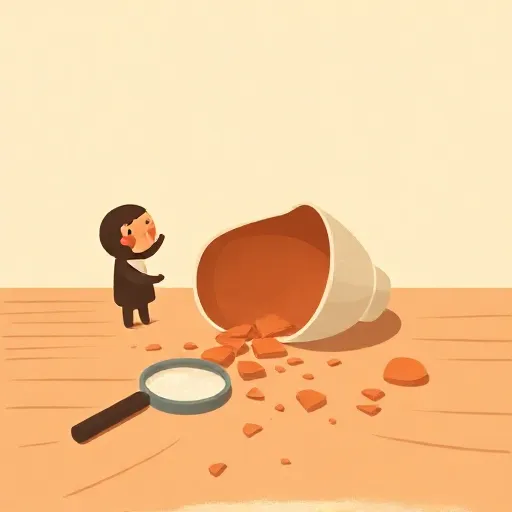
Imagine you are holding a clay cup. What is it made of? Clay, you say. Now smash the cup and grind the pieces finer and finer. Can you go on forever, or is there a smallest bit that cannot be divided? More than two thousand years ago, a Greek thinker named Leucippus (5th century BCE) took a bold stand. He argued that everything in the universe is made of tiny, unbreakable particles—he called them atoms—moving through completely empty space.
That sounds almost like modern science. But Leucippus had a deeper problem to solve. His idea set off a fight about what “nothing” even means. If empty space is truly nothing, how can it exist at all? And if change is just atoms rearranging themselves in the void, why does the world look so solid and stable? The puzzle Leucippus faced was planted by philosophers who came just before him, and it is still a puzzle today.
The Big Puzzle: Why Change Seems Impossible
To understand Leucippus’s move, you must meet the Eleatics. Parmenides (born around 515 BCE) claimed that reality is a single, unchanging thing. If you try to say something changes, he argued, you must admit that “what is not” somehow comes into being. But “what is not” is nothing, and nothing cannot become something. So change is an illusion.
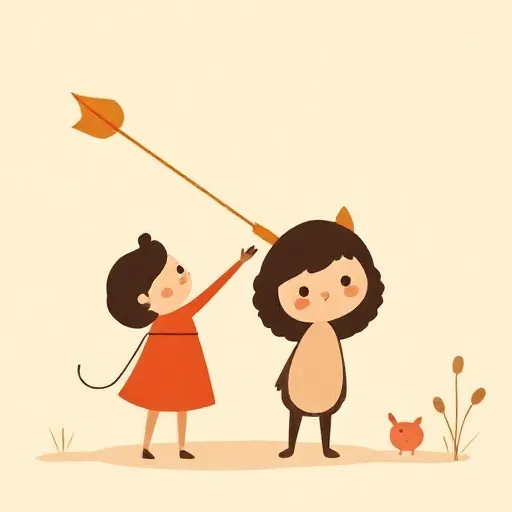
Parmenides’ student Zeno (c. 490–430 BCE) created clever paradoxes to make the same point about motion. Suppose you wanted to shoot an arrow at a target. Before the arrow reaches the target, it must get halfway. Before that, halfway again. If space can be divided infinitely, the arrow has to cross an endless number of points in a finite time—which seems impossible. Zeno concluded that motion cannot really happen.
Another Eleatic, Melissus (5th century BCE), tightened the knot. He argued that motion would need empty space—void—for things to move into. But void is “what is not,” pure nothing. Since nothing cannot be, void does not exist. Therefore, motion is impossible. The Eleatics had thrown a bomb into Greek thought: they made change, and even movement, seem to break the rules of reality.
Leucippus’s Bold Move: Making Room for Nothing
Leucippus did not run from the Eleatics. He took their own logic and flipped it. He agreed with Melissus that void is necessary for motion. But he insisted we do experience motion—we see things move all the time. Therefore, he concluded, void must be real. Empty space exists, and things move through it.
That meant facing Zeno’s puzzle about infinite division. If you could cut matter forever, you would never reach a stopping place, and motion would be as impossible as Zeno said. So Leucippus proposed that matter is not infinitely divisible. The ultimate bits of the world are indivisible atoms—solid, unbreakable, and unchanging. They never turn into something else or dissolve into nothing. They just rearrange.
Ancient reports attribute a striking image to Leucippus. He compared the atoms to letters of the alphabet. A few simple shapes can form an endless variety of words. The difference between A and N is their shape; between AN and NA, their arrangement; between N and Z, their orientation. In the same way, a limited number of atomic shapes can combine to produce the richness of the world—rocks, trees, dogs, even you. The changes we see are not creation or destruction; they are atoms moving, separating, and joining again in different patterns.
The Cosmic Whirl and a Mysterious Phrase
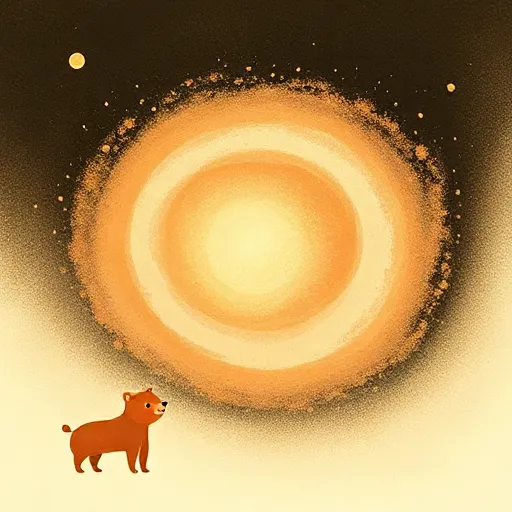
Leucippus did not stop at tiny particles. He also tried to explain how whole worlds come to be. Ancient sources say he taught that countless atoms move through the infinite void. Sometimes a group of them gathers into a great spinning whirl. The motion sorts the atoms—heavier ones drift to the center, lighter ones toward the edges. A kind of membrane forms, trapping more atoms inside. The outer layer catches fire and becomes the stars. Worlds grow, live for a time, and eventually perish. Everything happens, Leucippus is reported to have said, by necessity.
One of the few sentences from Leucippus that survives is mysterious. He wrote that nothing happens “in vain, but everything from logos and by necessity.” The ancient Greek word logos can mean “reason,” “account,” or “explanation.” Did Leucippus think the universe is steered by a cosmic mind, a rational intelligence? Or did he simply mean that for every event there is a rational explanation—that you can give an account of why things happen? Scholars are divided. The later atomist Democritus seems to have ruled out any universal mind driving events. So it is possible Leucippus meant only that a chain of causes can be described, not that a great intelligence is in charge. The puzzle remains open.
Why a Shadowy Thinker Still Matters
Leucippus is a ghostly figure. Hardly anything certain about his life survives. Some ancient writers even doubted he existed. Yet his core insight—that the world is atoms and void—echoed through two and a half millennia. It helped spark the atomic theory of modern chemistry and physics. Even after scientists discovered that atoms can be split, the deeper philosophical question Leucippus raised did not vanish. What is “empty space” really? Is it a total nothing, or does it have its own strange kind of existence? Physicists today still puzzle over that.
There is a quieter challenge, too. Leucippus taught that everything happens by necessity, without a cosmic mind. If every event is the result of atoms colliding according to fixed rules, what about your own choices? You might feel free when you decide what game to play or who to sit with at lunch. But if the particles in your brain are only following the same necessity as a falling rock, can you truly be free? Leucippus never answered that question—but he gave you a reason to think about it every time you pick up a cup or watch a puddle dry.
Think about it
- If you could never see inside anything, how would you test the idea that the world is made of tiny, unbreakable particles?
- Imagine a universe where every event, including your thoughts, happens by necessity. Would it still make sense to praise or blame people for what they do?
- Is empty space a real something, or just the absence of anything at all? How could we tell the difference?