
Could a Circle Prove Your Religion Right? Ramon Llull’s Wild Idea
A Love Song, a Vision, and a Mission

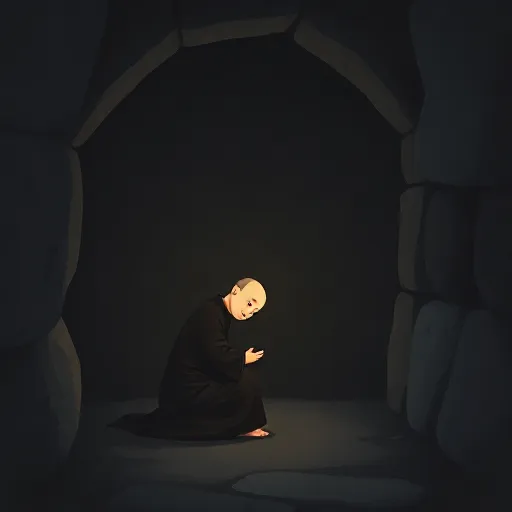
When Ramon Llull (1232–1316) was a young man, he sat down to write a love song for a woman he adored — a woman who was not his wife. Halfway through, he saw something that changed everything. An image of Christ on the cross appeared in front of him. He shook it off and tried to keep writing. The vision came again. And again. Four more times it interrupted him, until at last his own conscience, as he later described it, told him that the only proper response was to drop everything and serve God.
That moment pushed Llull away from his comfortable life as a bourgeois merchant in Majorca. He sold most of his possessions, set aside just enough for his wife and children, and began to study. But he did not become a quiet monk. He hatched a plan: he would travel to lands where Muslims and Jews lived, and — without weapons, without threats — he would persuade them, through reason alone, that the Christian understanding of God was correct.
He set for himself three enormous tasks. He would write books that refuted what he saw as errors in other religions. He would help found monasteries where missionaries could learn Arabic and Hebrew. And he would personally walk into foreign cities and debate anyone who would listen. All of this depended on a single, brilliant invention: a method he called the Ars — the Art.
The Art: A Logical Puzzle to Prove God

The Ars was not a painting or a sculpture. It was a system of movable mental pieces, like a board game for ideas. Llull created it after a long retreat on a mountain in Majorca, where he believed God had given him the design. The Art would let missionaries walk into a conversation with a Muslim scholar or a Jewish rabbi and, without ever quoting the Bible, arrive at the same truths — starting from principles everyone already accepted.
At its heart, Llull’s system was combinatorial: he took a handful of basic terms, assigned them letters, and showed how to mix them according to fixed rules to produce every possible true statement about God and the world.
In the final, most polished version of the Ars — the Ars brevis of 1308 — Llull used just nine letters (B through K). Each letter stood for six different things at once. For example, the letter B could mean the divine quality Goodness, the logical relationship Difference, the question word whether?, the highest being God, the virtue justice, or the vice greed. The letter C could mean Greatness, Concordance, what?, angels, prudence, or gluttony. And so on.
By combining letters according to charts and rotating figures, a person could build chains that said things like “Goodness is great” or “Difference is concordant.” Then, by plugging in definitions — for instance, “Goodness is that whereby good does good” — and applying special rules, the mind would climb from simple truths all the way up to the nature of God and the human soul.
Llull called the core divine qualities the Dignities: Goodness, Greatness, Eternity, Power, Wisdom, Will, Virtue, Truth, and Glory. He believed these were not just Christian ideas. Muslims and Jews also described God as perfectly good, great, and eternal. So the Dignities were neutral ground. If you could show that the logic of these qualities forced you to accept the Christian Trinity and Incarnation, you would, in theory, persuade anyone who was truly reasonable.
The Ladder of Being and the Mirror of Creation

Llull’s world was woven together tighter than any modern scientific picture. He believed creation was a mirror. Every good thing you see — the greatness of a mountain, the wisdom of a teacher, the power of a storm — reflected one of the divine Dignities in a lesser, created form.
The universe was ordered in a ladder of being. At the bottom sat the elements and the artificial tools humans make. Above them rose plants, then animals with senses, then animals with imagination, then human beings, then heavenly spheres, and finally angels. At the very top was God, the only reality that did not depend on anything else.
This ladder made knowledge possible. Start with a tree, and you could reason upward through its life, its beauty, its goodness, until your mind touched the perfect Goodness from which all goodness flows. Start with the Dignity of Greatness, and you could reason downward to see how every creature participates in greatness in its own way.
One of the most original pieces of Llull’s metaphysics was his theory of correlatives. He argued that every real thing has a three‑part structure built into its very existence: an active part, a passive part, and the act that connects them. A stone, for example, has something that makes it stonelike, something that can be stonelike, and the actual stonifying process. In Latin he used special words: lapidificativus, lapidificabilis, lapidificare.
For Llull, this was not just wordplay. It meant that all of creation, from rocks to humans, carries a pattern of three‑in‑one. That pattern, he argued, is nothing other than the mark of the Trinity — Father, Son, and Holy Spirit. So by simply examining existence itself, a careful thinker using the Art could discover that the God behind the world must be triune.
Can Reason Leap into Faith?

Llull faced a deep problem being argued at the University of Paris. Some philosophers there, inspired by the Muslim thinker Averroës, said that what reason tells you and what faith tells you can be completely different — and both can be true in their own way. This was called the theory of double truth. It horrified Llull. If you could not trust reason all the way to God, then his entire mission of converting people through argument was doomed.
So he sharpened his own theory of knowledge. He said that there are three kinds of objects your mind can grasp: sensible things (a barking dog, a warm stone), intelligible things (the concept of justice, the laws of arithmetic), and divine things (the Dignities themselves). Your mind climbs from the first to the second by ordinary philosophy and science. But a third move is needed: a transcendent point where your concepts get stretched beyond their normal meaning, so that “goodness” means not just human kindness but the infinite source of all goodness. That leap, he insisted, is still rational — it follows the same combinatory rules — but it requires you to use a special kind of demonstration.
Besides the two usual types of proof in Aristotle’s logic (cause‑to‑effect and effect‑to‑cause), Llull added a third: the argument by equivalence (argumentum per aequiparantiam). This demonstration works when two things are equal in power, like God’s will and God’s power. For example: God cannot sin, because God’s power is exactly equal to God’s will, and God’s will does not want to sin. Llull believed this third argument allowed you to prove truths about God that normal logic could never reach.
The Knight of Reason: A Life of Travel and Trouble
The Art was not just a book. Llull carried it across the Mediterranean, trying to put it to work. He convinced King James II of Majorca to fund the monastery of Miramar, where thirteen Franciscan friars were to learn Arabic and train in the Art. He lobbied popes and councils to establish language schools and unify military orders. He traveled to Paris and debated Averroists at the Sorbonne, winning letters of approval from the faculties of medicine and theology.
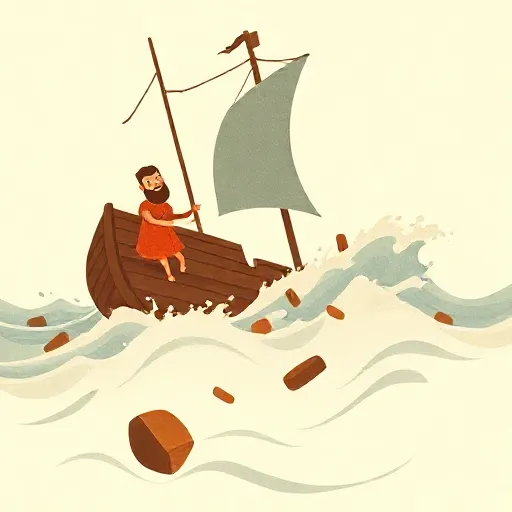
But his personal missions into Muslim lands were rarely successful. In 1293, when he finally sailed to Tunis to share his Art with the intellectual circles there, he was imprisoned and expelled. Over a decade later, in the city of Béjaïa (in modern Algeria), he went straight to the main square and began shouting his arguments to the crowd. The people were furious; he was arrested, interrogated, and held for six months. Instead of giving up, he spent his time in prison debating local sages who tried to convert him to Islam. Then he was deported — and his ship sank on the way back. He survived by clinging to wreckage until he reached the shore.
Through all of this, Llull remained convinced that a careful, patient, logical demonstration — his Art — could heal the divisions between religions. He never succeeded in converting large numbers of people. Yet by the time he died in 1316, well into his eighties, he had written over 260 works and left behind one of the most intricate philosophical systems the Middle Ages ever produced.
Why Llull’s Machine for Truth Still Matters

Llull’s Art looks to modern eyes like a strange proto‑computer. Centuries later, the philosopher Gottfried Leibniz would be enthralled by the idea of a universal language made of symbols that could reason all by itself. In a sense, Llull’s rotating letters and combinatory tables were an early attempt to build a truth engine — a “characteristica universalis” that would settle arguments without appeal to authority.
But the Llullian project is more than a piece of computing pre‑history. It raises a question a twelve‑year‑old can feel in ordinary life. Can you really argue someone into believing something as deep as a religious faith? Have you ever tried to convince a friend that a game, a team, or a song is the best, only to discover that reasons don’t move them? Llull’s whole life was a bet that sound logic, built on shared principles, can cross any divide. Yet his missions to Tunis and Béjaïa show how often people refused even to engage with his proofs. Reason, it turns out, is slippery. It needs a listener who is willing to play by the same rules.
Llull’s story matters because he took the hard path. He did not pick up a sword. He picked up letters and circles. He believed the mind itself could be a meeting ground. That may not have solved all conflict, but it sets a table at which people who deeply disagree can still sit down together. Even if you never spin a single metaphysical wheel, you inherit his wager: that the things we most fiercely disagree about are still worth thinking through together, one small, clear step at a time.
Think about it
- Llull believed any reasonable person, no matter their religion, would agree with his Art if they followed the rules. Do you think it’s possible for a single argument to convince everybody about the existence of God? Why or why not?
- Have you ever used perfectly logical reasons to persuade a friend and watched them completely ignore your argument? What do you think their mind was doing when you presented the reasons — and does that tell you something about Llull’s failures?
- If someone built a real machine today that could prove one religion to be true beyond any doubt, do you think believers of other religions would accept its verdict, or find a flaw? What would that reaction teach you about the difference between logic and belief?