
Why Should You Follow Rules You Never Agreed To?
The Invisible Fence
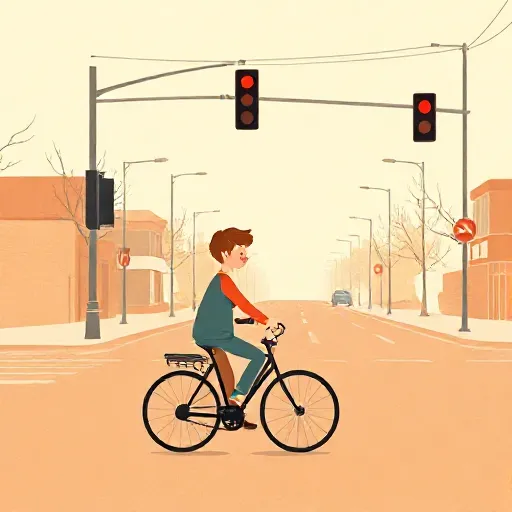
It’s six in the morning. The streets are empty. You’re on your bike, and the light turns red. No cars, no police, nobody watching. You stop anyway.
Why?
Not because you’re afraid of getting caught — there’s no one to catch you. Something else is going on. You feel like you have to stop. Philosophers call this feeling a legal obligation: a requirement that makes an action non-optional in the eyes of the law. But what makes something a legal obligation? That turns out to be a surprisingly tricky question.
One answer, popular centuries ago, is dead simple: it’s all about punishment. The English legal thinker John Austin (1790–1859) argued that having a legal obligation just means you’re subject to a command backed by a threat. If the sovereign says “don’t do X” and attaches a penalty, then you have a duty not to do X. On this view, called the sanction theory, the obligation is the risk of suffering something unpleasant. Jeremy Bentham (1748–1832) pushed the idea even further, claiming that every single law could be rewritten as a command creating a duty.
The philosopher H.L.A. Hart (1907–1992) thought this was deeply wrong. He pointed out that if obligations were just threats, then “you have a duty not to steal” would mean the same thing as “if you steal, you’ll be punished.” But those aren’t the same at all. The law isn’t neutral between a world where nobody steals and a world where everyone steals and goes to jail. Besides, judges talk about duties as reasons for their decisions, not just as triggers for punishment. Hart defended a rule-based theory: you have a legal obligation when you’re subject to a social rule that people actually follow, that they reinforce with serious pressure, and that they believe matters deeply to community life.
Then came Joseph Raz (1939–2022) with a third idea. He argued that obligations are special kinds of reasons. A legal obligation, he said, is a content-independent reason — its force doesn’t depend on whether the required action is good or bad in itself. The law can obligate you to drive on the left or the right; it doesn’t matter which. More strikingly, Raz said obligations are exclusionary reasons: they don’t just compete with your other reasons for acting — they push some of those reasons right off the table. If the law says “pay this tax,” you’re not supposed to weigh it against your desire to spend the money on ice cream. The tax obligation excludes that desire from counting at all.
These three theories — sanction, rule, and reason — are different ways of answering a basic question: what kind of thing is a legal obligation? But an even bigger question lurks behind them.
Did You Sign the Contract?
Now we hit the really hard problem. Even if we know what legal obligations are, we still have to ask: why should you obey laws you never personally agreed to? This is the problem of political obligation, and it has kept philosophers busy for centuries.
The most intuitive answer is consent. You obey because, somehow, you said yes. Thomas Hobbes (1588–1679) wrote that the right of rulers “is derived originally from the consent of everyone of those that are to be governed.” John Locke (1632–1704) put it even more starkly: people are naturally free and equal, so “no one can be put out of this estate and subjected to the political power of another without his own consent.” This idea — that legitimate government rests on the agreement of the governed — became one of the most powerful political ideas in history.
But here’s the problem: did you actually consent? Most people never sign a contract with their government. They’re born into a country and never explicitly agree to anything. Locke had an answer: he said that by enjoying the benefits of living under a government — even just “travelling freely on the highway” — you give tacit consent. You consent silently, through your actions.
The Scottish philosopher David Hume (1711–1776) wasn’t buying it. He pointed out that most people have no real choice about where they live. They stay because leaving is impossibly hard — it’s not a free choice. And if you’re already obeying the law because it’s reasonable to do so, adding a promise to obey doesn’t add anything. The promise is doing no real work.
There’s a deeper issue too. Even if you could consent, there are things you can’t validly consent to. Locke himself argued that nobody can consent to slavery or to being killed. So even consent has limits — which means consent alone can’t justify every obligation the law claims.
You Got the Good Stuff — Now Pay Up?

If consent doesn’t work, maybe the answer is simpler: you benefit from the system, so you owe something in return. This is the fairness theory (sometimes called the fair-play theory). H.L.A. Hart first sketched it, and John Rawls (1921–2002) developed it further. The idea is that when you receive benefits from a cooperative scheme that others are sacrificing to maintain, you have a duty to do your fair share. You shouldn’t get a free ride.
It’s a powerful intuition. You enjoy safe streets, clean water, public schools, and a legal system that enforces contracts. All of that exists because other people follow the rules and pay their taxes. Isn’t it only fair that you do your part?
The philosopher A. John Simmons, writing in the 1970s, spotted a major flaw. Think about the kind of benefits governments provide: security, order, the rule of law. These are what Simmons called open benefits — public goods that are provided to everyone in a territory whether they want them or not. You can’t opt out. You receive them simply by living there, even if you’d rather not. And here’s the key point: normally, if someone forces a benefit on you without your asking, you don’t owe them anything. If your neighbor washes your car without being asked and then demands payment, you’re not obligated to pay. So why would forced benefits from the state create obligations?
Some philosophers reply that the benefits from government are different — they’re essential for any decent life, so it’s irrational to reject them. But people do reject them sometimes, and the law doesn’t seem to care. It claims authority over everyone in its territory, whether they welcome its benefits or not.
What If There’s No Good Answer?

So consent theories have a problem: most people never actually consent. Fairness theories have a problem: the benefits are forced on you. Other theories — like the idea that we owe gratitude to our country, or that we have a natural duty to support just institutions — run into similar difficulties. Each theory covers some cases but leaves gaps.
This has led some philosophers to a surprising conclusion. Robert Paul Wolff (born 1933) argued that if no theory can justify a general duty to obey, then we should take that seriously. The view that law doesn’t have all the authority it claims is called philosophical anarchism. It’s not the same as ordinary anarchism — it doesn’t say government is never justified, and it doesn’t say you should ignore every law. It says something more modest: the law claims authority over all of us in all areas of life, but that claim may be too big.
Philosophical anarchists don’t think you get to pick and choose whenever you feel like it. Hart himself said that recognizing any duty to obey means accepting that there’s at least some area where you don’t judge each law on its merits. The debate is about how big that area really is.
Notice what this doesn’t mean. It doesn’t mean laws are useless. It doesn’t mean you should never obey. It doesn’t even mean that nobody has a moral duty to obey. It just means that the law’s own self-image — that it binds everyone, everywhere, in every domain — may be hard to defend.
Rules Worth Thinking About

So where does this leave you, the kid on the bike at the empty intersection?
It leaves you with something more valuable than a tidy answer. The fact that philosophers still disagree about political obligation after hundreds of years tells you something important: the relationship between you and the law is genuinely puzzling. The law isn’t just a big person telling you what to do. It’s a system of rules that shapes your life in ways you didn’t choose and can’t easily escape. Understanding why — or whether — you owe it anything is one of the deepest questions you can ask.
Every time you stop at a red light with nobody watching, you’re living inside that puzzle. You might be acting out of habit, or respect, or fear of punishment, or a sense that it’s simply the right thing to do. Philosophers have given those feelings names — sanction theories, consent theories, fairness theories, exclusionary reasons — but the feelings came first.
And here’s what philosophical anarchism really invites you to do: think. Not to break rules for the sake of it, but to notice when a rule asks for your obedience and to ask why. Some laws deserve to be followed because they protect people from real harm. Others might be worth following because they solve coordination problems — everyone driving on the same side of the road is genuinely useful. But if a law is unjust, or pointless, or serves only the powerful, you’re allowed to notice that too. The law’s claim to authority doesn’t end the conversation. It starts it.
Think about it
- If a new student joins your school and nobody explains the rules to them, do they still have to follow rules they don’t know exist? Why or why not?
- Imagine your family has had the same chore system since before you were born. You never agreed to it, and you think it’s unfair. Do you still have to do your chores? What if the system benefits everyone — including you — but you’d rather not participate?
- If a scientist could prove tomorrow that no theory can fully justify the duty to obey the law, would that change how you behave? Or would life go on pretty much the same?