
Where Does Law’s “Ought” Come From? A Puzzle About Rules
A Roomful of People Raise Their Hands—Is That a Law?
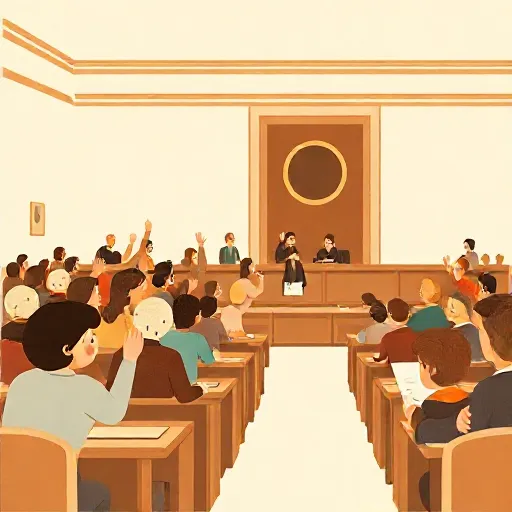
Picture a large room in Sacramento, California. Some people gather, debate an idea, then raise their hands when asked if they approve a document full of words. Someone counts the “yes” votes, and the words get announced. That’s how a new law is made. But what exactly is the law here? The law isn’t the hand-raising, the noise in the room, or the paper. To see those events as the birth of a real law, we are giving them a special meaning. We interpret them as creating a legal norm—a rule that tells people what they ought or ought not to do.
The legal philosopher Hans Kelsen (1881–1973) spent a lot of time thinking about this. He asked: why do some actions in the world carry this special legal meaning, while others don’t? His answer seems simple at first. An action creates or changes the law only when another, higher legal norm says it can. In California, the state legislature gets its power to make certain laws from the California Constitution. The California Constitution, in turn, gets its legal force from the U.S. Constitution. So every law points to a higher law that authorizes it, like a long chain of commands.
The Invisible Rule That Starts It All
Follow that chain all the way up. What makes the U.S. Constitution legally valid? You might say, “It says so itself—‘the supreme law of the land’.” But any document can claim that. The real question is why that particular document, and not some other, is the ultimate authority. At the top of the chain, Kelsen argued, we run out of higher legal norms. There is no further law that authorized the original Constitution. So we must presuppose that it is valid. We have to assume, without being able to prove it from another law, that the first, historical constitution of a legal system is binding. Kelsen called this assumption the basic norm.
Why is the basic norm inescapable? Kelsen followed a famous insight from David Hume (1711–1776). Hume noticed that you can’t logically jump from “is” to “ought.” No matter how many facts you pile up about how things are—people voting, words being written—you cannot squeeze out a conclusion about what anyone ought to do, unless you already have at least one “ought” among your starting points. The basic norm is that missing “ought.” It is the hidden, un-writable rule that lets us say that the actions in the legislature really do create a law we should follow. In a legal system, the chain of authorizations is an “is” chain until you hit the top. The basic norm turns that final “is” into an “ought.”
What Happens When the Ground Shifts Under Your Feet?
So the basic norm seems to sit outside the chain, giving it force. But Kelsen also insisted that the content of a basic norm depends entirely on what people actually do. He called this efficacy: a legal order exists only if it is generally followed by the population. A single law can be valid even if nobody obeys it yet. But a whole legal system, and its basic norm, must be by and large practiced.
Kelsen faced this head-on in the case of a successful revolution. Imagine a country where the basic norm is something like, “The constitution created by King Rex One ought to be obeyed.” Then a coup happens and a new government takes control. At that point, Kelsen admitted, the old basic norm no longer works. The population and officials shift their practice, and a new basic norm emerges—one that authorizes the revolutionary government. The basic norm, in other words, changes when the facts on the ground change.
This created a serious difficulty for Kelsen. He had wanted to explain legal validity without reducing it to just facts about power or social practice. That was the whole point of the basic norm: to avoid deriving an “ought” from an “is.” But now he seemed to be doing exactly that. The content of the basic norm is determined by which constitution people actually follow. So legal validity, at its deepest level, looks like it might be reducible to social facts. Later legal philosophers, like H.L.A. Hart (1907–1992), would build entire theories around that reductionist idea, using a social rule of recognition instead of a mysterious presupposed norm. Kelsen’s anti-reductionism was under threat from his own honesty.
An Anarchist Can Still Play Lawyer

Kelsen also wanted to explain how law is normative—that is, how it gives people genuine reasons for action, a real “ought.” On this point, he took a surprising path. He thought that the nature of normativity is the same in every domain: to see a rule as binding is to see it as a justified demand on your choices. The difference between a moral “ought” and a legal “ought” lies not in what “ought” means, but in the point of view you adopt. Each normative system—law, morality, religion—comes with its own basic norm that defines its point of view. If you accept that point of view, then the norms that follow from it are reasons for you.
To show how viewpoint-relative normativity works, Kelsen compared law to religion. A religious command only binds a person who presupposes the basic norm “Obey God’s commands.” If you don’t accept that, the command is just words. The same holds for law. You don’t have to accept the legal point of view at all. Kelsen was clear that anarchism—the rejection of law’s normative validity—is a perfectly possible option. The basic norm is an optional presupposition, not a requirement of Reason with a capital R.
But then how can an anarchist be a law professor and still talk about what the law requires? Kelsen answered that one can make detached normative statements. You can describe what follows from the legal point of view without endorsing it yourself. Imagine a Catholic priest who is an expert in Jewish law. The priest can explain, “According to Jewish law, you ought to do X,” while still believing that the ultimately binding rules come from elsewhere. The anarchist does the same: she temporarily presupposes the basic norm, as a kind of professional lens, without treating it as her own guide to right and wrong.
Why the Puzzle Still Follows You Home

Kelsen left us with a question he could not fully answer. If the basic norm you choose to presuppose depends simply on what people in your community already do, then what makes law more than a system of power that happens to be popular? He wanted law to be a genuine normative order, not just a set of threats. But by tying the basic norm so closely to practice and making its acceptance an optional ideological choice, he made it hard to see how law’s “ought” could ever be anything more than a useful fiction we tell ourselves.
You’ve probably felt this puzzle in your own life. Think of a rule at school or at home that you find unfair. Maybe someone says, “It’s the rule, so you have to do it.” You might ask, “But who made that rule, and why should that person’s say-so count?” Kelsen’s chain of authorizations helps you push that question further. Eventually you reach something like, “Because that’s how we do things here.” Does that final answer feel like a genuine reason, or just a fact about who has power? Whether you’re thinking about a country’s constitution or a list of chores on the fridge, the problem is the same. We may never be able to turn a description of what people do into an “ought” without smuggling in something invisible—and that invisible thing might just be a reflection of the world we already have.
Think about it
- If a country’s legal system was set up by a violent coup that everyone eventually obeyed, does that make its laws any less valid? Why, or why not?
- Imagine a club whose rules all come from “whatever the President decides.” Where is the basic norm in that club? Is it really a rule if it can change whenever the President feels like it?
- If someone obeys every law perfectly but never thinks about whether it’s right, are they doing something different from a person who obeys because they accept the legal point of view? Does that difference matter?