

Are You Latinx if You Don’t Speak Spanish? The Fight Over Who Counts
The Checkbox That Starts a Puzzle

You have probably seen a form that asks for your race or ethnicity. There is a box for “Hispanic/Latino.” You check it—or maybe you do not—but have you ever stopped to wonder what it really means? In the United States, the term Latinx (also written as Latino, Latina, or Hispanic) is used to talk about millions of people whose families came from Latin America. But here is the catch: people in Latin America do not usually call themselves Latinx. The label was born in the U.S., and it is not obvious who fits. Philosophers have been arguing about this for over twenty years, and their answers are not just for professors. They shape laws, immigration rules, and how we treat one another.
Three Different Answers to “Who Is Latinx?”
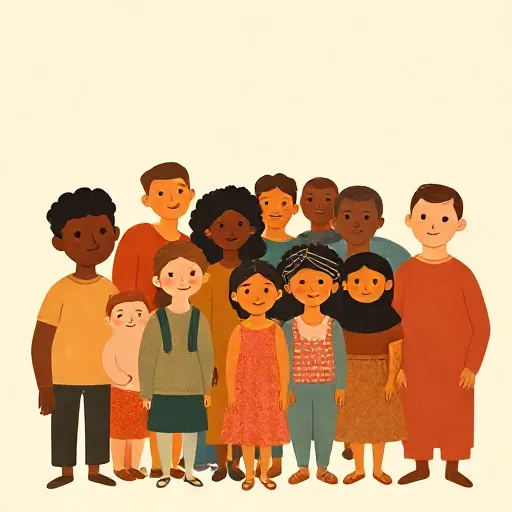
To figure out what makes someone Latinx, philosophers have offered three main theories.
Linda Alcoff, writing in the early 2000s, argued that Latinxs are an ethnorace—a group that sometimes works like a race and sometimes like an ethnicity. In the U.S., race is often about skin color and physical features, while ethnicity is about shared culture. But Latinxs break that mold. A dark-skinned Dominican might be seen as Black, while a light-skinned Argentine might be read as White—yet both could check “Latino” on a form. Alcoff pointed out that Latin America’s history of mixing Indigenous, African, and European peoples created a population that does not fit neatly into U.S. racial boxes. So, she concluded, the only honest label is a hybrid one: ethnorace.
J. Angelo Corlett had a different answer. He saw Latinxs as an ethnic group glued together by culture: speaking Spanish or Portuguese, having a traditional last name, recognizing yourself as part of the group, and being recognized by others. But when it comes to government policies like affirmative action, Corlett switched gears. For those purposes, he argued, being Latinx should be about descent—who your ancestors were—rather than how much culture you share. In that sense, the category sometimes functions more like a race.
Then came Jorge Gracia with a view that sounds almost like a family tree. His familial-historical view says you are Latinx if you have a historical tie to the events that started in 1492, when the Iberian Peninsula (Spain and Portugal) began colonizing the Americas. You do not need to speak Spanish, dance salsa, or eat tamales. You just need the right connection to that past. And what counts as the right connection can change: a person might be Latinx in one time or place but not in another, depending on local norms. For Gracia, the group is bound by a shared history, not by a shared list of cultural traits.
These three views do not agree, and the argument is far from settled.
When Identity Meets Borders and Laws

Defining Latinx is not just a word game. It affects real political questions about citizenship and immigration. In the second decade of the 2000s, more philosophers began asking how Latinx identity connects to who gets to cross a border and who belongs in a country.
Take Puerto Rico. Puerto Ricans are U.S. citizens, but if they live on the island, they cannot vote in presidential elections. That is a strange kind of citizenship, tangled up with the history of U.S. colonialism. Or consider the Tohono O’odham Nation, a Native American tribe whose homeland was split by the U.S.–Mexico border. Some members born in Mexico are U.S. citizens because their mothers enrolled in the tribe on the U.S. side; their neighbors, born to Mexican-citizen tribe members, are not. Their identity is woven into the border fence in ways standard theories of citizenship struggle to explain.
Philosopher José Jorge Mendoza, writing in the 2010s, argued that even if a country has a right to control its borders, that does not automatically make harsh immigration enforcement morally okay. Another philosopher, Amy Reed-Sandoval, studied communities in Oaxaca, Mexico, that have been crossing back and forth for generations. She argued they have special migration rights because they are a transborder community—their lives have always straddled the line. When you think about who “belongs” somewhere, definitions of group membership suddenly become urgent.
Seeing Yourself in Pieces: Latina Feminism

Some of the deepest thinking about Latinx identity came from Latina feminist philosophers, starting in the late 1980s. Their work did not just define the label; it described what it feels like to live inside it.
Gloria Anzaldúa, a Chicana writer, published Borderlands/La Frontera in 1987. She was not trained as a philosopher, but her idea of living on the border—both the physical U.S.–Mexico border and the psychological borders between cultures—shaped everything that followed. Philosopher María Lugones (who began writing in the late twentieth century) talked about “world-traveling”: the way a Latina might become a different self in an Anglo workplace, at a family party, or when speaking Spanish. She described identity not as one solid thing but as multiple selves that shift depending on where you are.
Ofelia Schutte noticed a painful dilemma. A Latina in the U.S., she argued, often faces two bad options: hide her Latinidad to fit in, or prove that her ability to move between cultures is an asset. Neither one lets her simply be herself. These insights do not just apply to Latinas; they capture something many Latinxs feel—a sense of fragmentation that standard categories cannot capture.
So, What Counts as Latinx Philosophy?

There is one more twist: what is Latinx philosophy itself? Some thinkers, like Jorge Gracia, argue that it is philosophy produced by Latinxs—any Latinx person doing any kind of philosophy is doing Latinx philosophy. Others argue it should be philosophy about Latinxs and their experiences.
A source-based view (focusing on who writes it) leads to odd results. A Latina astronomer who works on black holes and never thinks about identity would count as doing Latinx philosophy. Meanwhile, a non-Latinx scholar who spends a lifetime studying Latinx immigration ethics would not count at all. That clashes with how we usually talk. We do not call a math problem solved by a Mexican student “Mexican mathematics.” Most philosophers today lean toward a subject-based view: Latinx philosophy is whatever philosophical work meaningfully engages with Latinx people and questions. But the debate is not settled, and it matters when departments decide what counts as “real” philosophy.
Why It Matters to You

You might not be a philosopher, but you still live with categories every day. When you fill out a form, join a club, or meet someone new, labels are already in the air. The fight over “Latinx” is a reminder that no human group comes with a built-in definition. People made these categories, and people argue about them—because who gets counted shapes who gets listened to, who gets protected, and who gets left out.
So the next time you face that checkbox, you will know you are not just ticking a box. You are stepping into a conversation that crosses borders, spans centuries, and still is not finished.
Think about it
- If your family has roots in a Latin American country, but you do not speak Spanish and have never been there, would you still call yourself Latinx? What do you think Jorge Gracia would say?
- Should a government use skin color or family history to decide who counts as Latinx for a college scholarship? Why might Linda Alcoff disagree with that approach?
- Imagine moving to a country where people label you as part of a group you have never thought about. How might that change the way you see your own identity?