
Why Your Stubbed Toe is the Most Certain Thing You Know
A Stubbed Toe and a Secret: Enter Bertrand Russell
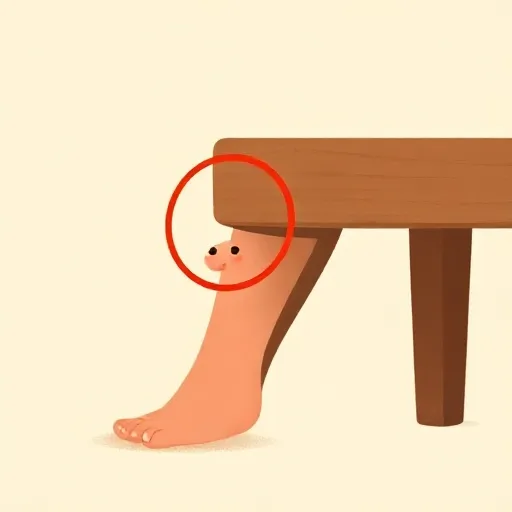
You’re running barefoot and — crack! — your little toe meets the table leg. A hot, sharp flood rushes in. You know you’re in pain. But how? You didn’t stop to think “I am in pain” before you knew it. The knowing just seems to be there, directly.
In 1912 the British philosopher Bertrand Russell (1872–1970) drew a famous line between two ways of knowing: knowledge by acquaintance and knowledge by description. According to Russell, the most secure knowledge you will ever have comes from being directly aware of something, with no detours through words or reasoning. That throbbing toe — the raw sting itself — is a perfect example. Everything else you believe about the world is built on top of that.
What Is Acquaintance? A Look Without Words

Russell described acquaintance as a kind of direct awareness that involves no judgment or thinking. When you are acquainted with something, you don’t apply a concept to it or form an opinion about it — you just have it in front of your mind, the way a toothache throbs without you needing to label it “toothache.” Russell called this a “nonjudgmental” and “nonconceptual” form of awareness.
Two features make acquaintance special. First, it is not a thought about anything — there is no “this is an X” going on inside you. Second, acquaintance is a real relation, like kicking a ball. Just as you cannot kick nothing, you cannot be acquainted with something that doesn’t exist. If you are directly aware of a stab of pain, that pain must really be happening. For this reason philosophers sometimes say acquaintance is “infallible”: it doesn’t guarantee that your later beliefs about the pain are true, only that the item you’re aware of is really present.
But what kinds of things can you be acquainted with? Russell and most acquaintance theorists doubted we are ever directly aware of physical objects — a table, a tree, another person’s mind. A vivid dream can give you experiences just like real ones, so it’s possible you could have the same direct awareness even if there were no table at all. What passes the test, they argue, are your own conscious states: that ache in your toe, the redness of a sunset, the sound of a bell.
Knowing Without Meeting: Description and Jack the Ripper

Most of what you call “knowing” is not direct at all. You know who Jack the Ripper was — a killer who terrified London in 1888 — but you have never met him, seen him, or heard his voice. You know him only through descriptions: “the person who committed those murders.” Russell called this knowledge by description. To know something by description is to know it as “the so-and-so” — the thing that fits a certain bundle of properties.
Russell argued that even proper names like “Aristotle” are really disguised descriptions. When you think “Aristotle was a philosopher,” you might be thinking something like “the Greek thinker who wrote the Nicomachean Ethics was a philosopher.” You are not acquainted with Aristotle himself — only with the concepts that make up your description of him.
Knowledge by description always leans on other knowledge. To know that Jack the Ripper was vicious, you must first know that someone committed certain crimes and that those crimes happened. And that knowledge, Russell insisted, must trace back to something you know directly — otherwise your beliefs would float in midair.
Why Foundations Matter: The Endless “Why?” Game

Why do you believe your friend is sad? Because she’s crying. Why believe she’s crying? Because you saw tears. Why believe you saw tears? Because of certain patterns of light hitting your eyes. You can keep asking “why?” for every belief, and if each answer needs another belief to back it up, you would have to run in an infinite chain — or go in circles.
Many philosophers think this regress argument shows that if any belief is truly justified, there must be some basic beliefs that don’t depend on further beliefs. These are foundational beliefs. Without a foundation, knowledge would be like a building with no bottom floor.
Russell’s answer was that acquaintance provides the bedrock. If you are directly aware of a fact — like the fact that you are now in pain — that awareness can justify your belief that you are in pain without needing another belief to support it. Acquaintance, he thought, is the ultimate source of all knowledge of truths.
But here’s the puzzle: acquaintance itself isn’t a belief. It has no truth value — a toothache isn’t true or false, it just is. So how does bare awareness turn into knowledge that something is the case?
From Awareness to Knowing: Two Answers

Russell himself was a little fuzzy on the connection. Later philosophers sharpened his picture. One family of views, championed by Richard Fumerton (b. 1949) , adds a crucial ingredient: you must be acquainted not only with, say, your pain, but also with the thought “I am in pain” and with the correspondence — the fit — between the thought and the fact. Picture seeing a puzzle piece click into place, and you see the clicking itself. When all three are present, Fumerton argues, you have the strongest possible justification.
A different strategy, defended by philosophers like Timothy McGrew and David Chalmers (b. 1966) , relies on a special kind of concept. When you are directly aware of a pain, you can form a demonstrative thought like “I am experiencing this,” where this points directly to the quality you feel. Because the very content of the thought includes the pain-quality you’re acquainted with, understanding the thought guarantees that it is true. You don’t need a separate awareness of a “fit” — the thought itself hooks directly onto reality.
Both approaches try to explain how something as simple as a bare sensation can anchor a whole tower of beliefs.
Why It Still Matters: The Speckled Hen and the Color Scientist
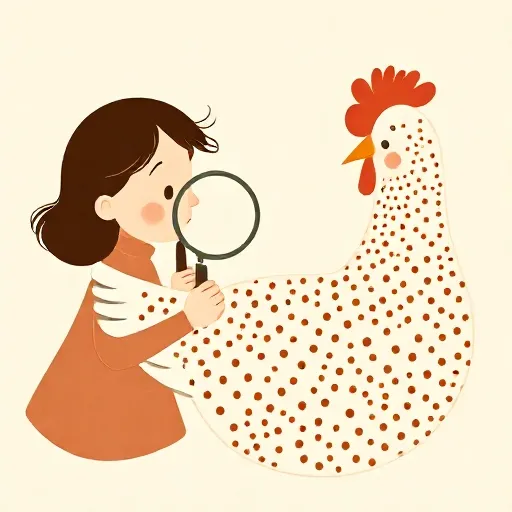
One famous challenge is the problem of the speckled hen. Imagine a hen with exactly 48 speckles. You are directly aware of your entire visual field, including all 48 speckles. Yet if you haven’t counted them, you can’t form a justified belief that there are 48 — even if you guess correctly. Acquaintance alone seems not to give you knowledge.
Acquaintance theorists respond that you might not be directly aware of the fact “there are exactly 48 speckles” in the way you are aware of the hen overall. Your attention is selective, and you may lack the concept “48-speckled” to compare directly with the experience. Direct knowledge requires the right kind of attention and the right conceptual tools — it’s not automatic.
The debate gets even more alive when we think about consciousness. In the famous thought experiment of Mary the color scientist, Mary knows all the physical facts about color but has never seen red herself. When she finally steps into a red room, she seems to learn something new — what red is like. Philosophers such as Chalmers use this to argue that direct phenomenal knowledge, Russell’s acquaintance with our own experiences, points to something that can’t be captured in a purely physical description of the world. So the question of direct awareness isn’t just dusty history: it sits at the heart of what it means to be a conscious being.
Next time you stub your toe, you can ask: is that raw sting a direct window to a real pain, something no science can fully replace? Or is it just a trick your brain plays that feels like a foundation, even if it isn’t? The answer is still up for grabs.
Think about it
- If a friend tells you they have a headache, can you ever truly know they’re in pain? Or do you only know your own pain directly?
- You dream that you’re flying and feel the wind rushing past. In the dream, that feeling is as real as anything. Does it count as direct knowledge, or is it a kind of fake awareness?
- If a brain scan could predict exactly what you’re about to feel, would that prove that feelings are nothing but physical brain events, or would the direct “what it’s like” still be something extra?