
Did God Use Geometry to Build the Universe?
The Teacher Who Drew the Universe on a Napkin

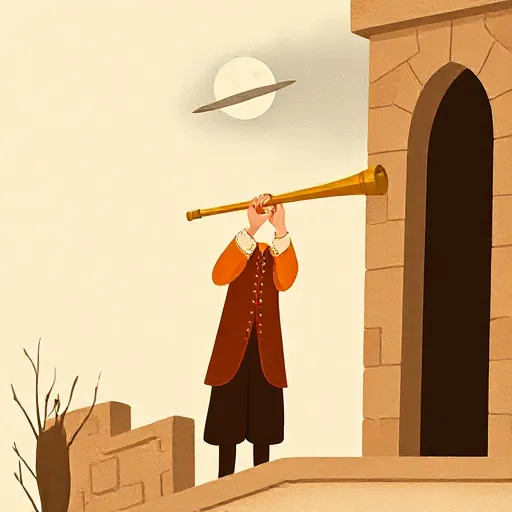
In the spring of 1594, a twenty-three-year-old math teacher in Graz, Austria, was trying to keep his students awake by drawing circles and triangles on the board. As he sketched, a question popped into his head: why did the solar system have exactly six planets? That was the number of planets anyone knew about at the time — Mercury, Venus, Earth, Mars, Jupiter, and Saturn. Johannes Kepler (1571–1630) couldn’t let go of the question. He was not content just to describe the planets’ paths; he needed to know why they were arranged that way.
That sudden question turned into a daring answer. What if, he thought, the distances between the planets are not random at all? What if they are built into a series of invisible, perfectly shaped three-dimensional boxes that nest inside one another like a set of cosmic measuring cups? In his first book, the Mysterium Cosmographicum (The Secret of the Universe, 1596), Kepler argued exactly that. The book made him famous overnight — and launched a philosophical and scientific adventure that would rewrite the map of the sky.
The Cosmic Blueprint: Five Perfect Shapes

At the heart of Kepler’s early theory sat five regular polyhedra — the so-called Platonic solids: cube, tetrahedron, octahedron, icosahedron, and dodecahedron. A regular polyhedron is a three-dimensional shape whose faces are all identical regular polygons, and the same number of faces meet at every corner. The ancient Greeks, especially Plato and his followers, had decided there were exactly five of these perfect solids. Euclid proved it in his Elements, a book Kepler knew almost by heart.
Kepler’s stroke of genius was to nest these shapes one inside another, slipping a sphere between each pair. Each sphere marked the orbit of a planet. The outermost sphere, carrying Saturn, surrounded a cube; inside the cube sat the sphere of Jupiter; inside that, a tetrahedron separated it from Mars’s sphere, and so on, until you reached the Sun nestled at the center. Because there are only five regular solids, Kepler argued, there could be only six planets — a necessary truth, not a lucky accident. He believed he had found the “formal cause” of the solar system: the geometric reason the Creator had for building it this way.
Most astronomers before Kepler merely tried to “save the phenomena” — that is, to design mathematical models that could predict where a planet would appear in the sky, without claiming the model was physically real. Kepler rejected that halfway approach. He was a realist: a good astronomical theory should describe the actual architecture of the world, not just serve as a calculating trick. The polyhedral model was his opening shot in a long battle to prove that the Copernican system — with the Sun, not the Earth, at the center — was not just a useful fiction but the literal, physical truth.
When Perfect Circles Failed Him
Kepler’s elegant nested-solid theory won him an invitation to work with the greatest observational astronomer alive, Tycho Brahe (1546–1601), in Prague. Tycho possessed decades of the most precise naked-eye observations ever made. But the marriage of Kepler’s geometry and Tycho’s data was a rough one. The model looked beautiful on paper; the numbers did not quite match the sky.
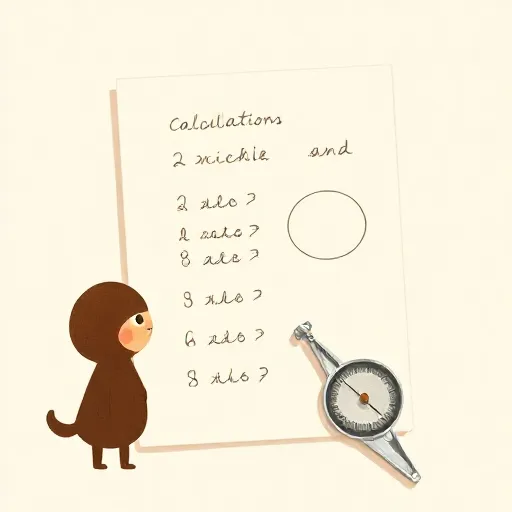
Kepler set out to crack the orbit of Mars, the planet that refused to behave. For several years he built hypothesis after hypothesis, always starting from the ancient axiom: orbits must be perfect circles, and planetary motion must be uniform around some chosen point. He almost succeeded with a “vicarious hypothesis” that got positions correct to within two minutes of arc — about the width of your little finger held at arm’s length. Most astronomers would have celebrated. Kepler stared at the remaining error. He wrote a sentence that rings through the history of science: those eight minutes of arc “alone will have led the way to the reformation of all of astronomy.”
And they did. Forced by Tycho’s relentless data to accept that the path of Mars absolutely could not be a circle, Kepler tried an egg-shaped oval. Eventually, in a kind of intellectual agony, he hit on the ellipse — a squashed circle with two center points, called foci. In 1609, in his Astronomia Nova (New Astronomy), Kepler published his first two planetary laws:
- The orbit of every planet is an ellipse with the Sun at one focus.
- A line drawn from the Sun to a planet sweeps out equal areas in equal times — the planet moves faster when it is closer to the Sun and slower when it is farther away.
Both laws killed ancient dogma. The first killed the perfect circle. The second killed uniform speed. In their place Kepler gave the world something deeper: a physics of the heavens.
Why the Planets Move: Physics, Not Spirits

For Kepler, it was not enough to describe the orbit. He demanded a cause — a physical reason that pushes the planets and steers them. This was the real revolution in the Astronomia Nova, which he subtitled “A New Astronomy Based on Causes or Celestial Physics.” In his view, astronomy had been a branch of mathematics for two thousand years; he was going to turn it into a branch of physics.
The cause, he reasoned, must lie in the Sun. The Sun rotates. From this rotating body, a motive power (in Latin, vis motrix) pours outward and sweeps the planets along their paths. This power weakens with distance, which is why distant planets move more slowly. To handle the push and pull that create an elliptical shape, Kepler borrowed ideas from William Gilbert’s new book on magnetism. He imagined each planet as a giant magnet with a fixed orientation: one pole is drawn toward the Sun, the other repelled. As the planet approaches the Sun it gets an extra tug; as it retreats it feels a shove. A material sluggishness he called inclination to rest (inclinatio ad quietem) kept the planets from matching the Sun’s own rotation speed.
To modern ears this sounds like a tangle of partially correct guesses. But the philosophical shift was momentous. Before Kepler, the standard view held that planets were carried by invisible crystalline spheres or pushed by angelic intelligences. Kepler insisted that the motions are natural, not spiritual. The heavens are made of the same stuff as Earth and obey the same kind of laws. He had no word for inertia in our modern sense — for him it was a resistance to motion, not a tendency to keep moving — but he was building the conceptual bridge that later thinkers would cross.
The Music of the Planets

In 1619, Kepler published the book he considered his masterpiece: the Harmonice Mundi (The Harmony of the World). It contains his third planetary law: for any two planets, the ratio of their orbital periods squared equals the ratio of their average distances from the Sun cubed — or more simply, the farther out a planet lives, the much longer its year takes, according to a precise mathematical lockstep.
But the third law was almost a side effect of a grander vision. Kepler was trying to hear the universe. For him, harmony was not a metaphor; it was the deepest fact about reality. The same ratios that produce beautiful musical intervals — an octave, a fifth, a third — are built into the speeds of the planets at different points in their orbits. The Solar System literally sings, though the sound is unheard to our ears: it is a pure harmony, perceived only by the mind.
How, he asked, can a mind recognize geometry and harmony that it has never seen or heard? His answer drew on Plato: the human soul contains archetypes — eternal geometric patterns put there by the Creator — and when sensory experience or astronomical data matches one of those patterns, the soul recognizes it as beautiful and true. This was not a passive taking-in of sense data (like an empty blackboard being written on). The mind actively compares and relates. A relation like “twice as fast” or “three times as long” does not exist in any single thing — it exists only because a mind connects two things. Harmony, for Kepler, is a relation of quantity that the soul itself forges.
Why Kepler Still Matters
Kepler died in 1630, broke and far from home, still trying to get his imperial salary paid. But the philosophical engine he built kept running. His three laws gave Isaac Newton the target he needed to invent universal gravitation. More importantly, Kepler’s stubborn insistence that mathematical order, physical cause, and careful observation must go hand in hand set the template for modern science. He was willing to abandon a two-thousand-year-old belief in perfect circles when the data said no. That is the courage of someone who cares more about the way the world really is than about the way we wish it were.
You live in a universe Kepler helped uncover — one where invisible forces and exact numerical laws explain everything from a falling apple to a galaxy’s spin. The next time you hear a piece of music that gives you chills, or notice a pattern nobody else sees, you are doing what Kepler did: letting your mind find a relation that is not just in the things themselves, but in your own act of connecting them. The universe is not random noise, he believed; it is a message. And you are built to read it.
Think about it
- Kepler felt sure the universe must be arranged by a mind. If we someday explain the whole cosmos with laws of physics, would that prove a mind designed it, or just that matter naturally follows these laws?
- Imagine you find a beautiful, simple pattern in some data. Later, better data shows it was wrong. Would you rather have believed the elegant false pattern or the messy truth? Why?
- Kepler thought the Sun physically pushes the planets. Today we say gravity is a force that acts at a distance. What does it mean to really “explain” why something moves — and do you ever hit a final answer?