
Can Logic Crack the Bible’s Code? Joseph ibn Kaspi Said Yes
A Long Journey to Find Wisdom… and a Big Letdown

In 1314, a Jewish scholar named Joseph ibn Kaspi (c.1280–1345) set out from southern France toward Egypt. He had heard that the descendants of the great philosopher Maimonides (1138–1204) still taught in Cairo, and he longed to learn their secrets. But when he arrived, he found only disappointment. Maimonides’s great‑great‑grandchildren were good people, Kaspi wrote, but none of them cared about science or deep learning. The journey had cost him hope, but it sharpened his ambition: he would search for the hidden meaning of the Bible on his own, using a tool most religious teachers ignored — logic.
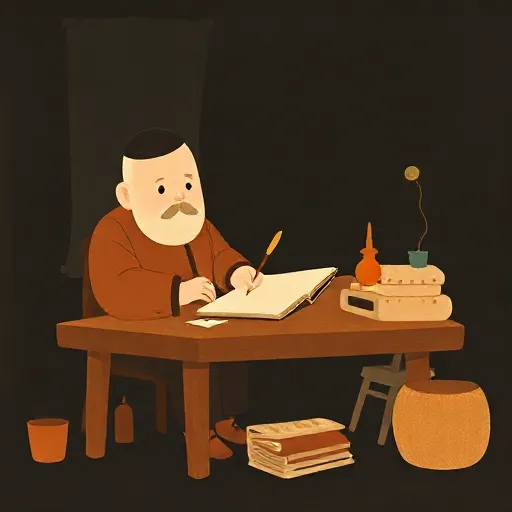
Kaspi was born around 1280 in Arles, in what is now southern France. He later lived in Tarascon and, from 1330, moved with his family to Spain, where he stayed in Perpignan, Barcelona, Majorca, and other towns. During these years he wrote a flood of books, many of them never printed. He was comfortable in Hebrew, Provençal, Arabic, and Latin, and he knew the works of Aristotle, Averroes, and other philosophers inside out. Yet he always called himself a commentator first. His life’s mission was to explain what the Bible really meant — and he was convinced that most interpreters had failed because they did not use logic, the study of correct reasoning.
The Bible and the Logician’s Toolkit
Kaspi believed that careful thinking had rules, and those rules could unlock a text. He called the work of interpretation exegesis, meaning the task of uncovering an author’s intention. A true commentary, he said, must lead you straight to what the author meant. But he was honest enough to admit that sometimes no one can be sure. When the “author” is God, the intention may be layered: a single story might hold several true lessons at once. The best a human commentator can do is follow where logic leads and check whether the explanation fits together without contradictions.
That is why Kaspi scolded other interpreters. They would read a verse, jump to a conclusion, and never stop to test it with logic. He complained that even those who had learned the rules of reasoning forgot them the moment they opened the Bible. To fix that, he wrote a short handbook for his son, summarizing the parts of Aristotle’s Organon that he thought mattered most for a commentator: how to sort things into genus (a broad category) and species (a narrower kind inside it), how to tell essential features from accidental ones, how to spot a valid argument, and how to avoid logical fallacies.
One example shows his method. The book of Genesis says, “There was no man to till the soil.” Some readers took this as evidence that no human beings existed yet. But Kaspi pointed out a logical mistake: a sentence can be true without its parts being true separately. Saying “no man was a farmer” does not prove there were no people at all. In fact, Kaspi quietly followed Aristotle’s view that the world had always existed alongside God, so he needed a reading that did not force the Bible into a conflict with philosophy. Logic, he thought, kept the peace.
The Perfect Language

Kaspi took his love of logic into the very sounds and shapes of Hebrew. Most philosophers agreed with Aristotle that human languages are conventions: people just agree to call a tree a “tree.” But Kaspi made a daring exception for the language of the Bible. He argued that Hebrew words are not just labels; they are built from letter‑roots that reveal the inner nature of the thing they name. For instance, the Hebrew word adam (human being) comes from adamah (earth), because people were formed partly from earth. The word ish (man) points to esh (fire), another ingredient of human nature.
This conviction had two striking consequences. First, Kaspi denied that Hebrew has any true homonyms — words that share a spelling or sound but have totally unrelated meanings. He was certain that every root carries one core idea, even if you have to dig to find it. The root l-ch-m, for example, signals “opposition and resistance.” That gives you milchamah (war) — and, more surprisingly, lechem (bread). Bread? Kaspi reached for Aristotle’s remark that food is the opposite of the thing being fed, and declared the problem solved. He was amazed that anyone could think the language’s creators, whom he regarded as great scholars, would use the same root accidentally.
Second, he denied that Hebrew contains any absolute synonyms — different words with exactly the same meaning. In his dictionary, Sharshot Kesef, he distinguished carefully between words for cutting tools. Herev (sword) emphasizes the destruction it causes; sakkin (knife) stresses the danger to the victim; maakhelet (slaughtering knife) calls attention to the way the flesh is consumed. They all name the same kind of object, but each word shines a light on a different facet. That, Kaspi said, is not an accident — it is the language’s genius.
He even changed the order of a dictionary. Older lexicographers listed verbs first because action seemed basic. Kaspi put nouns first, starting with the most abstract idea a root could carry, then moving down to concrete verbs. He believed language grew from the mind’s general concepts before it landed on particular actions. In his eyes, the structure of Hebrew was a map of thought itself.
God, Miracles, and Your Mind
Kaspi’s vision of God was equally shaped by Aristotle. He called God the unmoved mover, a necessary being whose very existence is pure thought. In a startling passage, he wrote that “the intellect is God and God is the intellect,” and that when you think deeply you bring God into your own mind. This was not a denial of God’s reality, but a claim that God is mind itself, and that the highest human activity — thinking — is the closest we come to touching the divine. He even dared to compare this three‑in‑one idea of intellect, thinker, and thought to the Christian Trinity, adding calmly that some Christians “are similar to us in opinions.”
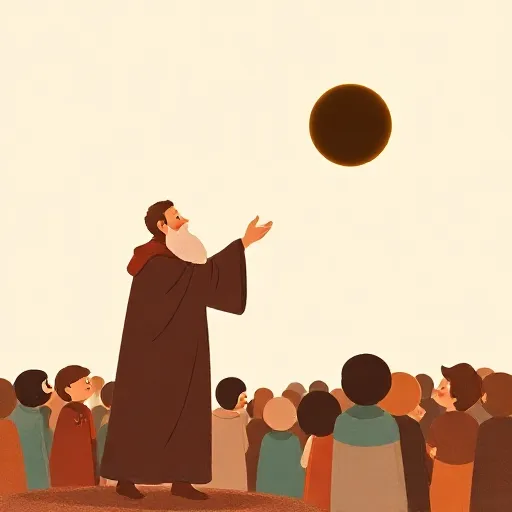
Because he saw God as a mind working through nature, Kaspi interpreted miracles in a naturalistic way. Floods, plagues, and wonders were not suspensions of natural law, he argued; they were rare events that spectators simply did not understand. Moses did not magically summon the plagues of Egypt. As the wisest man of his age, Moses had studied the celestial spheres and mastered the four elements — earth, water, air, and fire — and used that knowledge to trigger events that looked impossible. Kaspi was saying something close to what the thinker Spinoza would write three centuries later: what the Bible calls a miracle is often a natural occurrence witnessed by people ignorant of science.
Prophecy, too, was not supernatural in Kaspi’s system. A prophet was a person whose mind soaked up so much knowledge of cause and effect that he could forecast the future. It was like a clever observer who knows a friend’s personality well enough to predict what she will do. Even the problem of free will found a careful home here. How can God know the future if you are genuinely free? Kaspi suggested that God is the “remote mover” behind all events, even a bad choice. When the Bible says God hardened Pharaoh’s heart, it means that God, as the ultimate cause of all that exists, stands behind even that stubbornness — but the choice still belongs to the human being. It is a delicate balancing act that still puzzles philosophers today.
Why Was He Forgotten?

Despite all this brilliance, Kaspi’s name never glowed as brightly as that of his contemporary Gersonides (1288–1344). Gersonides wrote a big, systematic philosophy book that demanded attention, while Kaspi scattered his most original ideas inside Bible commentaries and unprinted works on logic and language. He was a philosopher among commentators and a commentator among philosophers — and neither group fully welcomed him. Many of his writings on logic and Hebrew grammar were never published in his lifetime. Even today, some exist only in manuscript.
Yet he left a quiet legacy. Kaspi’s naturalism about miracles and his claim that only humans can love God (God does not love back) reappeared in Spinoza’s Ethics. His relentless insistence that reason must walk hand in hand with faith keeps his voice alive for anyone who wonders how far logic can go. The next time you read a story, a poem, or even a friend’s message and puzzle over what it really means, you are doing a little of what Kaspi did — using the rules of thought to find a hidden layer. His forgotten books are a reminder that sometimes the boldest ideas are the ones we overlook.
Think about it
- Kaspi believed every Hebrew word had exactly one core meaning, so there were no true synonyms. If you had to pick one word to describe yourself, do you think any single word could capture everything about you?
- Kaspi thought that even dramatic miracles could be explained by science. If someone today described an event as miraculous, would you trust the claim or suspect that science just hasn’t caught up yet? What would it take to change your mind?
- Many of Kaspi’s ideas were so controversial that his books went unprinted for centuries. Can you think of an opinion you hold that might be unpopular but you think is worth defending? How would you decide if you are right?