
Do Your Feelings or Your Reason Decide What’s Right?
The Argument That Never Ended
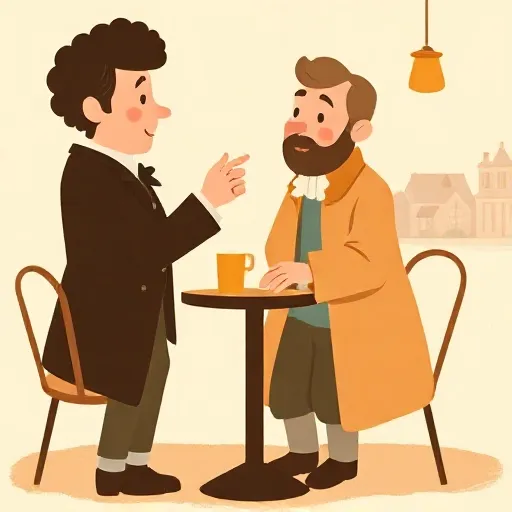
You are lying in bed, replaying a moment when you told a small lie. Your stomach knots up — it feels wrong. Then reason chimes in: If everyone lied all the time, nobody would trust anyone. Lying has to be wrong. Which voice do you listen to? Your gut or your logic? That question divided two of philosophy’s greatest minds: the Scottish thinker David Hume (1711–1776) and the German professor Immanuel Kant (1724–1804). They never met, but their ideas about morality still fuel arguments today. Hume believed we discover right and wrong through feeling. Kant insisted that only reason can reveal our duties. This is not just a dusty old debate; it is about how you choose to be a good person every single day.
Hume’s Answer: Morality Is a Feeling

For Hume, calling an action “wrong” is not like solving a math problem. It is more like tasting something bitter. When you see someone act kindly, you feel a warm glow of approval. That feeling is what Hume calls a moral sentiment. It is not a cold, detached judgment; it is an emotional response. Reason can help figure out what consequences an action will have, but the final verdict — this is good — is always a sentiment of approval. And only sentiments that come from a general point of view count as moral. A judicious spectator, Hume thought, sets aside personal bias and sympathizes with everyone affected. When such a spectator feels approval, that makes a character trait a virtue, and the opposite disapproval makes something a vice.
Hume’s list of virtues includes obvious ones like generosity and justice, but also traits like wit and good manners. Anything that is either useful or immediately agreeable to an impartial spectator can count as virtuous. He did not draw a sharp line between moral goodness and other pleasing qualities; a quick sense of humor, for him, could be just as much a virtue as honesty. This made morality part of ordinary human nature, rooted in the same feelings that connect us to friends and family.
Kant’s Answer: Morality Is a Law of Reason

Kant came to see feelings as too shaky a foundation. What feels good to you might feel terrible to somebody else. Even if all humans shared the same feelings, that would just be a fact about our psychology, not a command that every rational being must follow. Morality, Kant argued, demands something unconditional — a law that reason itself gives us, without any help from emotion. He called this law the categorical imperative. It is an absolute command, not a tip that depends on your wants.
One version of the categorical imperative says that you should act only according to that maxim whereby you can at the same time will that it should become a universal law. In plain words: before you act, ask yourself, “What if everyone followed the rule I am about to follow?” If that leads to a world you could not rationally want, the action is wrong. Imagine making a false promise to get money. If everybody made false promises, the whole practice of promising would break down — nobody would trust a promise anymore. You would be willing something impossible. Another version says that you should act so that you treat humanity, whether in your own person or in the person of another, always as an end, never merely as a means. That means you must never use people as pure tools for your own goals.
For Kant, the source of this law is our autonomy. The will gives itself the moral law, not because of outside pressure, but because that is what pure reason commands. This is what gives morality its special dignity. Reason, not feeling, is the supreme moral authority.
Can Logic Push You Off the Couch?

Even if reason can tell you what is right, can it make you actually do it? Hume famously wrote that reason is, and ought only to be, the slave of the passions. Reason alone, he argued, can never motivate an action. Think about reaching for a snack: you feel hunger or a desire for chocolate (a passion), and reason just works out where the cookies are. No matter how clearly reason shows you a reason to act, you will not move unless some feeling pushes you. If morality is supposed to move us — and it is — then its foundation cannot be cool, logical reason alone.
Kant rejected that picture. He insisted that pure reason can be practical — it can determine the will all by itself. The most morally admirable actions, he said, are done from duty alone, motivated solely by respect for the moral law, without any sympathetic warmth or selfish hope. But here things get tricky. Kant admitted that respect is a peculiar feeling, one that is produced by reason’s awareness of the law, not by anything in the senses. It feels like a mix of humility (when the law strikes down our self‑importance) and elevation (because the law comes from our own reason). So even for Kant, a feeling is involved when pure reason moves us. Later in his life, Kant also said that natural feelings like sympathy can be useful helpers — they can nudge us to do our duty, though we should not depend on them alone. Hume and Kant thus agree that emotion has a role in getting us to act; they clash on whether reason itself can create the crucial spark.
Freedom: Are You the Author of Your Choices?

If everything you do is caused by your brain chemistry and past events, can you really be responsible for your actions? Both Hume and Kant believed that morality requires freedom, but they pictured it very differently.
Hume was a compatibilist — he thought freedom and causal necessity can coexist. The only freedom that matters, he said, is liberty of spontaneity: you are free as long as you can do what you will, without being violently forced. If your desire to help a friend comes from your own character, the act is yours, even if that character was shaped by a long chain of causes. Kant found that too shallow. He argued that true freedom requires the will to be determined by pure reason, not by any prior natural event. This led him to a radical idea: we can think of ourselves as belonging to two orders. In the phenomenal world of cause and effect, our actions are determined. But as rational beings we also belong to a noumenal order, outside time and empirical laws, where we can initiate new causal chains. That is the only way, Kant thought, that we can obey the moral law and be genuinely free — not just pushed around by desires we happen to have. He admitted we can never know whether we really have this freedom, but we must believe we do whenever we see ourselves as moral agents. So next time you think “I could have chosen otherwise,” you are stepping into Kant’s deep mystery.
Why Your Inner Tug‑of‑War Still Matters

Every day you face moments where your heart and your head pull in opposite directions. Should you share your video game when you really do not want to? Should you tell an uncomfortable truth? You are living the very same clash that Hume and Kant battled over. Modern psychology suggests that moral judgments often start as quick emotional gut‑reactions, but then we use reasoning to check them. The debate is far from settled.
Hume reminds us that morality grew out of human sympathy, social life, and the kinds of character that help people flourish. Kant reminds us that some lines — like never using a person as a mere tool — must hold firm no matter how we happen to feel. Perhaps you need both: feelings to notice what matters, and reason to build a fair world. The next time you are torn, imagine the two philosophers sitting on your shoulders, one pointing to your heart, the other to your head — and realize the best answer might come from listening to both.
Think about it
- Think of a time you felt torn between what you thought was fair (like sharing) and a strong feeling that you did not want to. Which side won, and why do you think that happened?
- If a scientist could predict every choice you will ever make by looking at your brain, would it still make sense to say “I could have done otherwise”?
- Can someone who never feels sympathy or guilt still figure out right from wrong using only reason? Why or why not?