

Who Deserves the Biggest Slice of the Pie?
The Pie That Started a Thousand Arguments

Imagine you and your friends are splitting a pizza at a sleepover. One person gets the biggest slice, another gets the smallest. Is that fair? Did the person who paid for the pizza deserve more? What if one friend is hungriest? Or what if you all agreed to share equally at first? This small squabble is a window into one of the biggest questions in philosophy: distributive justice — the branch of philosophy that asks how the benefits and burdens of living in a society, such as income, wealth, jobs, and opportunities, should be shared among its members.
Every day, governments make laws that change who gets more and who gets less: taxes, school funding, healthcare, minimum wages. For most of history, people thought economic positions were fixed by nature or the gods. But once it became clear that human choices can reshape the distribution, distributive justice became an unavoidable moral question. Philosophers don’t just dream up perfect imaginary worlds. They offer moral guidance for the choices our own societies face right now — whether to keep current policies or change them.
Over the last sixty years, thinkers have proposed dramatically different answers. Here are four of the most influential.
The Simplest Rule: Everyone Gets Exactly the Same
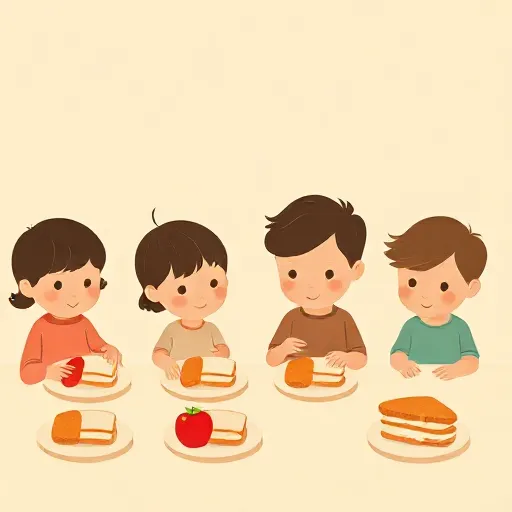
The most straightforward idea is strict equality: every person should have the same level of material goods and services. The justification is that all people are morally equal, so equality in stuff is the best way to respect that ideal.
But even this simple rule hits two big snags. The first is the index problem: how do you measure “the same level”? If you give everyone exactly the same bundle — say, four oranges and six apples — that may not suit anyone. Someone who loves apples and hates oranges could swap with a friend who feels the opposite, and both would be happier without making anyone else worse off. This kind of win‑win change is called a Pareto superior improvement. So identical bundles aren’t efficient. Most theorists turn to money as a convenient, though imperfect, measuring stick.
The second snag is the time frame. Should everyone have equal wealth at a starting point (a starting‑gate principle), after which people are free to trade and become unequal? Or must income stay equal every year? Strict egalitarians usually prefer continuous equality, but even that can lead to wealth gaps if people save differently.
The most common objection, however, is that strict equality can leave everyone materially worse off. If the prospect of higher pay encourages people to work harder or invent new things, the whole economy might grow — and even the worst‑off could end up better than under rigid equality. It was partly this criticism that inspired a powerful alternative.
Rawls’s Radical Idea: Help the Worst‑Off First

The most widely discussed theory of distributive justice comes from the American philosopher John Rawls (1921–2002). In his book A Theory of Justice, Rawls proposed two principles. The first guarantees equal basic rights and liberties for all. The second deals with economic inequalities and contains his famous Difference Principle: social and economic inequalities are just only if they work to the greatest benefit of the least advantaged members of society.
Rawls does not demand equal incomes. He cares about the absolute position of the worst‑off, not whether the gap between rich and poor is large or small. If allowing skilled doctors to earn much more brings better healthcare to poor neighborhoods, the inequality is acceptable. But if equal incomes would maximize the well‑being of the least advantaged, then strict equality is what justice requires. Rawls also insists on fair equality of opportunity, so that talented children from poor families have a genuine chance to compete.
Critics have pushed back from many angles. Strict egalitarians argue that huge wealth gaps damage social solidarity and give the rich unfair power over others, even if the poorest are a little richer. A group known as luck egalitarians, inspired by Ronald Dworkin (1931–2013), complains that the Difference Principle ignores how much of a person’s advantage comes from brute luck rather than choice. Dworkin distinguished between endowments (the talents and circumstances you are born into) and ambitions (the choices you make). He argued that a just society should compensate people for bad brute luck — for instance, severe disabilities — but let them live with the consequences of their own choices, like working long hours or spending on luxuries. Rawls’s principle, by contrast, offers no special compensation for natural misfortune unless a person also ends up in the lowest income group.
The Happiness Calculator: What if We Just Add Up Smiles?
What if the only thing that truly matters is how much happiness, or utility, a distribution creates? That is the core of utilitarianism, a welfare‑based principle. Jeremy Bentham (1748–1832) argued that pleasure is the only intrinsic good; his successor John Stuart Mill (1806–1873) broadened the idea to include higher forms of happiness. Modern utilitarians often say that the goal should be to maximize preference‑satisfaction — getting people whatever they want.
For a utilitarian, the right distribution is whichever one produces the greatest total utility, summed across all individuals. Questions about equality or desert matter only if they happen to boost overall happiness.
The most famous objection is that utilitarianism fails to take seriously the distinctness of persons. Imagine that making a small group of people miserable allows a large group to be slightly happier. The total happiness rises, but many would say it is unjust to sacrifice a few for the benefit of the many. A related worry is that utilitarianism counts every preference equally — including racist or sexist ones. If the majority dislikes a minority and wants them to have less, a classic utilitarian calculation could, in principle, endorse an unfair distribution. Utilitarians often reply that, in the long run, good institutions and education would erase such harmful preferences. Yet critics point out that we don’t need to wait for data to know that racist policies are wrong.
Even if we agree with the utilitarian goal, putting it into practice is extremely hard. To know which policy maximizes total utility, we would need to measure and compare how much happiness every single person gets from every possible arrangement and then sum it all up. That information is impossible to gather, so different utilitarians end up recommending wildly different policies — some favoring strong equality, others laissez‑faire capitalism.
“It’s Mine Because I Made It”: The Libertarian Challenge

The American philosopher Robert Nozick (1938–2002) rejected the idea that distributive justice should aim for a particular pattern at all. In his Entitlement Theory, a distribution is just if everyone got their belongings through just acquisition or just transfer. If you earned your money fairly or received it as a gift from someone who did, the government has no right to take it and give it to someone else — not even to help the poor.
Nozick’s starting point is self‑ownership: you own your body and your talents. Therefore, he argued, you own whatever you produce with them. He famously challenged the idea that mixing your labor with unowned things always gives you ownership: “why isn’t mixing what I own with what I don’t own a way of losing what I own rather than a way of gaining what I don’t? If I own a can of tomato juice and spill it in the sea… do I thereby come to own the sea, or have I foolishly dissipated my tomato juice?” Still, Nozick believed that increasing the value of unowned resources could justify exclusive property rights.
But even Nozick recognized a limit, borrowed from John Locke: the Lockean proviso. An acquisition is just only if it leaves “enough and as good” for others. Nozick’s weaker version says you may not acquire something if doing so worsens other people’s situation. Critics argue this is too weak — the first person to grab a beach can fence it off and charge admission, as long as they compensate previous visitors with a lifeguard service. Yet those visitors would have been even better off if a different organizer had taken charge and charged less. The proviso also cannot fix the enormous problem of past injustice: so many holdings today trace back to theft, conquest, or fraud that it is practically impossible to figure out what a truly just distribution would look like. Nozick himself admitted that without a full theory of rectification his theory cannot be applied to actual societies.
Why the Shouting Never Stops — and Why It Matters to You

These theories are not just distant academic debates. They shape your life every day. When your school decides whether to spend its budget on new computers or art supplies, someone is making a distributive choice. When your parents pay taxes, when governments set a minimum wage, or when a family decides how much allowance each child gets — all of it involves taking a stand on who deserves what.
And you cannot avoid taking a stand. Saying “we should just leave things as they are until everyone agrees” is itself a position — it says the current distribution is morally acceptable. Silence is a vote for the status quo.
The four rival pictures — strict equality, Rawls’s difference principle, the happiness calculator, and the libertarian’s “it’s mine” — each capture a real value. Equality, compassion, overall well‑being, and personal freedom all tug our moral compass in different directions. Real‑world arrangements almost always mix these ideas, and new evidence about how economies work can shift which blend seems fairest. The shouting never stops because the question is so human: in a world where we can choose, what do we owe each other? Next time you hold the knife to cut the pie, you are doing philosophy.
Think about it
- If a new school rule gave the earliest arrivals the best seats, would that be fair? Why or why not?
- Imagine a society where everyone works equally hard but some people are naturally faster. Should they earn more?
- If you found a $100 bill on the sidewalk, do you have a right to keep it, or does it belong to everyone in some way?