Who Gets the Biggest Slice? The Fight Over What’s Fair
The Cake Problem: What Is Each Person Owed?
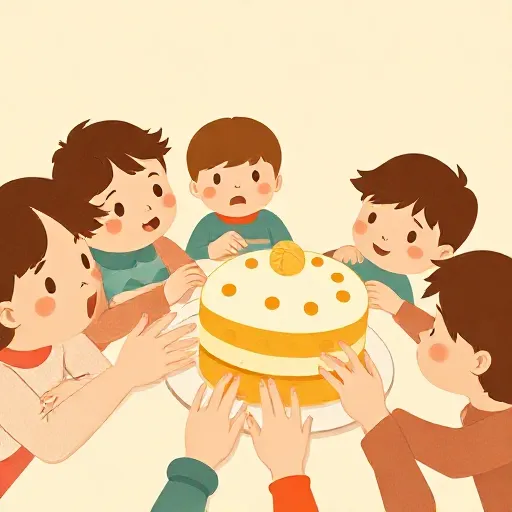
Imagine it’s your birthday party. You have one cake and six friends. One helped set up, one brought you a gift, and someone else is allergic to chocolate. How do you decide who gets which piece? This is a question of justice.
The ancient Roman legal code known as the Institutes of Justinian (6th century) defined justice as “the constant and perpetual will to render to each his due.” That sounds dry, but it points to four things all talk of justice shares.
First, justice is about individual persons and what they can claim — a piece of cake, a chance to play, fair pay. It matters how each separate person is treated. That’s why a parent dividing cake can’t just say, “the group is happy overall,” and call it a day. The philosopher David Hume (1711–1776) noticed that if cake were infinite, nobody would bother with justice — you’d just take what you want. Justice only becomes urgent when resources are limited and people’s claims bump into each other.
Second, justice involves what is owed. If you deserve a slice, you can demand it, not just beg for a favour. Justice creates obligations can be enforced. If your brother swipes your fair portion, you can rightfully complain and expect someone to make it right.
Third, justice demands impartial rules. You can’t give your best friend a bigger slice just because you like them more. If two cases are alike, they must be treated alike — today, tomorrow, and next week.
Fourth, justice needs an agent — someone or some institution that makes the decision. Without a person or a system acting, a lopsided cake isn’t an injustice in the same way; it’s just a lopsided cake. But when an agent could have divided it fairly and didn’t, we rightly complain.
These four features crop up whenever we argue about what’s fair.
Two Faces of Justice: Following Rules vs. Rewriting Them
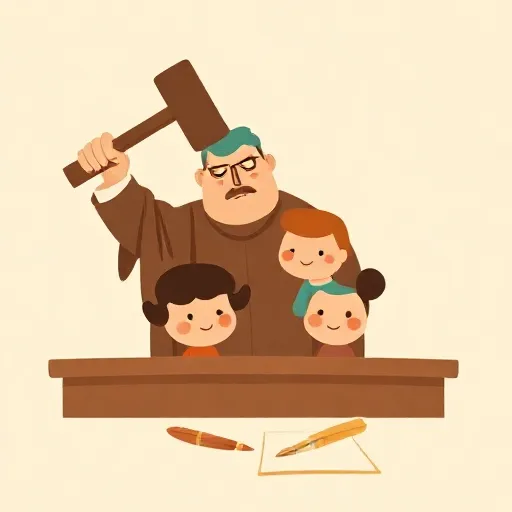
Philosophers have noticed that justice wears two different masks. One face looks backward, at the rules and expectations people already have. If your school has always let the tallest kid pick first for basketball, some might say it’s simply just to follow that custom — everyone knows what to expect. Hume argued that justice is nothing more than following the conventions that let society run smoothly.
The other face looks forward. It asks whether those existing rules are themselves fair. Maybe height has nothing to do with who deserves to pick first. In that case, ideal justice demands that we change the rules — create new rights and new expectations.
This tension shows up in a second ancient distinction, drawn by Aristotle (384–322 BCE). Corrective justice is about putting right a wrong between two people: if Bill steals Alice’s computer, justice requires that Bill returns it or compensates her. Distributive justice is about how a pile of good things — money, opportunities, jobs — should be shared among many people from the start.
The two can pull in opposite directions. Even if Alice is far richer than she ideally “should” be, corrective justice still says Bill must give back her computer. Respecting titles people have already acquired sometimes collides with our wish to make the whole distribution more equal.
Can Justice Be Measured in Smiles? The Utilitarian Tug-of-War
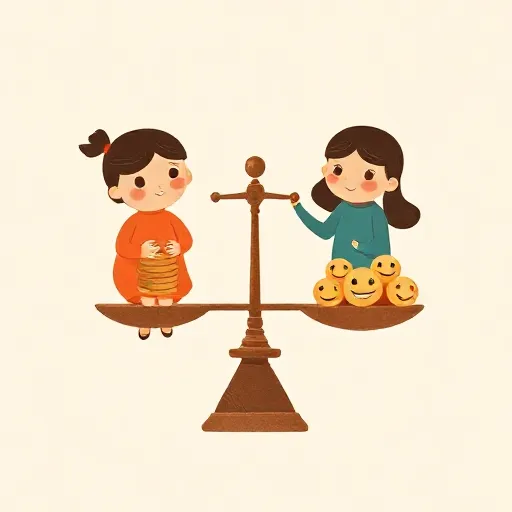
What if the real point of justice isn’t dividing things at all, but making people as happy as possible? This is the heart of utilitarianism, a view championed by John Stuart Mill (1806–1873) and Henry Sidgwick (1838–1900). Utilitarianism says the right action is the one that produces the greatest total happiness.
Apply that to justice, and you get a two-part task. First, the utilitarian must show that familiar rules of justice — don’t steal, keep your promises, punish only the guilty — are exactly the rules that, when everyone follows them, create the most overall happiness. Mill and Sidgwick both tried to do this. They argued, for example, that punishing people for what they deserve works better to deter crime than punishing randomly, even though “desert” initially seems like a backward-looking idea.
Second, the utilitarian must explain why justice feels so distinctive — why we get angry when someone breaks a promise in a way we don’t when they forget to be grateful. Mill’s answer was that justice protects the most vital interests of human beings, so we react with resentment when those interests are threatened.
But three stubborn problems remain. First, justice seems to care about things — rights, resources, opportunities — not just about the happiness those things produce. A fair paycheck is about the right amount of money, not about whether John ends up more cheerful than Jane with his wages. Second, utilitarianism adds up happiness across the whole crowd. If torturing one innocent child would somehow make everyone else ecstatic, a strict utilitarian might have to call it just — a conclusion most people find monstrous. Third, justice often looks backward: you deserve a reward for work you’ve already done, not because rewarding you will encourage future work. But utilitarianism only looks forward, to what will happen next. Even critics doubt this is enough.
The Blindfold Gamble: What Would You Choose If You Didn’t Know?

Partly because of utilitarianism’s troubles, philosopher John Rawls (1921–2002) revived a very old idea: the social contract. Imagine you had to design a whole society from scratch. The catch? You’ll have to live in it, but you don’t yet know anything about who you’ll be — not your family’s wealth, your talents, your gender, your health. Rawls called this the original position behind a veil of ignorance.
Rawls argued that rational people in this position would pick two principles. First, everyone gets the same basic liberties — freedom of speech, the right to vote — unless all agree otherwise. Second, any economic inequalities must work to the greatest benefit of the least well-off group. This is the difference principle.
Think of cutting a cake when you don’t know which slice you’ll receive. You’re likely to cut it very evenly. Rawls’s contract tries to capture that fairness instinct. But critics ask: why assume the worst-off group’s position matters more than the average? A self-interested person behind the veil might simply try to maximise average well-being, since they have an equal chance of landing anywhere. Rawls had to build extra features into the choosers — a special fear of being poor, for instance — to make them prefer the difference principle. So some philosophers suspect the contract doesn’t discover justice; it just mirrors the sense of justice Rawls already had.
A different contract thinker, T.M. Scanlon (born 1940), suggested a simpler test: a rule is just if no one could reasonably reject it as a basis for general agreement. But this too relies on an independent notion of what counts as reasonable. So contract theories may not give us a freestanding blueprint for justice after all.
Equality — But What Kind?

If utilitarianism and contractarianism aren’t completely satisfying, what about egalitarianism — the view that justice is fundamentally about treating people as equals? But equality of what?
One straightforward version says justice requires everyone to have the same amount of whatever matters, unless there’s a good reason for a difference. But that seems to ignore people’s own choices. So many philosophers now defend luck egalitarianism. On this view, inequalities are fair if they result from your free choices — like choosing to practice piano for hours instead of watching TV — but unfair if they come from brute bad luck: being born with a disability, or into a poor family, or hit by a sudden flood. Society should compensate for bad luck, not for bad choices.
Trouble is, choices and luck are tangled up. A child who practices piano probably did so because early experiments revealed a natural talent. That talent itself is a matter of luck. So drawing a clean line is almost impossible. Also, one person’s responsible choice — say, inventing a brilliant gadget — can make others worse off through no fault of their own. The luck they then suffer is still brute.
Another group of philosophers, called relational egalitarians, shifts the focus. They say the real problem with steep inequality isn’t unfair shares, but that it damages how people see and treat each other. When some children arrive at school with empty lunchboxes while others have gourmet meals, a society of equals is hard to maintain. Relational equality doesn’t give a precise recipe for dividing goods, but it provides a strong reason to care about closing gaps.
Why It Still Matters Every Day
The next time you hear yourself say, “That’s not fair!,” pause and ask what kind of justice you’re reaching for. Are you saying an existing rule wasn’t followed? Or that the rule itself is rotten? Are you thinking about correcting a one-time wrong, or about how the whole system should be arranged?
Philosophers don’t agree on one master answer. Utilitarianism captures the importance of outcomes but seems to miss the way each person counts. Contract theories build fairness into the choosing situation but can end up smuggling in the very values they were supposed to prove. Egalitarian views keep equality at the centre but wrestle with responsibility and luck.
That might sound like a mess, but it’s also freeing. It means justice is a conversation, not a finished formula. Every argument you have about allowances, school rules, or who sits where is part of that conversation — and your voice counts in it too.
Think about it
- If a teacher awards prizes based on test scores, but some students had expensive tutors and others did not, is the outcome fair? What, if anything, should be changed?
- Should a government ever punish an innocent person to prevent a bigger disaster? Why or why not?
- Imagine you have to divide a pizza among friends: one planned the party, one is especially hungry, and one brought drinks. How would you decide who gets what — and what principle are you actually applying?