
Who Really Deserves the Bigger Slice of Cake?
The Cake-Cutting Rule and the Dream of Envy-Free Slices

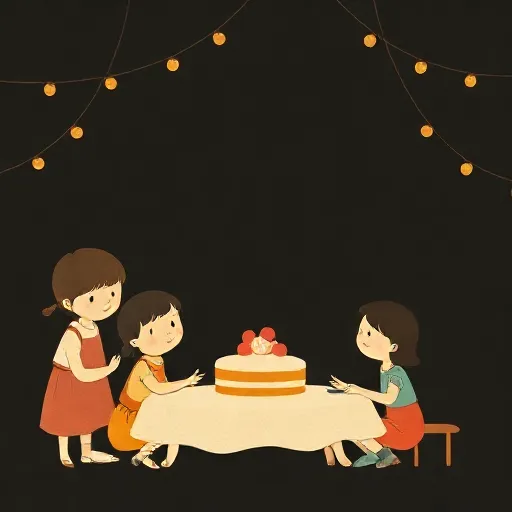
Imagine you and a friend are sharing a cake. You get to cut it, but your friend gets to pick which slice to take. This simple trick forces you to cut as evenly as possible: if one piece is bigger, you’ll end up with the smaller one. Economists call this an envy-free outcome—nobody would prefer to swap their slice for the other person’s. No one envies anyone else.
The idea of envy-freeness isn’t just for cake. Starting with the work of French economist Serge-Christophe Kolm in the 1970s, thinkers have used it to ask big questions about fairness in whole economies. What if you could design a system where nobody looks at their neighbor’s house, salary, or healthcare and wishes they had that instead? That would be an envy-free society.
There’s a famous result that gets close. Imagine everyone in a town starts with the same amount of money. Then they all go to a huge marketplace and trade freely, buying what they want. According to a key theorem in economics, the final outcome will be Pareto-efficient—meaning you can’t make anyone better off without hurting someone else—and, under certain conditions, it will also be envy-free. Since everyone had the same budget, nobody could point to someone else’s bundle of goods and honestly say “I wish I had that.” They could have bought it themselves.
But the cake-cutting rule only worked because you and your friend wanted exactly the same thing: more cake. Real life is messier.
When Fairness Falls Apart: Different Needs, Different Talents

Now suppose you’re sharing not just cake, but a whole dinner, and your friend has a much bigger appetite—or a medical condition that requires extra nutrients. Giving you both identical plates would be envy-free in a narrow sense, but it might leave your friend hungry or unhealthy. Suddenly, “same for everyone” doesn’t feel fair at all.
Economists call the deeper problem here the clash between compensation and reward. The compensation principle says that if two people have exactly the same preferences, differences in outcomes that come from circumstances beyond their control—like natural talent or a disability—should be evened out. The reward principle says that if two people have the same talent or circumstances, differences that come from their own choices or effort shouldn’t be taken away. Both ideas are buried inside the concept of envy-freeness. If you successfully eliminate all envy, you’ve probably both compensated for bad luck and respected personal effort.
But the economist Elisha Pazner and the philosopher David Schmeidler showed in 1974 that these two principles can directly clash when people have unequal skills. Imagine one person finds work effortless while another finds it exhausting. An envy-free system would have to make sure both end up equally satisfied in the end. That might mean the hardworking person gets more goods—but that can look unfair to the person with more talent, who feels punished for having an easier time. In some simple economies, no arrangement can satisfy both principles at once. No single definition of fairness can do it all.
This kind of conflict isn’t just theoretical. It shows up every time a government tries to design taxes or benefits.
The Arrow Impossibility: Can We All Vote on Fairness?

Maybe you think we could just vote on what’s fair. After all, if enough people agree, that’s democracy. But the American economist Kenneth Arrow (1921–2017) shook that hope in 1951 with his Impossibility Theorem.
Arrow asked: Is there a method for taking every person’s individual list of preferences and turning it into one consistent group ranking—a method that works for any possible collection of preferences and respects a few basic, decent rules? The rules were things like: if everyone prefers option A to option B, then the group ranking should prefer A to B (this is called Weak Pareto). Also, the way the group ranks two options should depend only on how individuals rank those two options, not on irrelevant other options (this is called Independence of Irrelevant Alternatives). And finally, no single person should be a dictator whose strict preference always wins.
Arrow proved mathematically that no voting system can satisfy all those rules at once, as long as there are at least three alternatives and at least two voters with distinct preferences. The result isn’t a glitch—it’s a deep fact about group decision-making. You can end up with cycling majorities, where A beats B, B beats C, but C beats A, leaving the group stuck.
This doesn’t mean democracy is hopeless. It means that any working voting system must sometimes go beyond the simplest rules. It might need to know how intensely people care, or use richer information about fairness—like who is worst off.
What Philosophers Brought to the Table: Priorities and Capabilities

While economists wrestled with impossibility theorems, philosophers sharpened the question of what fairness even requires. In 1971, the American philosopher John Rawls (1921–2002) proposed the difference principle: social inequalities are only acceptable if they benefit the least advantaged members of society. That idea pushed many economists to examine the maximin criterion, which focuses entirely on making the worst-off position as good as possible—rather than simply adding up total happiness.
Then came the Indian economist and philosopher Amartya Sen (born 1933), who argued that looking only at resources or money misses what truly matters. He developed the capability approach, which asks not “how much do you have?” but “what can you actually do and be?” Two people with the same money might have very different real freedoms if one is disabled, sick, or living in an unsafe neighborhood. Sen’s framework doesn’t give a simple formula, but it forced both economics and political philosophy to take seriously the non-material dimensions of a good life—like health, education, and dignity.
Together, Rawls’s focus on the worst off and Sen’s focus on real opportunities widened the toolkit. They showed that fairness isn’t just about smooth mathematical properties. It’s about whose life gets better and what they can actually achieve.
Why This Matters for Your Lunch Money and the Whole Planet

Every time a government decides how much to tax, how to fund schools, or who gets healthcare first, it’s choosing a fairness rule—knowingly or not. If economists ignored these moral questions, policies would simply chase bigger numbers on a chart, even if that left many people worse off. The messy reality is that no single formula—not majority vote, not equal shares, not pure market freedom—handles every situation perfectly.
But the arguments you’ve just read give us tools. The concept of envy-freeness reminds us to ask whether people feel they could have what others have. The clash between compensation and reward forces us to separate bad luck from personal choice. Arrow’s impossibility warns us that we can’t just stack up preferences without losing something valuable. And the capabilities approach insists we pay attention to what people can actually do, not just what’s in their wallet.
Next time you split a pizza, decide which movie to watch as a group, or wonder whether your allowance is fair, you’re doing applied moral mathematics. The big questions of economic fairness aren’t far away in textbooks—they’re folded into every family dinner and every choice about who gets what.
Think about it
- If two people start with the same money but one has a disability that makes daily life much more expensive, is giving them the exact same amount of cash still fair? Why or why not—and what would a better solution look like?
- Suppose a class votes on a field trip. Everyone’s top choice is either the zoo or the museum, but a loud group insists on adding a third option—the water park. After the vote, nobody is happy because the preferences keep cycling. Should the group simply refuse to consider the water park, or is there value in hearing it even if it messes up the vote? Can you think of a fair way to move forward?
- If you knew that no rule could ever be perfectly fair for everyone, would you still try to design the most fair system possible? What would “good enough” fairness mean to you in your own life—with friends, at school, or at home?