
Why a Zen Master Might Say the Bridge Flows, Not the River
The River Does Not Flow: Zen’s Challenge to Ordinary Thinking

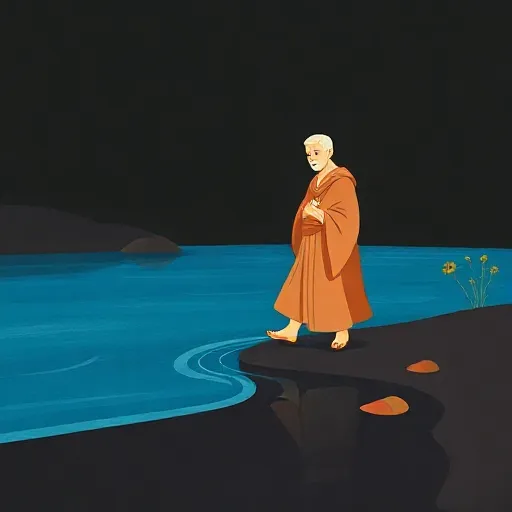
If I told you that the river does not flow but the bridge does, you’d probably think I was joking. But in Zen Buddhism, statements like that are taken seriously. They aren’t meant to confuse you for fun; they’re tools designed to shake you out of ordinary thinking.
Zen is often called an anti-philosophy. Why? Because it argues that reasoning from everyday observations is like trying to fix a blurry photo by taking another blurry photo. If your mind already sees the world through a filter of “me” versus “everything else,” then piling more thoughts on top won’t help — you need to clean the lens itself. Where Western philosophy often starts with ideas and builds complicated systems, Zen starts by mistrusting the very tool we use to build them: the thinking mind. It insists that real understanding comes not from adding concepts but from transforming the way you perceive in the first place.
The word Zen (from the Chinese Chán, which comes from the Sanskrit dhyāna) simply means meditation. The historical Buddha, it is said, achieved enlightenment through deep meditation. For Zen, the key is prajñā, or nondiscriminatory wisdom — a practical, lived knowing that doesn’t slice the world into little labeled boxes. Theoretical knowledge, by contrast, relies on language and distinction-making, and Zen believes that by itself it can never free a person from suffering. Only a training of the whole person — body and mind together — can do that.
Two Paths Up the Mountain: Kōans and Just Sitting
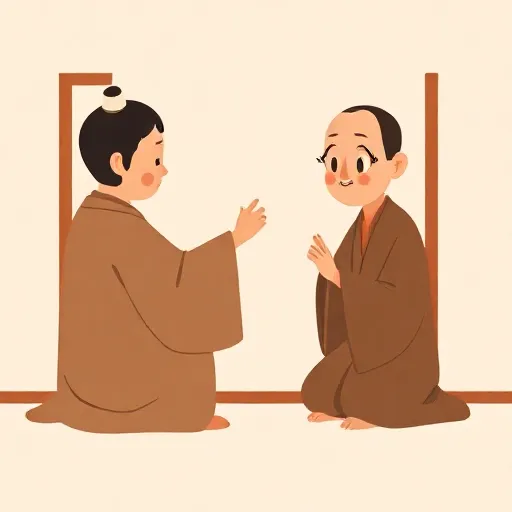
Zen has two main schools, both still alive in Japan today. The Rinzai school is famous for its use of kōans — riddle-like puzzles that cannot be solved by normal thinking. Hakuin (1685–1768), who systematized modern Rinzai training, collected around 1,700 of them. A practitioner works through them one by one in private meetings with a master, and each one pushes their ordinary mind to its breaking point. A kōan might be, “What is the sound of one hand clapping?” or “Show me your original face before your parents were born.” The goal is not a clever answer but a sudden breakthrough — an insight into a reality that words can’t capture. The Rinzai school describes its path in four phrases: a special transmission outside the scriptures, no dependence on words and letters, pointing directly at the human mind, and seeing into one’s nature to become a buddha.
The Sōtō school, founded by Dōgen (1200–1254), takes a quieter route. It relies on shikan taza, literally “just sitting.” There are no elaborate kōan systems. The practitioner sits in meditation without any goal, desire, or interference from the ego. In Dōgen’s view, sitting isn’t a means to an end — it is itself realization. He called this practice-realization: you don’t meditate to get enlightened; the very act of sitting is enlightenment when done with a pure mind. This collapses the usual gap between acquired enlightenment (gaining it through effort) and original enlightenment (the idea that we’re already awakened deep down). Both schools, despite their different styles, aim for the same thing: embodying wisdom and compassion in a living, breathing human being.
The Three Adjustments: Body, Breath, and Mind

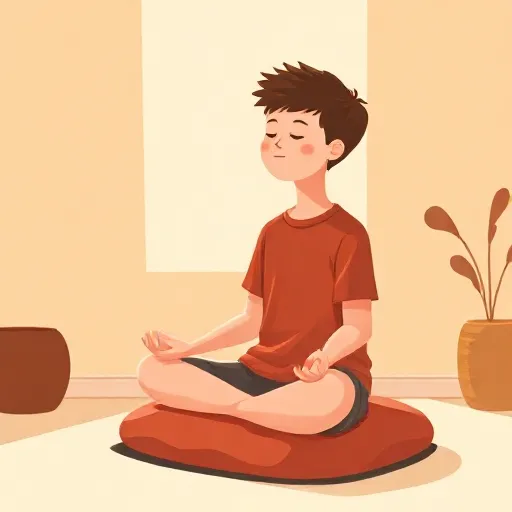
When someone begins Zen meditation, they generally follow three steps in order: adjust the body, adjust the breath, and adjust the mind. First, body posture. The classic postures are the full or half-lotus cross-legged seat, but sitting on a chair with a straight spine works too. The aim is to be stable and alert, so the body doesn’t distract the mind.
Breathing comes next. The exercise is called observation of breath count. You inhale and exhale through the nose, counting each full breath. The breath is pulled deep into the lower belly — this is abdominal breathing. It’s simple, but hard: random thoughts, worries, memories all surge up. Zen calls these wandering thoughts. You learn to just notice them and let them go.
This breathing does more than calm you. Normally we breathe about sixteen to seventeen times a minute, automatically controlled by the autonomic nervous system. Zen breathing shifts that to a conscious, self-aware process, which helps regulate the unconscious. When you breathe deeply and smoothly, the parasympathetic nerves quiet your mind. Think of how a person in a rage breathes: shallow, rough, irregular. Now picture someone utterly peaceful — their breath is deep, slow, and rhythmic. Through the breath, you can soften the grip of powerful emotions without having to fight them with sheer willpower.
Once body and breath are settled, you adjust the mind. But you can’t stop your thoughts by forcing them to stop — that’s just more thinking. Instead, by holding the posture and breathing calmly, the mind gradually settles on its own. The practice moves through three deepening states: concentration (still a sense of “me concentrating on something”), meditation (that split starts to blur), and absorption or samādhi, where the dualistic framework disappears altogether. Eventually, one may touch a state Zen calls no-mind (mushin). This doesn’t mean being mindless. It means the mind is free from the constant chatter of an “I” that judges, clings, and pushes things away.
Not Two: When the Watcher Disappears
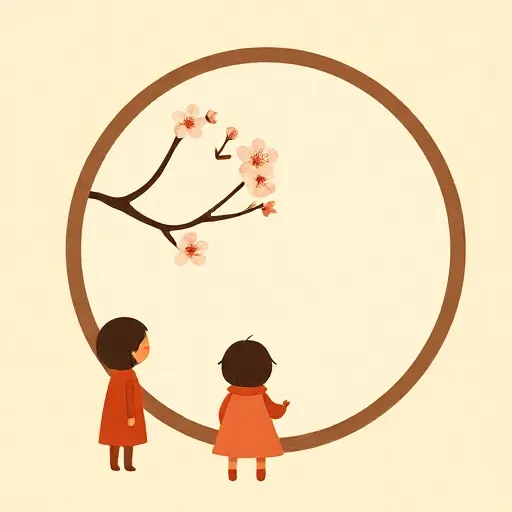
From its very beginning, Zen keeps pointing to the phrase not two. In your ordinary daily life, you feel there’s a “you” in here and a world out there. That’s dualism: subject‑object, I‑other, mind‑body. Zen argues that this split creates all kinds of trouble. It makes you feel isolated, sets you against nature and other people, and traps you in an either‑or logic that chops reality into fragments.
Logically, Zen says, the either‑or mindset forces you to pick one side and ignore the other. If you say “only the mind is real,” you’re an idealist; if you say “only the body is real,” you’re a materialist. Both are one‑sided reductions. Zen insists that mind and body, self and world, belong together as a single flowing whole. A traditional Zen saying puts it this way: Heaven and Earth share the same root, and I and all things are one.
But “not two” isn’t an idea you agree with — it’s something you wake up to through practice. It’s an existential, practical undoing of the “I.” You can’t just think your way out of dualism, because the act of thinking is already dualistic — there’s a thinker and a thought. So Zen recommends forgetting the self while acting. A master named Joshū (Zhaozhōu, 778–897) once answered a monk’s question about whether a dog has buddha-nature with the single word Mu (meaning “no” or “nothing”). He wasn’t denying anything; he was shattering the monk’s assumption that such a question can be asked in a yes‑or‑no framework. Reality, for Zen, isn’t captured by “has” or “doesn’t have.”
The Mirror That Doesn’t Judge
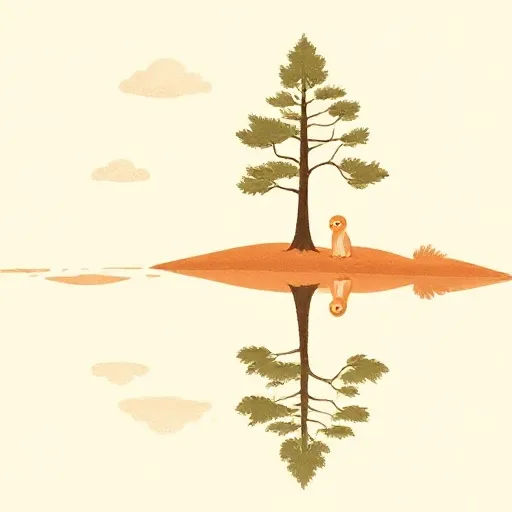
A Zen master named Jinne once compared the awakened mind to a clear, transparent mirror. The mirror’s very nature is to reflect. Even when nothing is in front of it, it is still mirroring — that capacity is what it is. When a flower appears, the mirror reflects the flower without adding, “How beautiful!” When mud appears, it reflects the mud without complaining. It doesn’t cling to the beautiful or push away the ugly. It simply sees.
This is what Zen means by nondiscriminatory wisdom. It’s not a blank numbness; it’s a kind of seeing that discerns everything clearly but without the ego’s constant likes and dislikes. Zen calls this the state of no-thought and no-image (munen musō). In the deepest meditation, when the stream of personal worries and labels falls away, things show themselves as they truly are — what Zen calls suchness or thusness. The flower is just itself, fully and completely, without your mental commentary pasted on top.
Jinne’s mirror never changes because of what it reflects. It remains clear and still. In the same way, Zen says, your original mind is always clear underneath the noise. The practice doesn’t give you something new; it uncovers what was already there. Seeing then becomes seeing without a seer — a knowing where the “I” has stepped aside and only the thing shines forth.
Back from the Mountain: Zen Freedom in Ordinary Life
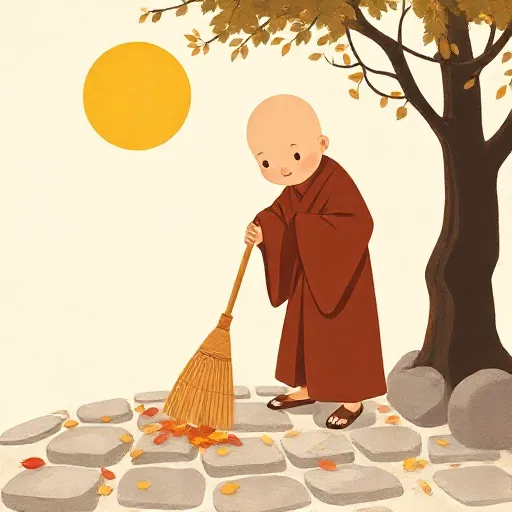
If Zen stopped at “not two,” a practitioner might stay lost in a peaceful, blank absorption. But Zen insists on a further movement. After experiencing non‑duality, you must return to the everyday world of multiple things, people, and actions — without getting stuck in either side. This is the stance of not one. You live in the ordinary world, but now with a mind that doesn’t cling.
A dialogue between two Zen practitioners, Ungen and Dōgo, captures this. Ungen was making tea. Dōgo asked, “To whom are you going to serve that tea?” Ungen replied, “There is the person who wants it.” Dōgo pressed, “Can’t that person make it themselves?” Ungen answered, “Fortunately, I am here to do it for him.” Here the “person who wants it” represents the deeper, awakened self — but it needs an ordinary human body and mind to act in the world. The Zen person is both ordinary and extraordinary, fully engaged yet completely free inside.
This freedom, called jiyū, literally means “arising from the self on its own.” It’s not about doing whatever you want — that would just be driven by ego‑desires. Zen freedom is a spontaneous action that flows from the clear, bottomless ground of no‑mind. A Zen master named Baso (Mǎzǔ, 709–788) said, “The mind as it is, is the Way.” By “the mind as it is,” he didn’t mean the everyday mind full of cravings and worries, but the mind freed from those defilements — right here, right now, in the middle of living.
Takuan (1573–1645), a Zen master who taught swordsmen, described this as immovable wisdom: the mind that moves freely in all directions but never stops or gets stuck on any single object. He called the body’s training “the body’s learning,” where mind and body become one integrated whole. An archer, a dancer, or just someone pouring a glass of water — when the self disappears into the action, the action becomes effortless and complete. That, Zen says, is real freedom, and it’s available in the most ordinary moments.
Think about it
- If a friend told you “The river does not flow, but the bridge does,” would you try to understand it logically or experience it some other way? How could you test what that sentence might mean?
- Zen says our ordinary “I” creates a barrier between us and the world. Can you think of a moment — maybe in sports, art, or nature — when you forgot yourself and felt completely connected to what you were doing? What changed?
- Is it possible to live your whole life without ever questioning the split between “inside my head” and “outside in the world”? What might you gain or lose by not questioning it?