Can Six Words Save You? The Radical Pure Land Path
The Monk Who Couldn’t Meditate His Way to Freedom
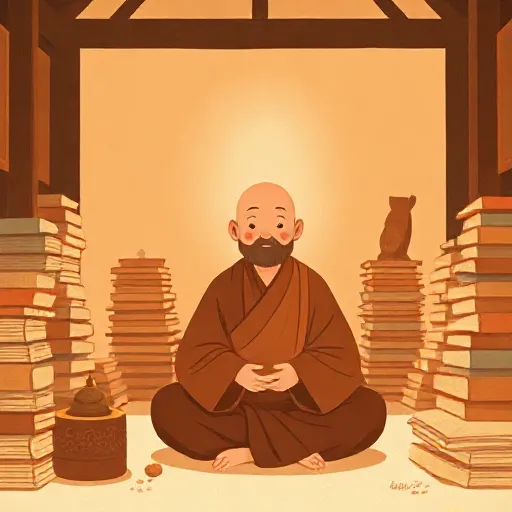
Around 1175, on Mount Hiei, the great monastery near Kyoto, a monk named Hōnen (1133–1212) sat surrounded by scrolls. He had studied every major Buddhist teaching. He had kept the rules, recited sutras, practiced meditation — and yet he felt further from enlightenment than ever. In his own eyes, he was a walking disaster: full of anger, greed, and confusion. No amount of effort seemed to quiet his mind. If even a dedicated monk couldn’t do it, what chance did ordinary farmers, merchants, or parents have?
Hōnen was wrestling with a problem that runs through much of Buddhist thought. The traditional path to awakening demands what’s called self-power (jiriki) — you purify your mind through your own discipline, wisdom, and moral action, life after life. But after centuries of trying, many Buddhists began to worry that in a world far removed from a living Buddha’s presence, self-power had become nearly impossible. People were too broken, too distracted, too full of cravings. Hōnen thought the only honest answer was to find a path that didn’t depend on your own strength.
A Vow Older Than Stars: Amida’s Promise
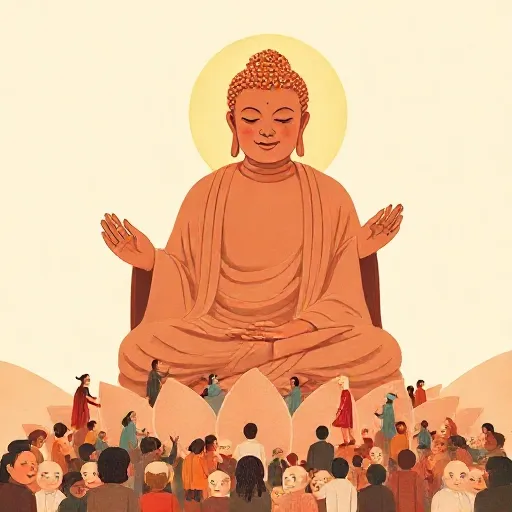
Long before Hōnen’s crisis, Mahayana Buddhist sutras told a story. Eons ago, a bodhisattva — a being who vows to become a Buddha for the sake of all living things — made a series of staggering promises. This bodhisattva, named Dharmākara, declared that he would not accept final awakening unless everyone who simply called his name with sincere trust would be reborn into his buddha-field, a realm free from confusion where enlightenment comes easily. After unimaginable ages of practice, Dharmākara fulfilled his vows and became Amida Buddha, the Buddha of infinite light and life.
The buddha-field he established, the Pure Land, isn’t exactly a geographical place. It’s better thought of as a sphere of compassionate influence — an environment where Amida’s own perfectly accomplished practice washes up against beings trapped in samsara, the painful cycle of birth and death. Saying Amida’s name, the nembutsu, is taught to align you with that compassionate current. The nembutsu in Japanese is simply “Namu-amida-butsu” — “I take refuge in Amida Buddha.”
Saying the Name: The Nembutsu That Changes Everything

Other Buddhist schools already used the nembutsu as one practice among many — a way to focus the mind, alongside meditation, rituals, and ethical discipline. Hōnen made a radical break. He said the nembutsu that Amida chose was completely different from every other technique. It didn’t depend on your concentration, your moral purity, or your intellectual understanding. In fact, it was precisely because you lacked those things that it fit.
Hōnen labeled all traditional practices self-power, because they rely on your own abilities. He taught that Other Power (tariki) — Amida’s wisdom-compassion already at work in the world — reaches people through the simple act of saying the name with trust. You don’t have to meditate for hours, keep perfect precepts, or generate deep insight. You just voice “Namu-amida-butsu,” entrusting yourself to the vow. That, Hōnen argued, is enough for birth in the Pure Land and eventual Buddhahood.
This didn’t mean you could wave the name around like a magic spell while carrying on cruelly. Hōnen’s own teacher from the Chinese tradition, Shandao (613–681), described what he called deep mind, a two-sided awareness: you truly know you’re a foolish being caught in endless suffering with no ability to save yourself, and you also truly believe that Amida’s vow guarantees your birth without a trace of doubt. Those two knowledges arise together. You see your weakness, and at the very same moment, you feel held by compassion larger than yourself.
Trust vs. Practice: What Matters Most?

Almost immediately, a fierce question tore through Hōnen’s community. If the nembutsu is already perfected by Amida, which matters more — the act of saying it, or the trust behind the act? Some disciples stressed practice; they believed that those who truly trusted the vow would naturally want to recite the name constantly, out of gratitude, all their lives. Over time, this shaded into anxiety: maybe you needed a certain number of repetitions, or a perfectly pure last-moment thought at death.
Others leaned the opposite way. They said Amida’s vow works the moment you truly entrust yourself, even if you’ve spoken the name only once. Any extra recitation might even be a sign of doubt — as if you were trying to add your own effort to something that’s already complete. At an extreme, this led a few to behave as if ordinary morality no longer mattered at all.
Hōnen tried to hold the balance. He told his followers, in words that were later recorded:
If, because it is taught that birth is attained with but one or ten utterances, you say the nembutsu heedlessly, then faith is hindering practice. If, because it is taught that you should say the Name without abandoning it from moment to moment, you believe one or ten utterances to be indecisive, then practice is hindering faith. As your faith, accept that birth is attained with a single utterance; as your practice, endeavor in the nembutsu throughout life.
But after his death, the split deepened, and his successors took the teaching in different directions.
The most creative response came from Shinran (1173–1263), one of Hōnen’s most loyal disciples. Shinran pushed the logic of Other Power to its limit. He taught that the trust you feel — which he called shinjin, “true entrusting” — is not something you produce. It is Amida’s own mind working in you. The moment shinjin arises, your birth in the Pure Land is completely settled. Even the nembutsu you speak is not your invocation to Amida; it is Amida calling through you. When you say the name, you’re not earning anything. You’re just voicing the Buddha’s activity that is already saving you.
Why It Still Matters: Letting Go of Control

You might hear this and think, “Isn’t relying on a cosmic Buddha’s vow just a way to dodge responsibility?” The question is fair. If a teaching says your own effort can’t fix you, does that encourage people to stop trying to be better? And if trust itself is a gift from Amida, do you have any real agency at all? These are not only religious worries; they’re also philosophical ones about human freedom, moral life, and the subtle ways we tie our self-worth to achievement.
Pure Land Buddhism doesn’t invite you to sit around doing nothing cruel or kind. Shinran, for instance, taught that once your birth is settled, compassion acts through you naturally, without calculation. You say the nembutsu not to get something, but because gratitude spills over. Ethical living blossoms not from fear or ambition, but from having the burden of “saving yourself” finally lifted.
In a world obsessed with self-improvement, productivity, and proving your worth, the Pure Land tradition asks an unsettling question: What if the truest way forward is not to try harder, but to let yourself be carried? The debate that started in a 12th-century monastery still echoes in our own struggles with burnout, perfectionism, and the longing for a grace we can’t manufacture.
Think about it
- Can you truly trust someone or something without any effort of your own, or does all trust require some choice from you?
- If a person believes their own actions don’t ultimately determine their deepest well-being — because a higher power already guarantees it — could that belief lead them to stop caring about being kind or honest? Why or why not?
- Is it ever wiser to give up on constant self-improvement if the effort itself makes you miserable, or should you always keep trying to become better?